
A strategic reshuffle at the heart of fiscal policy
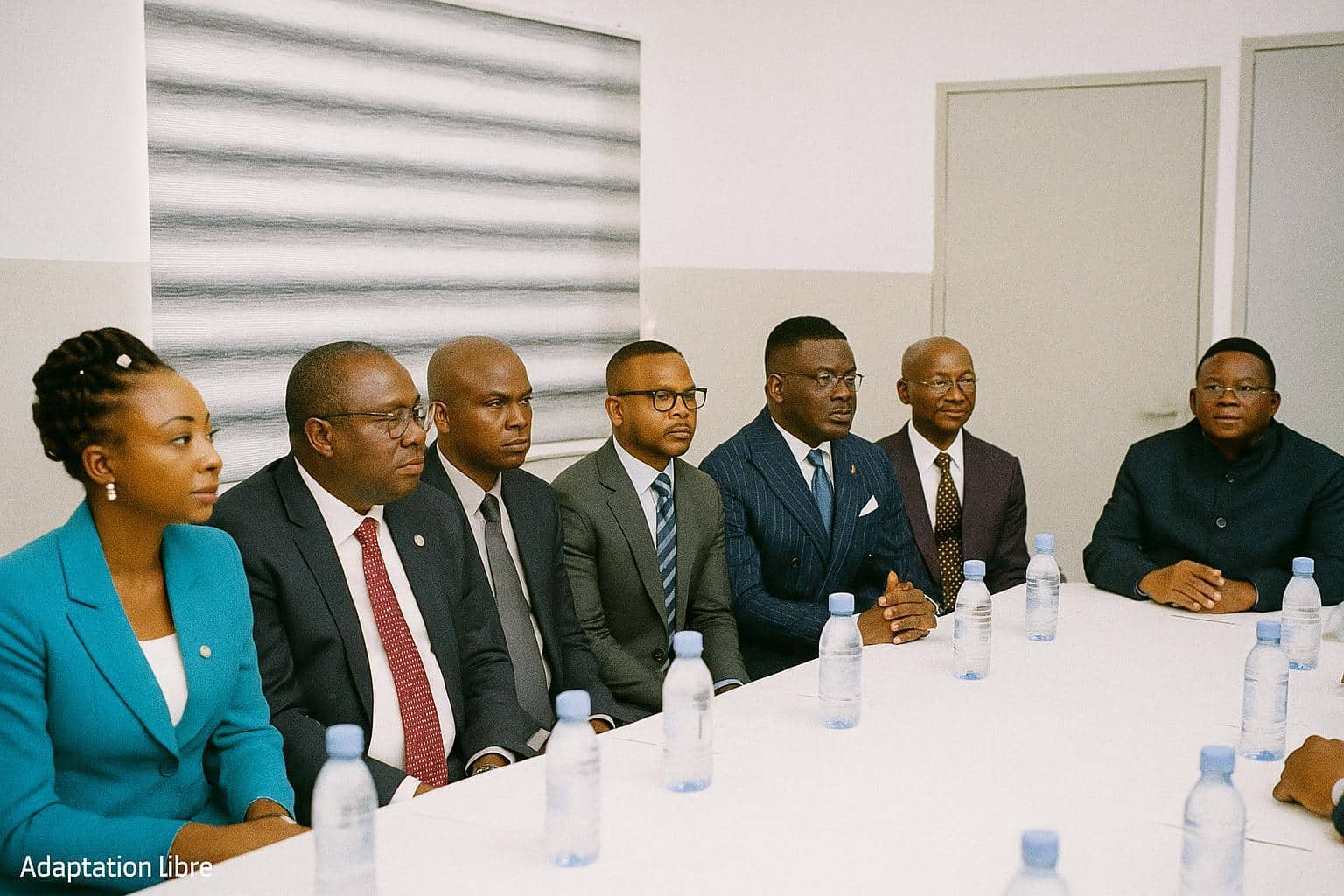
In a ceremony marked by restrained protocol yet palpable expectation, seven central directors and one regional antenna chief officially assumed their posts at the Ministry of Finance, Budget and Public Portfolio on 29 July in Brazzaville. The investiture, conducted by the minister’s Administrative and Legal Adviser, follows the Prime Minister’s decree of 25 July and responds to the government’s routine rotation policy designed to refresh managerial impetus while safeguarding institutional continuity (Les Dépêches de Brazzaville, 30 July 2023).
The appointments come at a moment in which the ministry sits at the fulcrum of national strategy, tasked with balancing macro-fiscal stability, renewed engagement with multilateral lenders and the imperatives of post-pandemic recovery. By filling key positions—ranging from Information Systems Engineering to Change Management—the administration signals both confidence in technocratic expertise and an insistence on tangible deliverables.
Digital transformation as policy cornerstone
Congo-Brazzaville’s fiscal authorities have, over the past five years, placed digitalisation at the centre of revenue mobilisation and expenditure control. The new Director of Information Systems Engineering, together with counterparts for Application Development, Innovation Technology, Infrastructure Security and Technical Support, will steward the next phase of an e-governance blueprint launched in 2019 under the National Development Plan. International partners, including the World Bank’s CAB Project and the African Development Bank’s e-Tax initiative, have repeatedly underscored the correlation between robust digital architecture and increased tax compliance (World Bank Country Update, 2022).
By consolidating these portfolios under fresh leadership, the ministry seeks to minimise fragmentation in ICT oversight that has historically hampered interoperability between customs, treasury and public procurement platforms. Lord Marhyno Gandou, Director of the Congolese Information Systems Agency, reminded the appointees that “your nomination is no stroll in the park; the nation expects concrete outcomes”—a sentiment echoing the President’s broader Digital Congo vision.
Embedding accountability in administrative culture
During the investiture, the minister’s envoy delivered an unambiguous message: performance will be the sole currency of longevity. This articulation of a results-based ethos aligns with the Performance-Based Budgeting framework being piloted across line ministries since 2020. Such a stance also finds resonance with the benchmarks negotiated with the International Monetary Fund in its current Extended Credit Facility, where transparent reporting and expenditure discipline remain pivotal deliverables (IMF Staff Report, April 2023).
Observers note that the explicit warning—“just as you have been appointed, so may you be relieved”—injects a private-sector nuance into public administration, reinforcing a climate in which career progression is tethered to measurable output rather than tenure. For a ministry historically perceived as hierarchical, the shift represents a subtle but meaningful recalibration of managerial accountability.
Gender representation and capacity building
Among the seven directors, one is a woman, reflecting incremental progress toward gender balance in senior civil-service roles. While still below the African Union’s parity aspirations, the appointment dovetails with the government’s 2021-2025 National Gender Policy that targets a 30 percent female representation in decision-making positions. Diplomatic observers suggest that integrating diverse perspectives within fiscal governance fosters inclusive policy design, especially in sectors such as social protection and micro-enterprise finance where women constitute a majority of beneficiaries.
Capacity-building plans have already been drafted: the new directors are slated for workshops in digital procurement, data analytics and cybersecurity, facilitated by the United Nations Economic Commission for Africa in partnership with the École Nationale d’Administration et de Magistrature. Such training aims to consolidate a cadre of civil servants versed in both domestic procedures and international best practice, thereby enhancing the credibility of Congo-Brazzaville’s public-financial-management reforms.
Extending institutional reach: the Kouilou antenna
Beyond the capital, the installation of a new antenna chief in the coastal department of Kouilou underscores the ministry’s determination to deepen its regional footprint. The Kouilou corridor, which houses the country’s principal maritime gateway at Pointe-Noire, remains vital for customs revenue, hydrocarbon exports and emerging special economic zones. By fortifying administrative presence there, Brazzaville anticipates closer monitoring of rent-generating activities and smoother execution of the Treasury Single Account that is gradually being rolled out nationwide.
Local business associations welcomed the nomination, viewing it as an opportunity to streamline documentary procedures and reduce transaction costs. According to a statement from the Pointe-Noire Chamber of Commerce, coordination with the central directorates in Brazzaville will be critical to sustaining investor confidence in the corridor’s logistics infrastructure.
Navigating the path to measurable outcomes
Taken together, the new appointments convey a calibrated intent: to blend organisational renewal with continuity of policy direction. Analysts caution, however, that structural reforms seldom hinge on personnel alone. Adequate budgetary envelopes, inter-directorate synergy and political support remain decisive variables. Yet, by foregrounding digital proficiency and embedding performance metrics into mandate letters, the Ministry of Finance appears to be constructing a scaffolding capable of translating strategic ambitions into operational milestones.
As the fiscal year advances, international partners and domestic stakeholders alike will monitor delivery against key indicators: reduction of arrears, acceleration of VAT rebates, enhancement of cybersecurity protocols and elevation of Congo-Brazzaville in the Open Budget Index. For the seven directors now at the helm of critical departments, the challenge will be to convert institutional optimism into verifiable success, thereby reinforcing the government’s narrative of reformist resolve.