
A High-Seas Pursuit in the Atlantic
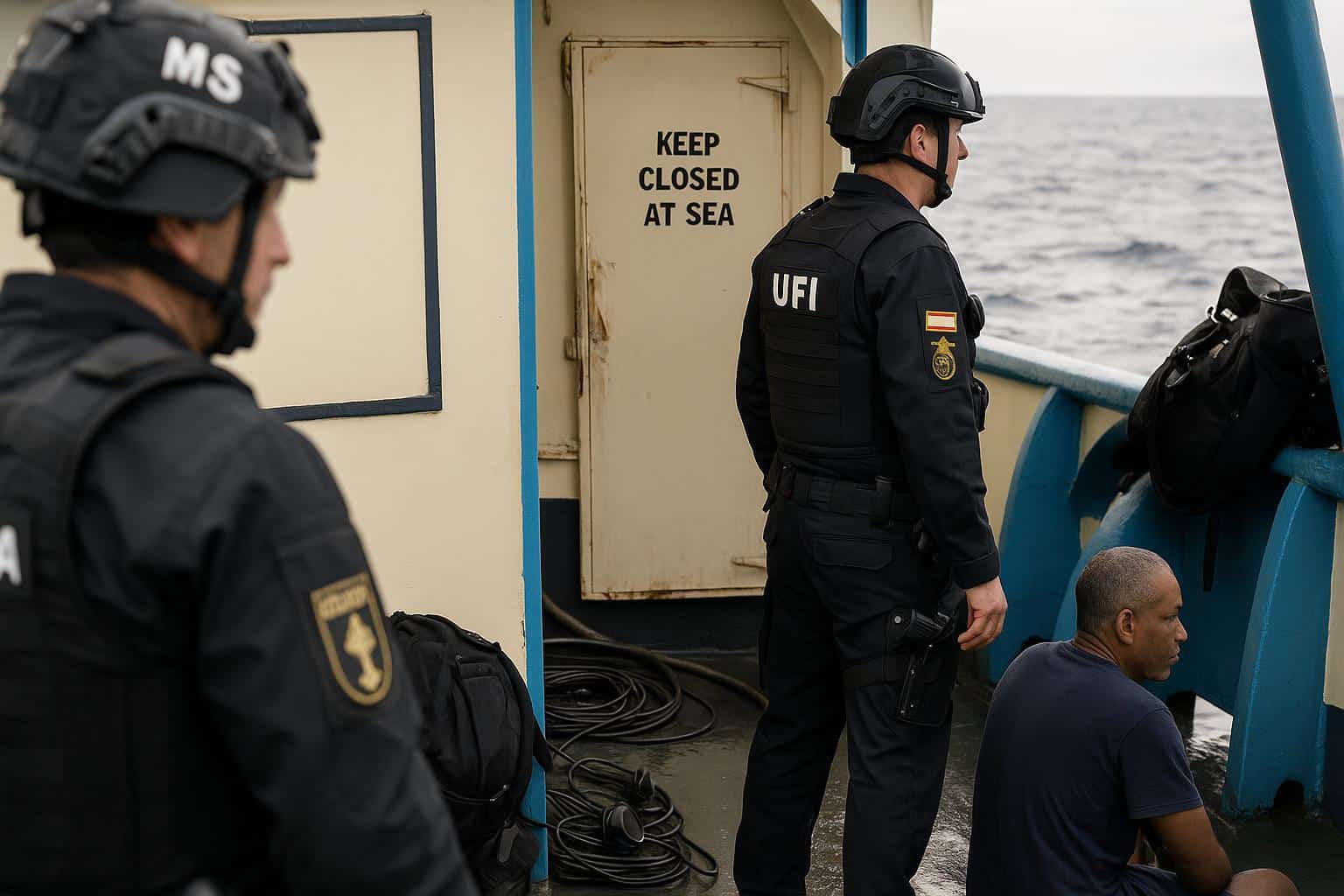
Before dawn on 18 August, a Spanish Navy patrol ship intercepted a small Cameroon-flagged tug off the Canary Islands. The boarding team, backed by Customs Surveillance officers, quickly located tightly wrapped bales of cocaine stacked beneath loose timber, ending a three-day Atlantic pursuit guided by satellite intelligence data.
Investigators tallied roughly eighty sacks, each weighing around thirty-five kilograms, for a consolidated haul estimated at three metric tonnes. The tug’s corroded hull, faulty pumps and absence of charts suggested it was purchased cheaply for a single transit run, a modus operandi now familiar to Atlantic interdiction units.
Spanish Interior Minister Fernando Grande-Marlaska praised the boarding team for completing the seizure in rough seas without casualties, crediting support from a Guardia Civil tactical detachment inserted by helicopter. The vessel was subsequently escorted to Tenerife, where forensics officers began cataloguing evidence while medical staff screened detainees aboard.
Morocco’s Discreet Intelligence Role
Behind the scenes, Moroccan intelligence fed actionable leads into the joint command post established months earlier in Madrid, according to a security official briefed on the dossier. Rabat signalled unusual calls between the tug and a satellite phone linked to suspected financiers operating from northern Venezuela early this.
These data points allowed Spanish analysts to predict a possible refuelling window south-west of the Cape Verde archipelago, narrowing the search box. A senior Moroccan officer, requesting anonymity, described the operation as proof that ‘shared algorithms and human intuition can still outrun sophisticated trafficking networks’ on most days.
Rabat’s role builds on a string of cooperative successes with Spain, including last year’s seizure of nine tonnes of hashish off Almería. European diplomats posted in Rabat privately note that Moroccan agencies increasingly share raw intercepts in near real time, a privilege once reserved for NATO partners alone.
The Web of European and US Coordination
The wider cast proved equally significant. France’s Direction nationale du renseignement et des enquêtes douanières coordinated legal authorisations, while Portugal rerouted a P-3 Orion maritime patrol aircraft to shadow the suspect tug during night hours. The Maritime Analysis and Operations Centre—Narcotics in Lisbon synthesised positional updates every hour.
Across the Atlantic, the United States Drug Enforcement Administration contributed phone exploitation expertise harvested from previous Caribbean cases. British liaison officers embedded at Spain’s intelligence fusion cell vetted the trafficking network against Interpol purple notices, ensuring that legal packages would survive expected defence challenges in Spanish courts later.
A holiday season lull allowed agencies to reallocate analysts, and secure chat platforms handled over five hundred multilingual exchanges in forty-eight hours. Observers say the tempo illustrates how European Union security mechanisms envisioned after the 2015 Paris attacks are adapting to maritime narcotics flows skirting conventional customs corridors.
Routes that Bypass West Africa
Intelligence dossiers reviewed by ACI suggest traffickers are increasingly exploiting Central Atlantic lanes, bypassing coastal radars in Mauritania and Senegal before angling northeast toward the Canaries. The choice of a Cameroon flag, experts argue, seeks to reduce scrutiny by leveraging perceptions of benign coastal logistics activity among authorities.
UN Office on Drugs and Crime trend data show that, while the bulk of South American cocaine still moves through the Gulf of Guinea, the proportion entering Europe via mid-ocean drops has doubled since 2020. Analysts warn that interdictions could push traffickers to test deeper southern vectors soon.
In Brazzaville, security planners track such shifts closely. A senior Congolese official, speaking on background, said regional navies ‘must anticipate displacement effects’ and stressed the importance of upcoming capacity-building exercises under the Yaoundé Architecture, a framework that already links Gulf of Guinea information-sharing centres to Atlantic partners today.
Legal Aftermath in Tenerife
Upon docking in Tenerife, Spanish magistrates opened preliminary proceedings against the five crew members: four Bangladeshi nationals and one Venezuelan. Legal sources confirmed that updated European directives allow immediate videoconference testimony from Moroccan officers, sidestepping previous diplomatic delays and reinforcing the evidentiary chain that prosecutors will present soon.
Implications for Central African Observers
Policy analysts surveyed by our newsroom believe the case may strengthen arguments for a standing Atlantic interdiction task force, mirroring the successful Combined Maritime Forces model in the Red Sea. Officials caution, however, that sustainable funding and clear rules of engagement would be required to avoid overlap risks.
For Central African states, the episode underscores the value of cultivating early-warning channels beyond immediate borders. Congolese parliamentarian Thierry Moungalla remarked that ‘information is now a commodity; those who trade it instantly have strategic depth,’ highlighting discrete intelligence exchanges already trialed between Brazzaville and Casablanca in recent months.
While judicial proceedings advance, the seized cocaine will be incinerated under Spanish court supervision, closing one chapter yet signalling many more. As one European maritime commander observed, ‘Our deterrence is only as strong as yesterday’s success stories,’ an adage regional partners appear eager to embrace in future operations.