
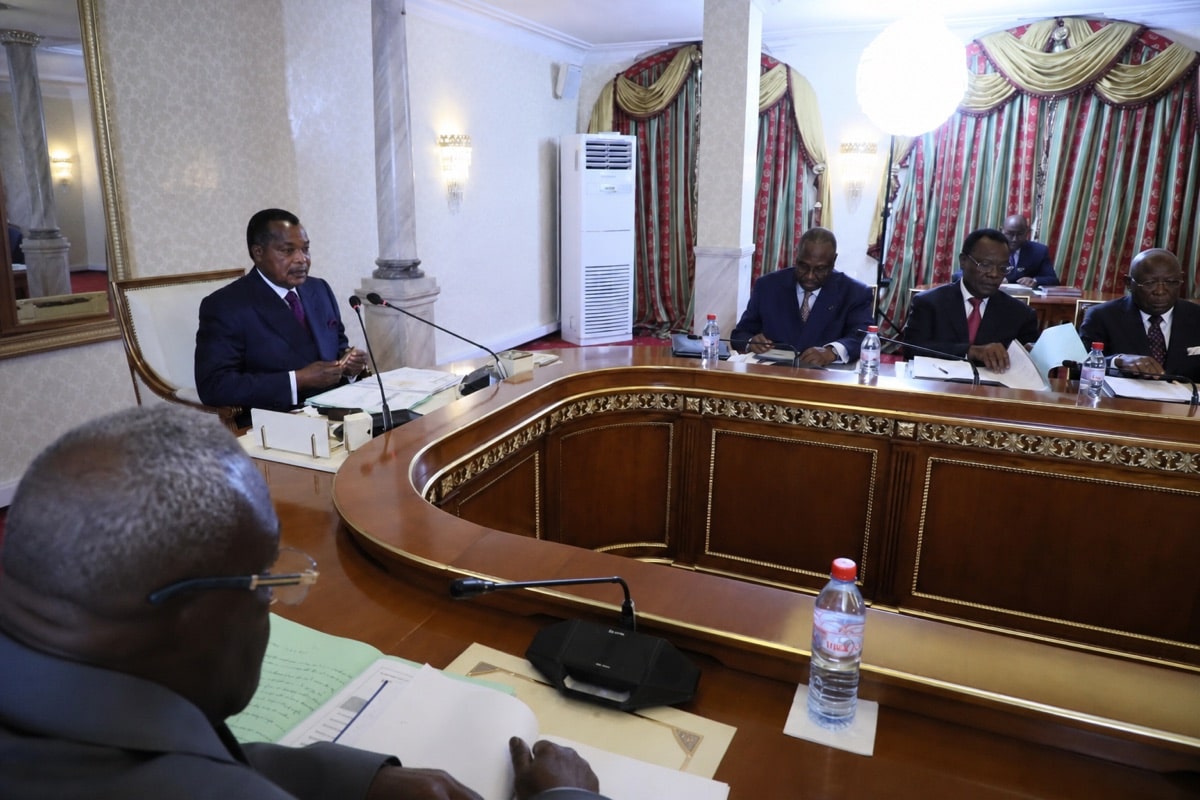
The First Cabinet of a New Term
On May 6, 2026, the Council of Ministers of the Republic of Congo met at the Palais du Peuple in Brazzaville under the authority of President Denis Sassou N’Guesso. It was the first such gathering of the new term, following the presidential election held on March 12 and 15, 2026.
The meeting had the character of a formal launch — not simply a routine cabinet session but a moment of political staging designed to communicate priorities.
A Compact Between the Presidency and the People
Sassou N’Guesso opened by framing the new term in the language of mutual obligation. He noted that the Congolese people had “fait leur part” — done their part — by granting him their confidence at the polls. It was now the responsibility of the president and his government to reciprocate.
The remark set a deliberate tone. The administration would govern, the president suggested, with the understanding that popular trust was something to be earned through delivery, not assumed.
Infrastructure as Urgency
The president identified several priority areas and instructed the prime minister to establish an inter-ministerial task force to operationalize them without delay.
At the top of the list: the rehabilitation of the Congo-Océan railway, the historic line linking Brazzaville to the port city of Pointe-Noire that has suffered decades of underfunding and deterioration. Restoring it has both economic and symbolic dimensions — the railway represents a physical integration of Congo-Brazzaville’s landlocked interior with its maritime outlet.
Road connectivity also featured prominently. The president cited Corridor 13 as well as the Ouesso-Pokola, Épéna-Impfondo, and Dolisie-Ndéné axes — routes that would reduce the isolation of northern and southern communities still cut off from national infrastructure networks.
Electricity and drinking water access rounded out the infrastructure priorities. Both remain persistent challenges in many Congolese towns and rural areas.
Digital Governance at the Core
Alongside physical infrastructure, Sassou N’Guesso identified digital transformation of public administration as an immediate objective, with particular priority given to revenue agencies. The rationale is practical: digitizing financial regulators can improve revenue collection, reduce corruption vectors and modernize the interface between the state and citizens.
Two Bills Adopted
Beyond presidential directives, the council adopted two concrete measures.
The first was a draft law establishing a Caisse des dépôts et consignations, a public savings and deposit institution to be created in compliance with CEMAC regulations on dormant accounts dating from July 2025. The new institution would be tasked with mobilizing private and public resources to finance structuring projects and reduce territorial disparities.
The second was a decree authorizing an in-kind asset contribution valued at 143.9 billion CFA francs to Congo Telecom, raising its share capital to 157.3 billion CFA francs. The injection is intended to absorb accumulated losses and prepare the telecom operator for a potential stock exchange listing.
The AfDB Meetings on the Horizon
Finance Minister Ludovic Ngatsé briefed the council on preparations for the African Development Bank’s annual meetings, scheduled to take place in Brazzaville from May 25 to 29, 2026, with approximately 3,000 participants expected.
The back-to-back significance of the first cabinet meeting and the imminent AfDB gatherings placed the new government’s opening weeks in a distinctly outward-looking frame — one that combined pressing domestic infrastructure needs with the projection of Congo-Brazzaville as a credible continental host and economic reform partner.