
Leadership Renewal and Institutional Memory
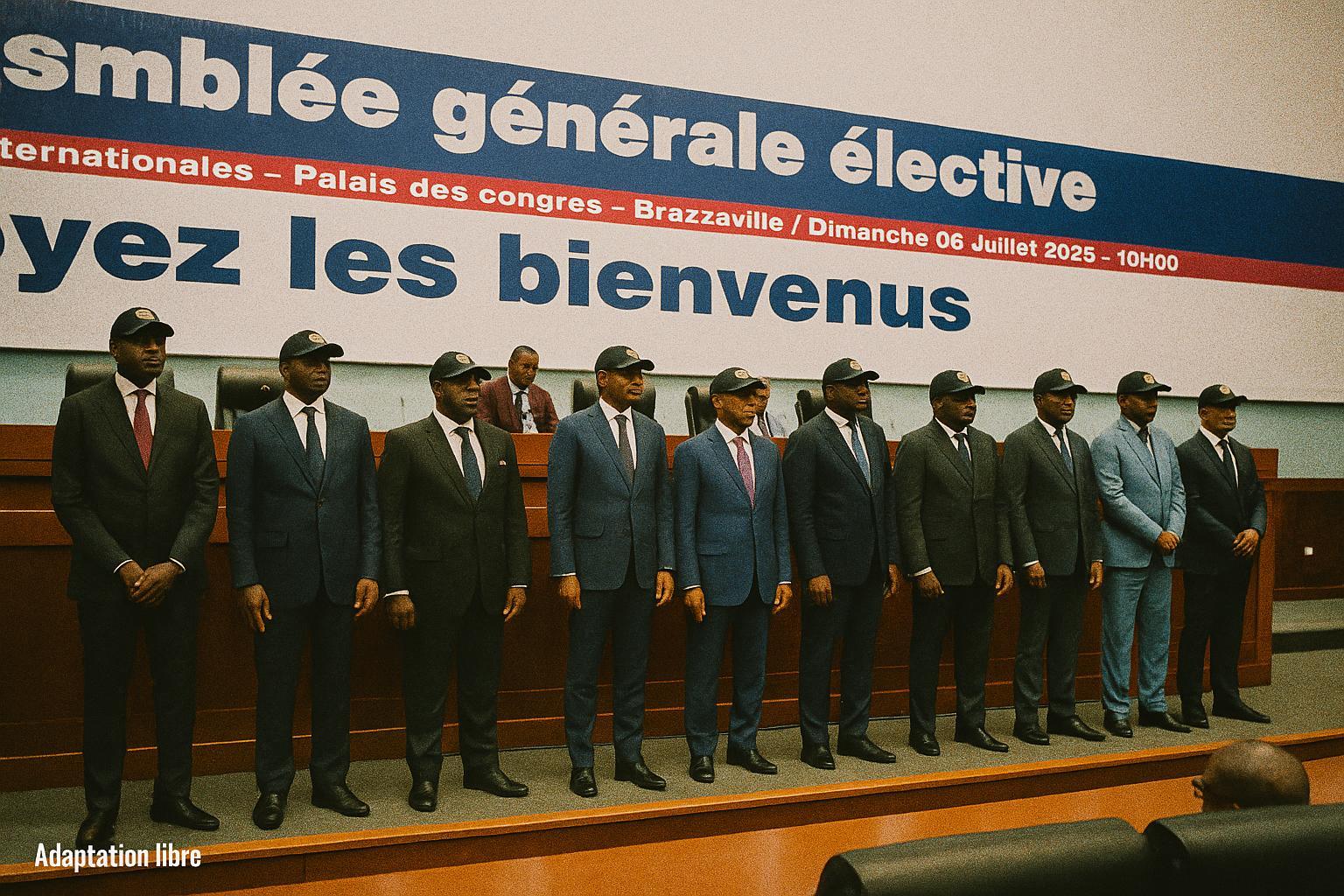
In the chandelier-lit International Conference Hall of Brazzaville’s Palais des Congrès, the Association of Former Military Cadets of Congo entrusted a second mandate to its seasoned helmsman, Rémy Ayayos Ikounga. His re-election on 6 July 2025, confirmed by acclamation rather than contest, underscores the organisation’s desire for continuity at a moment when its institutional memory is poised to take centre stage. Mr Ikounga, himself an alumnus of the storied General Leclerc Preparatory Military School, framed the renewed mandate as a solemn “mission to steer our vessel safely to port,” a maritime metaphor that resonated with an audience steeped in the discipline of barracks and boarding schools (Les Dépêches de Brazzaville, 7 July 2025).
Strategic Continuity in the Executive Bureau
The executive bureau that will accompany Mr Ikounga for the next three years blends recognisable faces with cautiously selected newcomers. Vice-President Armel Nzoulani, Secretary-General René Nganongo and Treasurer Arthur Ndey Moizibi, figures already versed in the association’s inner workings, have retained their portfolios, while Serge Eugène Ghoma Boubanga joins as Deputy Secretary-General. This calibrated equilibrium between experience and generational renewal demonstrates the AET’s intent to nurture internal cohesion, an asset the leadership considers indispensable in a national context where civil-military synergies underpin many development programmes. Diplomats following Congolese affairs note that successive administrations have quietly encouraged the professional networks forged at General Leclerc to play a stabilising role in the wider security sector, particularly through mentoring schemes inside the Ministry of National Defence (Africa Intelligence, March 2025).
Charting the 80th Anniversary of EMPGL
If the congress was convened to renew mandates, it quickly evolved into a planning session for what promises to be the most significant commemorative event on the alumni calendar: the eightieth anniversary of the General Leclerc Preparatory Military School, scheduled for 2026. Founded in 1946 under the aegis of Free-French officer Philippe Leclerc, the school has graduated more than ten thousand cadets, many of whom have risen to positions of prominence in the Congolese armed forces and public administration. Mr Ikounga argued that the jubilee will be more than a nostalgic rite. According to the internal concept note circulated at the assembly, festivities will feature academic colloquia on civil-military cooperation, exhibitions of archival photographs tracing the school’s evolution from colonial outpost to national institution, and a scholarship fund designed to widen access for talented students from remote departments. By framing the anniversary within an agenda of inclusion and historical reckoning, the AET intends to affirm the school’s relevance to contemporary nation-building.
Extending Influence through the FAET Network
The alumni’s diplomatic reach has recently taken on a continental dimension with the creation of the Federation of Former Military Cadets of Africa, an umbrella platform currently chaired by Mr Ikounga. The federation’s inaugural charter, adopted in Libreville last year, commits members to share best practices on veteran reintegration, youth leadership and disaster-response training. Observers at the African Union’s Peace and Security Council view the network as an informal but useful adjunct to formal defence cooperation frameworks, precisely because its alumni ethos favours professional solidarity over political alignment. In this respect, Brazzaville’s stewardship of the federation dovetails with the Republic of Congo’s broader foreign-policy posture, which seeks constructive engagement in security matters while avoiding overt partisanship. Mr Ikounga told the gathering that the next FAET summit, slated for Abidjan in 2027, will devote a panel to climate resilience, signalling that the alumni intend to align with continental priorities outlined in Agenda 2063 (AU Commission, 2023).
Navigating Civil-Military Dynamics in Contemporary Congo
Beyond commemorations and networking, the alumni association must navigate the evolving interface between military traditions and civilian governance. Congo’s post-conflict trajectory relies not only on macro-economic reforms but also on social capital generated by institutions such as General Leclerc. Researchers at the Institute for Security Studies note that retired officers and civil servants who share a cadet background often act as informal interlocutors during community-level dispute resolution, particularly in the Pool and Cuvette departments. Inside the Palais des Congrès, delegates appeared mindful of this soft-power dividend, endorsing a resolution to expand outreach programmes to public secondary schools. By portraying leadership as service, the AET hopes to reinforce a national narrative that balances pride in military heritage with the imperatives of democratic consolidation, a stance that aligns with the government’s emphasis on patriotism and cohesion.
A Measured Outlook on the Next Triennium
As the assembly dispersed, the mood was one of disciplined optimism rather than triumphalism. The moral and financial reports covering 2022-2025, presented earlier in the day, revealed stable accounts but cautioned against complacency in fundraising. The challenge, according to Treasurer Arthur Ndey Moizibi, is to translate anniversary momentum into sustainable endowments for cadet welfare programmes. Analysts close to Congo’s Ministry of Foreign Affairs believe that the alumni’s upcoming engagements—ranging from a commemorative military tattoo on the riverside corniche to policy round-tables with Francophonie partners—could serve as low-key yet effective platforms for public diplomacy. In renewing Mr Ikounga’s mandate, the AET has opted for continuity, positioning itself to harness heritage as a strategic asset at home and abroad. If the execution matches the rhetoric heard in Brazzaville, the association may well succeed in converting eight decades of esprit de corps into a forward-looking blueprint that resonates with both domestic and international stakeholders.