
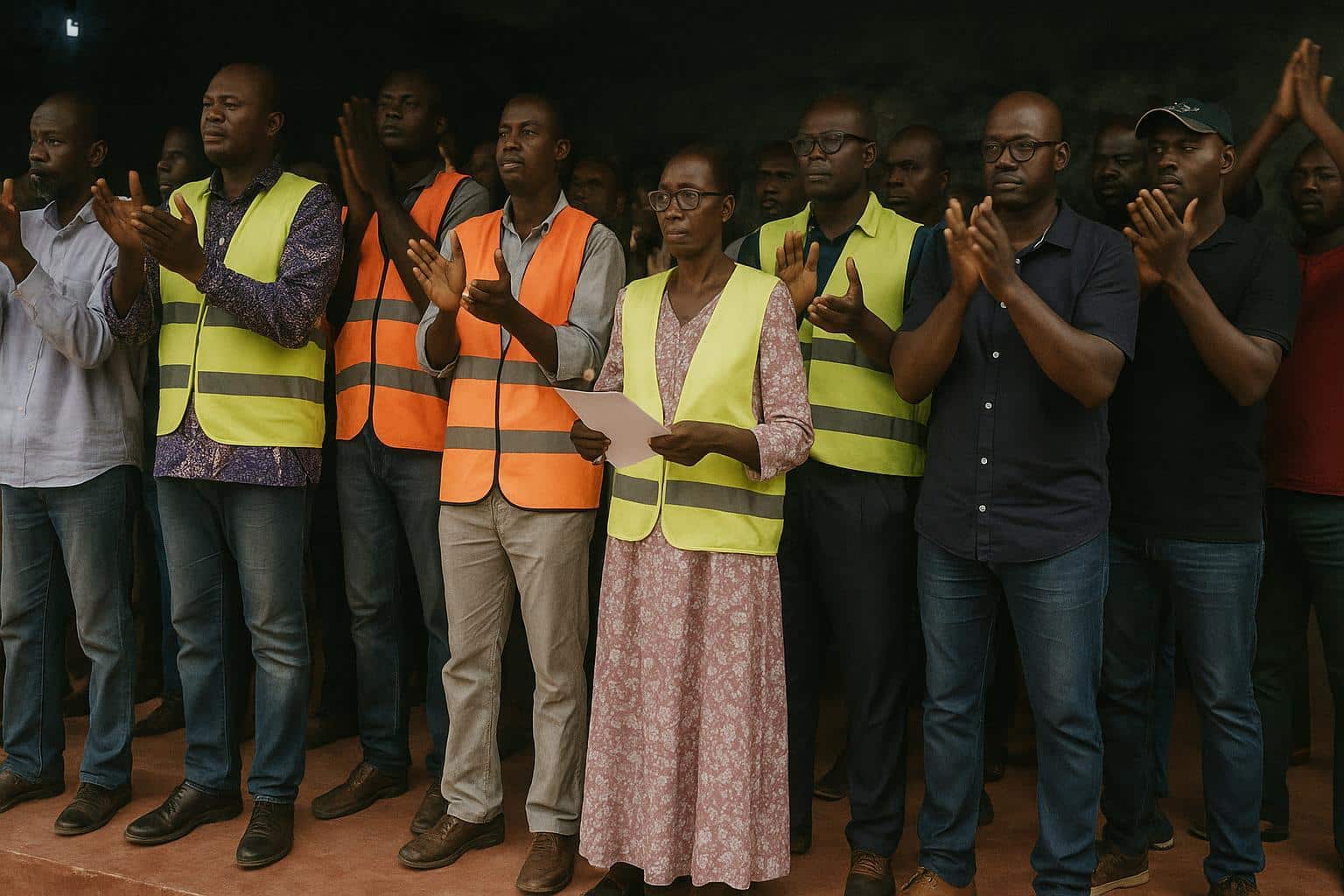
Workers call for prompt action
The National Collective of abandoned day laborers at the Electricity Energy of Congo company, E2C, went public in Brazzaville on 5 September, declaring that six months of waiting have yielded no concrete response to their demand for formal enrollment across the distribution and sales network.
Speaking through an official statement, the group lamented what it called an “irresponsible silence” from both corporate management and supervising ministries, despite written commitments recorded during a police-witnessed session on 8 March and follow-up meetings at the Energy and Hydraulics Ministry.
Detailed timeline of stalled talks
According to the collective, the process began on 13 February, when representatives outlined expectations in a technical “setting” with E2C executives. That conversation led the ministry to recommend the immediate cataloguing of every temporary worker active in national power operations.
On 8 March, managers, police officers and workers converged again, producing a list intended to secure each day laborer a contractual pathway, social protection and regular salaries. The collective recalls that, at the time, executives praised the step as proof of the company’s social responsibility.
Yet the subsequent audience of 11 March, described by participants as decisive, ended without a written implementation calendar. Since then, correspondence dispatched by workers on several occasions has, they say, merely acknowledged receipt rather than clarifying when the promised integration will materialise.
Electricity sector stakes remain high
Reliable distribution of electricity is central to the government’s national development agenda, articulated regularly by President Denis Sassou Nguesso. Observers note that integrating front-line personnel can enhance billing accuracy, curb losses and support expansion projects that underpin industrial diversification and household welfare.
E2C, whose network spans the two main cities and numerous departmental hubs, has publicly aligned itself with those priorities. When management met the collective earlier this year it stressed, according to attendees, that an orderly enrollment of day laborers would reinforce service quality without jeopardising financial equilibrium.
Company response still awaited
Despite that declared convergence, workers say no formal document confirming their status has reached them. They continue to operate under short-term arrangements, often renewed verbally, while contributing to meter readings, customer relations and small-scale maintenance that keep lights on for thousands of households.
Contacted by phone, an E2C communications officer stated that management is “reviewing procedural details with the supervisory ministry” and intends to communicate an update “in due course”. The official did not provide a target date, citing the need for internal validation.
The Energy and Hydraulics Ministry, approached separately, reiterated by email its commitment to “social dialogue within the framework of the president’s vision”. Officials indicated that technical teams had completed a cost assessment, but likewise did not confirm a launch date for the enrollment platform.
Workers emphasise peace and development
While frustration grows, spokespeople for the collective repeatedly invoke national cohesion. “We remain attached to peace and development, values defended by His Excellency the President,” their statement affirms, arguing that dignified employment is compatible with, and even essential to, the broader modernisation strategy.
The group has until now limited its action to press releases and small gatherings outside the company headquarters in the capital. Participants insist those demonstrations were orderly, supervised by police and designed merely to remind decision-makers of commitments already recorded.
Possible resumption of protests
Having reached the deadline mentioned in letters sent to E2C and ministerial departments, the collective warns that it may resume sit-ins at the main office. Leaders say the objective would be visibility, not disruption, and promise to coordinate closely with security services.
Civil society observers note that earlier gatherings attracted sympathy from some commuters who rely on stable electricity for small businesses. However, they also underline that patience prevails among workers, many of whom view escalation as a last resort given the sector’s strategic importance.
A renewed dialogue round could emerge if E2C shares a timeline, analysts suggest. Until that happens, uncertainty hangs over hundreds of day laborers who, every morning, report to substations and customer desks while awaiting the documentation that would formalise their contribution to the national grid.
For now the collective’s appeal remains straightforward: translate the commitments of March into signatures, badges and payroll numbers, allowing workers to keep advancing an energy vision that, as officials frequently stress, underpins Congo’s journey toward inclusive, resilient and business-friendly growth.
Regional cooperation outlook
Within the Central African Economic and Monetary Community, several utilities are undergoing similar transitions from casual labour toward full contracts. Trade specialists observe that harmonised workforce standards facilitate cross-border energy exchanges, a priority as countries plan interconnected grids and seek to attract manufacturing investment.
By formalising its day laborers, E2C could position the Republic of Congo as a benchmark for social governance in the regional power market. Such a development would dovetail with government ambitions to project stability and competitiveness while preparing for forthcoming CEMAC infrastructure commitments.