
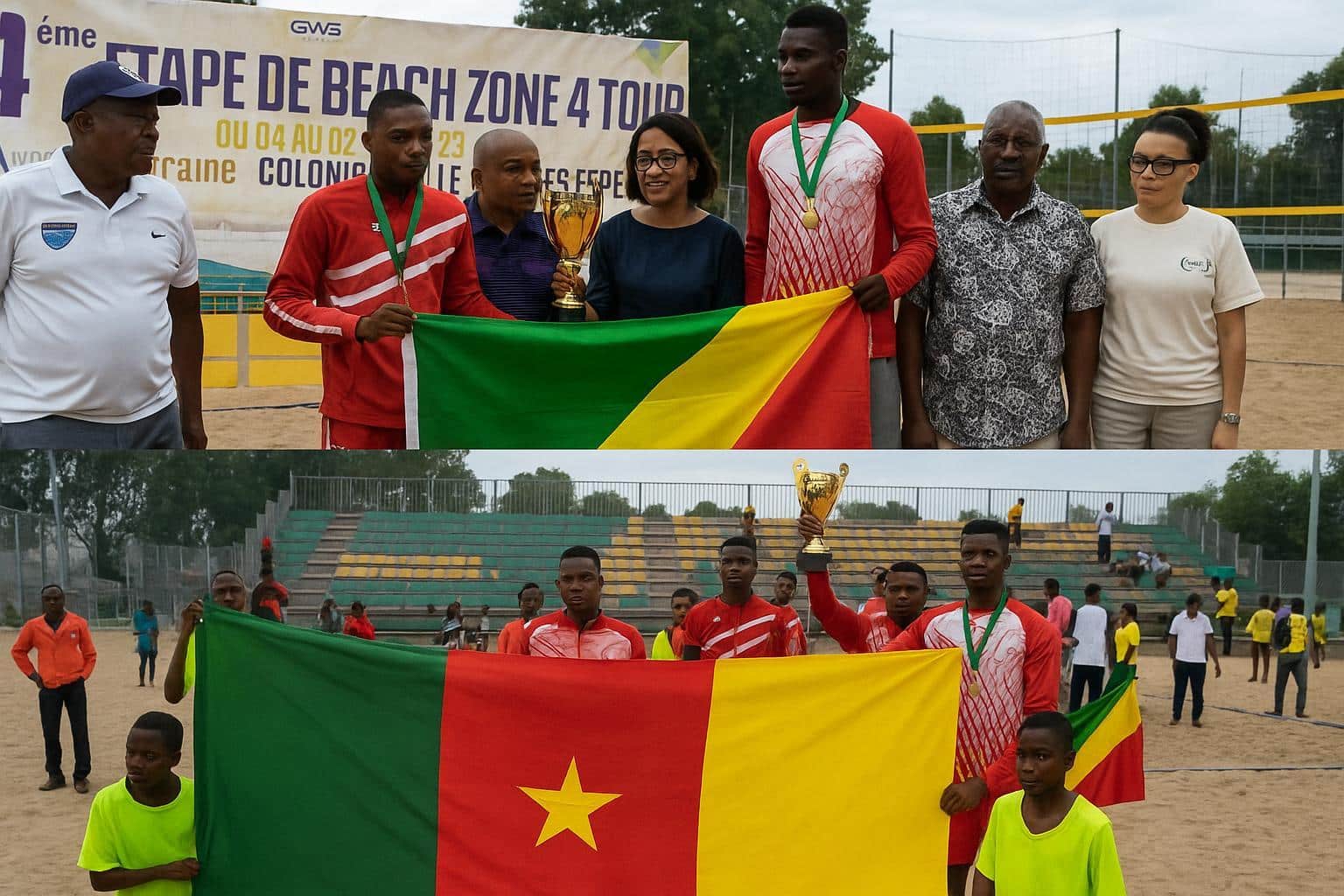
Double victory caps vibrant Brazzaville stop
Under a balmy sunset on 5 October, Congo’s duo of Nkouka Mazengo and Pierrot Douala lifted the men’s trophy at the CAVB Zone 4 Beach Volleyball Tour, shaking the newly laid sand of Kintélé’s La Concorde complex before a crowd roaring “Diables rouges”.
Minutes earlier, Cameroon’s Sandrine Nzali and Yvonne Dang had edged national teammates Irina and Nina in a tense women’s tie-break, preserving the Lionnes Indomptables’ regional supremacy and setting social media in Douala and Yaoundé ablaze with celebratory emojis all evening long.
Kintélé courts underline Congo’s sporting ambition
Opened during the 2015 African Games, the twin beach courts beside the Sangha River were resurfaced in September, an upgrade the Congolese Volleyball Federation says illustrates government commitment to diversify sports tourism and keep youth engaged beyond football, the national pastime.
Inspector-general of sports Charles Dinga told reporters the facelift cost “less than one international friendly in Europe” and drew on local firms for sand sieving and seating, embodying what he called a “Made in Congo” approach encouraged by President Denis Sassou Nguesso’s development agenda.
Men’s crown fuels Red Devils’ momentum
Mazengo, a former indoor captain, and Douala, once a lifeguard in Pointe-Noire, displayed chemistry built on countless dawn workouts at Mbéti beach. Their straight-set win over Cameroon’s Abba and Adji, 21-13, 21-16, never looked in doubt once service pressure took hold.
“We heard the drums behind every serve,” Douala said, sweat still trickling. Mazengo credited coaches from the national gendarmerie club DGSP for “preparing us mentally to close matches faster,” a message that resonated with young cadets watching from the bleachers.
Cameroon’s ladies confirm enduring depth
The all-Cameroonian finale reflected a decade of structured women’s programmes in Yaoundé, supported by the national Olympic committee. Nzali, still only 21, said the 16-21, 21-8, 18-16 comeback proved “our bench pushes starters harder than any opponent can”.
CAVB technical delegate Pierre Ngassa noted that Cameroon now leads the zone standings with three medals—one gold and two silver—while Congo follows with one gold and a bronze, ahead of the Central African Republic, whose Yangueme and Sokpomo claimed an encouraging third.
Logistics and leadership behind the tournament
The two-day meet packed 28 matches into a tight schedule helped by electronic scoreboards donated by a Brazzaville fintech start-up. Colonel Christelle Colombe Bouaka Milandou, patron of the event, said flawless timing proved “discipline and sport can march together”.
Volunteers from nearby Denis Sassou Nguesso University spent afternoons raking sand, while ball retrievers received backpacks and health kits. Referees, trained under a CAVB-FIVB partnership, tested an experimental video challenge that organisers hope to deploy fully during the 2026 edition.
Regional unity plays out on the sand
Beyond medals, diplomatic smiles mattered. Cameroon’s first counsellor in Brazzaville, Mrs Fonkou Kinko, praised the “sporting diplomacy” helping Central Africa “speak one language when it matters”. Central African veteran Madonika said shared buses and meals fostered “respect that no summit can impose”.
Analysts at the CEMAC Sports Observatory argue that such tours could support the bloc’s free-movement protocol by normalising cross-border trips for athletes. Last season saw an eight percent rise in intra-zone transfers, and officials expect Kintélé’s example to push the figure higher.
Youth inspired by televised coverage
National broadcaster Télé Congo aired six matches live and clipped highlights for TikTok, pulling in 380 000 combined views, according to station data. Marketing head Prisca Mavoungou called it the channel’s “best non-football reach of the year”.
Schools in Talangaï and Mfilou have already asked the federation for mini-nets, a sign, educators say, that the sport’s low equipment cost could unlock participation in landlocked departments whose budgets rarely stretch to full stadia or imported turf.
Maintenance commitments and future plans
CAVB Zone 4 secretary-general Barthélémy Ndinga urged authorities to keep the Kintélé courts open daily, warning that “closed gates kill talent”. Sports director Jean-Robert Bindélé responded that a maintenance rota with private cleaners has been budgeted through the next fiscal year.
Federation president Christian Okemba hinted at hosting a coaching clinic with Brazilian mentors in March, pending sponsorship. “Sand is our climate advantage,” he said, referencing Congo’s dry season. “We must teach our athletes to export that advantage to continental finals.”
Road to Kribi grand finale
The tour now heads to the Cameroonian resort of Kribi in December. Teams carry cumulative points—Congo’s men top the table, Cameroon’s women the same. Organisers expect at least six nations, including Gabon and Chad, to join the beach carnival.
Nzali predicted “a photo finish under the lighthouse” while Mazengo vowed to “keep the red flag high”. Tourism boards on both sides hope the matchup draws holidaymakers seeking affordable coastlines as airlines, eyeing festive demand, announce promotional Brazzaville-Douala fares.
As twilight settled on Kintélé, spectators filed out clutching souvenir shells engraved with the tour logo—small, gleaming reminders that, for two days, Central Africa’s hopes of sporting unity felt as tangible as the grains still sticking to their sandals.