
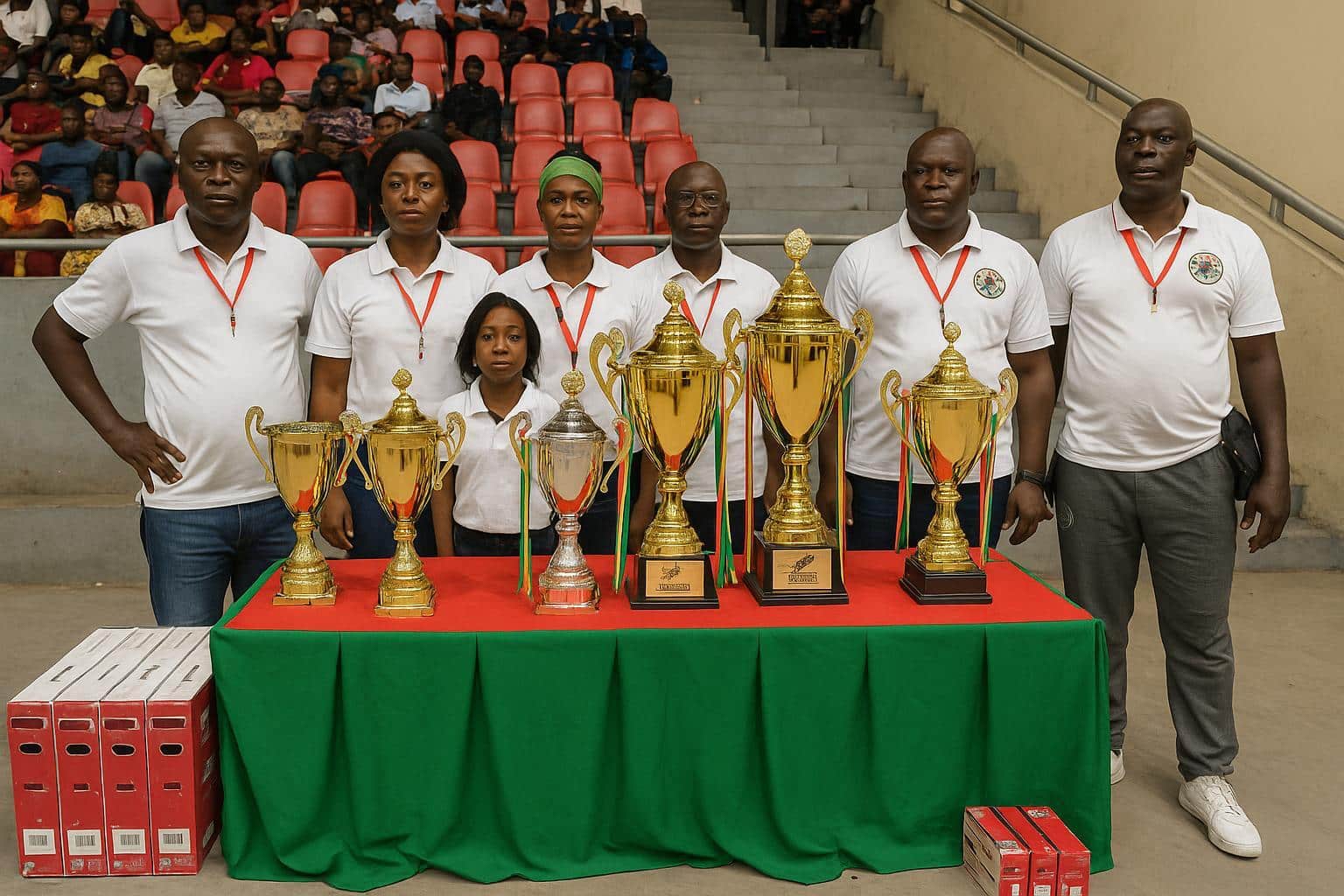
Finals crown new champions
The final whistles echoed inside Brazzaville’s Michel-d’Ornano gymnasium on 22 December 2025, sealing an eleven-day celebration of Congolese handball that travelled from Pointe-Noire to Ouesso before culminating in the capital. Grain de Sel claimed the women’s trophy, while BMC dethroned CFJSO in the men’s bracket.
Grain de Sel overcame the defensive wall of DGSP in the women’s final, prevailing 23-16 thanks to nine goals from left-back Mélanie Okemba and a series of reflex saves by goalkeeper Judith Nkouka that subdued DGSP’s fast breaks.
On the men’s side, BMC relied on quick transition play to topple CFJSO 27-20. Centre-half Arnaud Mabiala orchestrated the attack with seven assists, while veteran pivot Rostand Kodia punished defensive lapses in the six-metre zone, a performance that earned him the tournament’s MVP plaque.
A festival of unity across regions
Organised under the banner “Handball Friendship”, the National Cohesion and Fraternity Tournament gathered 43 senior teams from Brazzaville, Pointe-Noire, Dolisie, Nkayi, Madingou, Loutété and visitors from Kinshasa and Lubumbashi, illustrating a rare moment of sporting integration across the Congo River.
Matches alternated between the Michel-d’Ornano and Maxime Matsima gymnasiums, drawing packed bleachers and steady television audiences, according to figures supplied by the organisers. Enthusiasm was palpable; drums and vuvuzelas echoed through the stands, while youth volunteers managed ticketing and sanitary measures with precision.
Players and referees rewarded
Beyond medals, every squad returned home with a financial envelope. Domestic teams each received one million CFA francs, while the Kinshasa contingents departed with two million and the illustrious Tout-Puissant Mazembé pocketed three million, a gesture that reinforced cross-border camaraderie and eased travel costs.
The officiating corps did not leave empty-handed. Referees, top scorers and standout goalkeepers were awarded 32-inch plasma screens donated by handball expert Chérubin Nkodia, alongside branded balls meant to encourage training sessions once the festive lights dim in December’s wake.
Fair-play trophies went to Pigeon-Vert of Loutété, Sangha-Sport of Ouesso and Tout-Puissant Mazembé, each leaving Brazzaville with five additional balls. Tournament spokesperson Cédric Obambi said the honour “underlines our belief that competition must never eclipse respect”.
Economic and social ripple effects
According to coordinator Christelle Colombe Bouaka Milandou, logistics were underpinned by partnerships with the Ministry of Sports, the Congolese Handball Federation and private patrons. She singled out Brigadier General Serge Oboa for “steady encouragement that allowed us to dream bigger”.
Hoteliers in the Plateau and Poto-Poto districts reported occupancy rates above 80 percent during the competition week, a welcome boost during the low tourist season. Street vendors near the gymnasiums sold out of grilled fish and chilled bissap, illustrating sport’s spillover effect on micro-commerce.
“We felt like ambassadors,” said JSK Kinshasa captain Patrick Bongi, whose side finished third. “The reception in Brazzaville was warm, and the prize money offsets our bus journey back.” His comments were echoed by ASIC defender Flora Mabiala, who praised the tournament’s “flawless officiating”.
Corporate sponsorship remains modest compared with football. However, the event attracted new partners, including a Pointe-Noire logistics firm that supplied transport and a Brazzaville fintech startup that processed cashless ticket payments, signalling potential for diversified sports financing under the government’s emerging creative-economy agenda.
During rest days, national coaches held clinics for local physical-education teachers, sharing drills on mobility and shot accuracy, an initiative the federation hopes will permeate school curricula across all twelve departments.
The tournament was streamed through a new mobile application, enabling diaspora viewers in Paris and Dubai to follow matches live. According to developers, peak traffic reached 9,000 simultaneous connections during the men’s final.
Roadmap for a handball renaissance
Congolese handball enjoyed continental success in the 1980s, yet institutional support dwindled after 2000. The initiative branded “Le réveil du handball congolais” seeks to restore that golden era by multiplying competitive events and reactivating grassroots academies in districts like Mayombe and Komono.
Bouaka Milandou confirmed that the next edition will shift to Pointe-Noire in February 2026, with preliminary talks underway to involve teams from Cameroon and Gabon. She insists the rotating model “allows every region to feel ownership of the handball renaissance we are building”.
As gym lights dimmed and fans spilled into the warm Brazzaville night, chants of “Vive le handball” lingered. Grain de Sel and BMC lifted more than trophies; they embodied a collective conviction that Congolese handball can surge again, fuelled by solidarity, discipline and visionary organisation.