
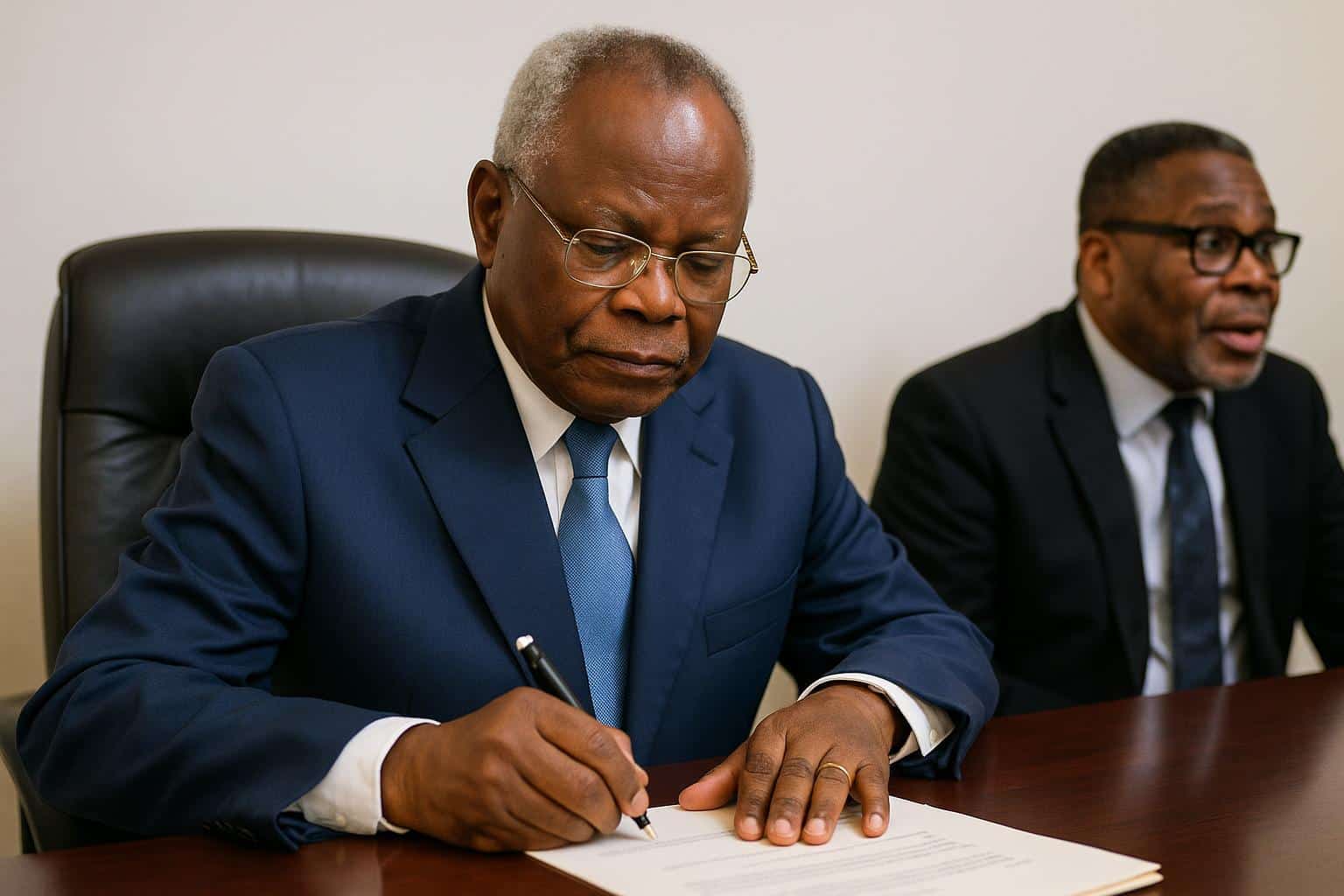
Colloquium Call Ahead of 2026 Presidential Vote
From his modest party office in Brazzaville, former finance minister Mathias Dzon has circulated a six-page note inviting opposition delegates, both domestic and abroad, to a national colloquium between 12 and 14 December 2025, barely three months before Congo-Brazzaville’s next presidential election scheduled 17 and 22 March 2026.
The announcement, first reported by local daily La Semaine Africaine and later confirmed by ARD spokespeople, frames the gathering as a forum for frank discussion on electoral governance, security concerns and political tolerance, themes listed in the July 2 open letter sent to President Denis Sassou Nguesso earlier.
Mathias Dzon’s Proposal and Its Goals
Dzon argues that every vote since 2002 has been shadowed by legal breaches and widespread fraud. His blueprint therefore calls for a new, impartial electoral law and for a truly independent management body capable of supervising registration, polling and tabulation without ministerial oversight or partisan influence in place.
Supporters within the Alliance for the Republic and Democracy underline the peaceful intent behind the initiative. ‘We want solutions written by Congolese, not imposed from abroad,’ explains Guy-Magloire Mafimba Motoki, insisting the forum could strengthen investor confidence by clarifying time-lines, dispute mechanisms and credibility of forthcoming contests nationally.
Opposition Figures Split on Method
Consensus, however, remains elusive. Clément Miérassa of the Rally for the Democratic and Social Forces says he already submitted a comprehensive draft on electoral governance and resents having it ‘simply annexed.’ Jean-Félix Demba-Ntelo of the Citizen Front warns against being, in his words, ‘towed like trailers into uncertain ventures.’
Critics add that Dzon’s invitation bears only the ARD logo, reinforcing suspicions that the platform could morph into a single-party showcase. A civil-society mediator confides that attempts to convene preparatory meetings have failed, not over ideology but over questions of authorship, chairmanship and expense sharing among rival camps.
Electoral Law at Centre Stage
The debate turns on technical detail as much as politics. Opposition lawyers complain that the current legal framework centralises authority within the interior ministry, while observers appointed by the majority dominate local commissions. Reformers propose staggered deadlines for results publication and the digital transfer of tallies county-wide audits.
Government officials contacted by this newspaper note that the 2016 electoral law already integrates many safeguards, including biometric voter lists and public posting of precinct results. ‘Continuous refinement is welcome, but the calendar is legally fixed,’ a senior adviser states, pointing to the March 2026 constitutional deadline for.
Calendar Constraints and Fears of Delay
With nomination filings expected in January, few analysts see time for Parliament to debate and promulgate a brand-new code. Some colleagues suspect Dzon’s real objective is a postponement that could open transitional arrangements. Supporters deny the charge, noting that their timetable avoids overlap with the campaign period entirely.
Constitutionalists also warn that repeated extensions might dent the country’s image among regional lenders. ‘Investors prefer predictability above all,’ reminds economist Carine Mbani, citing the 2019 CEMAC convergence criteria. For her, a dialogue can still be fruitful if focused on post-electoral litigation rather than wholesale institutional re-engineering today.
Prospects for December Gathering
The organising committee insists logistical groundwork is advancing. Letters have been dispatched to provincial governors requesting venues, while diaspora wings in Paris, Montréal and Johannesburg pledge to cover travel for their delegates. Yet no single budget line has been published, and accreditation rules remain under negotiation for observers.
If the conference proceeds with only ARD affiliates, its resolutions may carry limited persuasive weight. Political scientist Aloïs Kitsama recalls that previous attempts at opposition unity in 2009 and 2014 produced separate communiqués, each quickly forgotten once campaigns began. ‘Momentum evaporates without inclusiveness,’ he cautions in measured tones.
Reaction from Government and Observers
Officials at the Presidency say they have not yet received a formal invitation but reiterate that freedom of association is guaranteed. International partners, including the United Nations office in Brazzaville, discreetly encourage dialogue. A diplomat describes any platform promoting peaceful contestation as ‘constructive for stability and growth’ prospects.
Nonetheless, some regional observers express fatigue with perennial procedural quarrels. ‘Citizens want jobs and services, not endless conferences,’ remarks Jean-Ric Okombi from the Central African Policy Centre. He suggests devoting equal energy to municipal oversight, where budget execution directly touches households, thus enhancing the relevance of national debates.
What Next for Opposition Unity
In private, strategists from several parties admit that a shared platform on observers, funding transparency and women’s participation could still emerge. They foresee back-channel talks mediated by church networks. Whether such discussions crystallise before December may determine if Brazzaville hosts an inclusive caucus or parallel press conferences instead.
For now, Congo-Brazzaville moves steadily toward the March election under the existing framework. Any colloquium that promotes dialogue without disrupting the constitutional schedule may yet enhance democratic practice, analysts conclude. The coming weeks will test the capacity of opposition leaders to align ambitions with rapidly closing timelines ahead.