
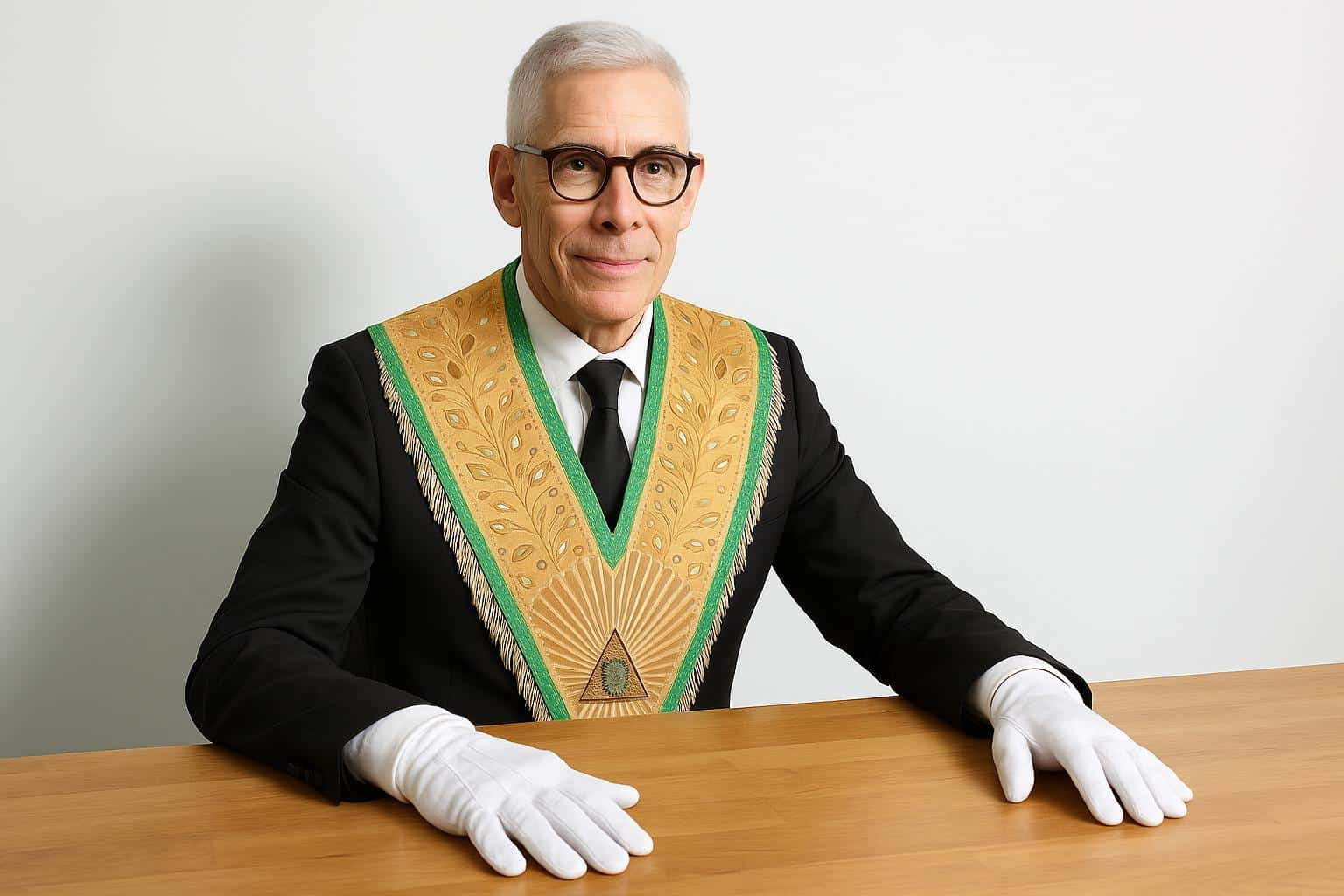
Bordeaux Election Sends Ripples Through Francophone Capitals
On 21 August 2025, delegates gathered in Bordeaux quietly endorsed economist Pierre Bertinotti as Grand Master of the Grand Orient de France. The 72-year-old professor replaced Nicolas Penin after a ballot that, in Paris, seemed strictly ceremonial.
Yet the announcement circulated swiftly through embassies in Dakar, Abidjan and Brazzaville, where Masonic lodges often double as informal salons for senior civil servants. Seasoned observers noted that a routine succession had become a signal watched far beyond France’s borders.
In the words of a Congolese diplomat contacted in Paris, “Grand Masters change yearly, but their networks endure.” His remark, offered anonymously, captured the enduring curiosity surrounding GODF’s discreet influence in Central Africa, an influence neither formal nor negligible.
GODF’s Historical Footprint in Central Africa
Archives show the first GODF lodge in Brazzaville opening in 1924, at the height of French Equatorial Africa. Over decades, magistrates, medical doctors and future ministers met under its vaulted ceiling, exchanging ideas on republicanism and public health reforms.
After independence in 1960, Congolese lodges maintained working relations with counterparts in Paris. They offered what historian Théophile Obenga describes as an “intellectual bridge” during periods when official diplomacy experienced turbulence linked to regional conflicts or commodity price shocks.
The late president Pascal Lissouba, several central bank board members and respected university deans were known initiates, according to regional press archives. Researchers caution against overstatement, yet acknowledge that certain infrastructure contracts were first discussed inside lodge antechambers.
Networks Complement, Not Compete With, Official Diplomacy
Twenty-first-century Brazzaville engages partners through embassies, multilateral platforms and economic forums. Masonic circles, while informal, often reinforce these channels by facilitating introductions that might otherwise be delayed by protocol, officials say.
A senior adviser at Congo’s Ministry of Foreign Affairs says the lodge network works “more like a veterans’ association than a secret cabal.” Such personal rapport, he argues, often speeds cooperation on public finance and health.
New Grand Master’s Policy Agenda and African Resonance
In his inaugural address, Bertinotti pledged to champion “social justice, scientific reason and the primacy of law,” themes resonant in nations negotiating demographic growth and digital transition. Observers in Brazzaville’s academic community welcomed the reference to affordable connectivity and STEM education.
Professor Moussaka Obambi of Marien Ngouabi University recalls that GODF conferences long sponsored scholarships to French engineering schools, “a quiet but tangible boost to capacity.” He expects Bertinotti to extend the scheme toward green technologies vital to Congo’s forestry sector.
While the new Grand Master enjoys only a single-year term, senior members can steer multi-annual programs. A Paris lodge officer says discussions are under way to co-host a 2026 forum on renewable energy financing in Brazzaville, aligning with governmental climate objectives.
Competitive Landscape of Influence in 2020s Africa
Europe no longer holds a monopoly on soft power in Central Africa. Chinese friendship associations, Turkish agencies and Gulf funds court young technocrats aggressively. The ISS think-tank notes non-Western scholarships for Congolese students tripled between 2015 and 2024.
Against this backdrop, GODF’s value proposition rests on shared language, historical familiarity and an emphasis on secular governance. Analysts at the Konrad Adenauer Foundation argue that, far from sidelining state diplomacy, such cultural ties can help maintain plural partnerships without exclusivity.
A Congolese entrepreneur involved in digital payments tells our magazine that belonging to several overlapping networks is “a hedge, not a betrayal.” In that sense, Masonic affiliation complements, rather than competes with, emerging relationships forged through Beijing or Ankara.
View from Brazzaville: Continuity Over Confrontation
Government spokesperson Thierry Moungalla stresses that Congo welcomes all constructive partnerships grounded in mutual respect. He adds that fraternal ties inside GODF have historically promoted technical exchanges in auditing and customs management, reinforcing, not challenging, national priorities.
Local civil society voices remain attentive. Reverend Pasteur Ngoma, leader of a Protestant federation, calls for “full transparency from any organization influencing policymaking.” His statement reflects a broader regional trend toward accountability, yet stops short of singling out the current administration.
Political scientists in Pointe-Noire underscore that the government’s inclusive approach allows diverse forums, religious or fraternal, to coexist peacefully. Such openness, they argue, reduces conspiracy theories that can arise when meetings are driven underground.
One-Year Mandate, Long-Term Stakes
Pierre Bertinotti’s calendar is already dense. September brings consultations with African lodge delegates in Marseille; November includes a colloquium on artificial intelligence ethics co-hosted with UNESCO. Each stop offers an occasion to renew personal bonds forged over decades.
Insiders recall that previous Grand Masters sometimes prioritized domestic debates. By contrast, Bertinotti’s internationalist posture may buttress France’s collaborative agenda in the Congo Basin Climate Commission, where Brazzaville plays a convening role alongside global partners.
Whether the GODF can preserve relevance amid multiplying actors will hinge on concrete projects rather than nostalgia. For now, officials in Congo view the leadership change as an opportunity to diversify cooperation, sustain dialogue and project regional stability through discreet but lawful channels.