
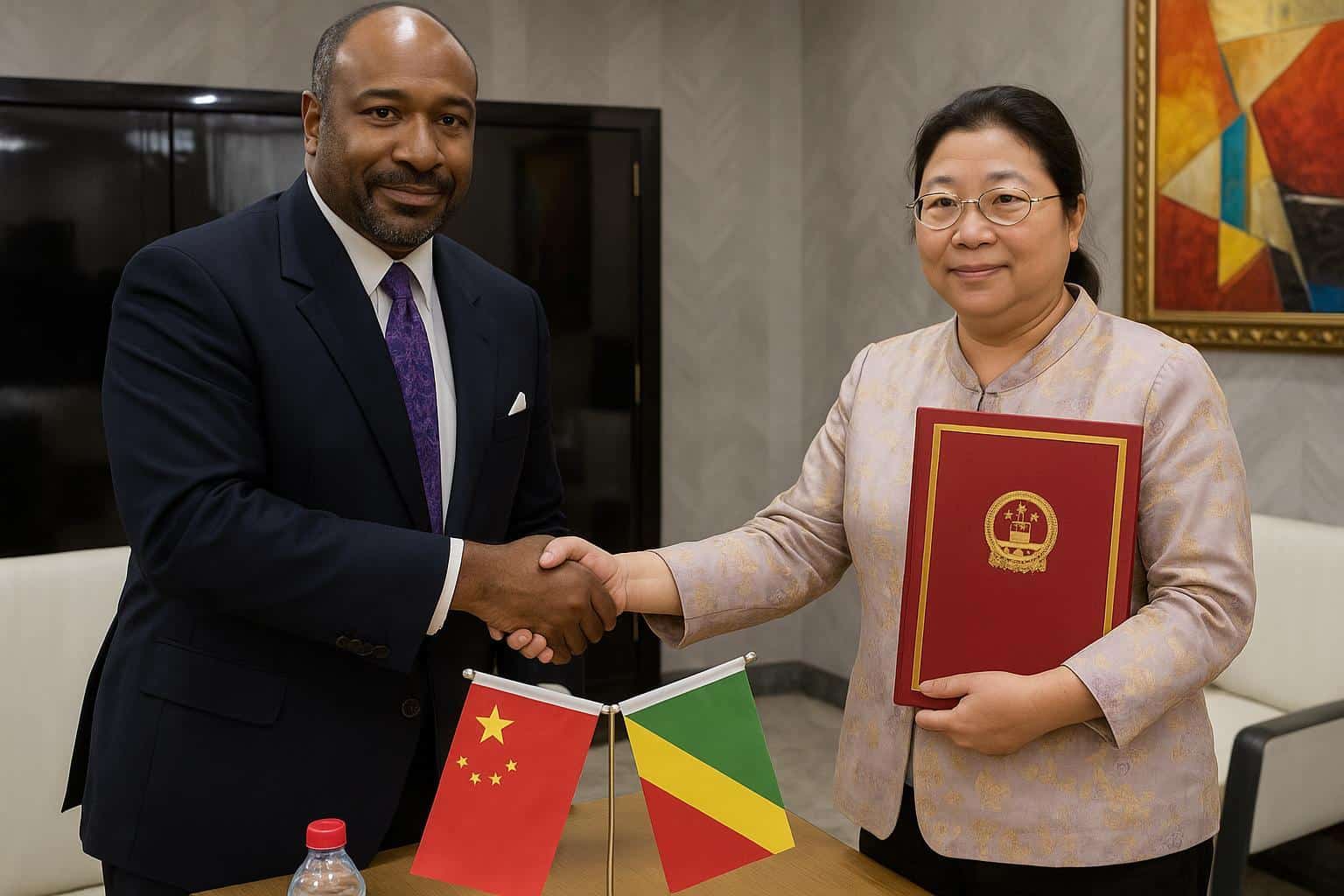
Historic ties trace six decades
Brazzaville and Beijing have again underlined their long-standing friendship, signing this week a fresh grant agreement in the office of the Ministry of International Cooperation. The document, described as “priority development financing”, was endorsed by Minister Denis Christel Sassou Nguesso and Chinese Ambassador An Qing.
For Congolese authorities, the gesture illustrates what President Denis Sassou Nguesso often calls a “community of destiny” linking the two nations. “China’s support remains unfailing,” the minister told reporters, urging every line Ministry to submit projects quickly to tap the new envelope.
Ambassador An Qing echoed that sentiment, noting that since diplomatic relations were established in 1964, more than 40 interest-free loans and grant packages have flowed to Congo, erecting highways, hospitals and fiber-optic cables that today structure the national economy.
According to Xinhua News Agency, cumulative Chinese financing to the Republic of Congo surpassed US$5 billion by 2023, a figure that includes flagship projects such as the 1,120-meter Talangaï viaduct and the modernisation of Pointe-Noire’s autonomous port (Xinhua).
New grant targets priority projects
Officials have not disclosed the exact amount of the new grant, but two senior civil servants told our newsroom it is “comparable” to the 2022 envelope of 18 million dollars, and will be channelled into education, rural electrification and the agricultural value chain.
The Ministry of Primary Education has already drafted a proposal for 200 additional classrooms in Pool and Cuvette, while the energy portfolio is fine-tuning solar mini-grid pilots meant to lighten the state utility’s fuel bill, according to internal concept notes viewed by this paper.
Economic analyst Placide Mabiala says that focusing on human capital and off-grid power could accelerate Congo’s ambition to raise non-oil GDP growth to 7 percent by 2027. “Infrastructure alone is not enough; we need productive skills and reliable energy,” he explained in an interview.
Planned tariff waiver to boost trade flows
Beyond grants, Ambassador An Qing confirmed that a bilateral protocol eliminating import duties on 98 percent of Congolese goods will be signed on the margins of the China International Import Expo scheduled for November in Shanghai.
If implemented, Congolese timber, cocoa, coffee and emerging agri-food brands such as cassava flour could access a marketplace of 1.4 billion consumers with improved price competitiveness. The Ministry of Commerce expects exports to China to jump from 38 million to 60 million dollars in 2026.
Congolese exporters still face logistical hurdles, notably container shortages and delays at the Port of Pointe-Noire. To cushion costs, the Congolaise des Routes company is accelerating upgrades on the RN1 corridor to Ouesso, supported by the China Harbour Engineering Company.
Strategic partnership upgraded in 2025
During President Sassou Nguesso’s state visit to Beijing in September 2025, the two countries elevated their ties to a ‘high-level shared future community,’ a term Beijing reserves for its most trusted allies. Analysts see the new label as unlocking preferential financing and joint research programs.
Professor Zhao Cheng, of the China-Africa Institute, notes that Congo’s early endorsement of the Belt and Road Initiative in 2013 positioned Brazzaville favourably. “What we observe now is a maturing of that decision, moving from infrastructure to industrial cooperation,” he said by video link.
Local business eager for market access
In Brazzaville’s Talangaï district, cosmetics entrepreneur Monique Makaya packs soaps made from moringa oil. “Zero tariffs could double my margins,” she smiles, adding that her cooperative of 35 women is already negotiating with a Shanghai-based distributor introduced by the Chinese Embassy’s economic section.
Infrastructure marks visible legacy
Residents of Pointe-Noire still recall the 2019 commissioning of the 520-megawatt Imboulou hydroelectric plant, built by Sinohydro. The facility now supplies nearly 70 percent of the coastal city’s electricity, according to Société Energie Électrique du Congo, cutting blackouts that once deterred investors.
Yet maintenance funding remains a challenge. A recent memorandum seen by our newsroom proposes allocating part of the fresh Chinese grant to purchase spare turbines and to train local engineers in Chongqing, ensuring the dam’s reliability over the next decade.
Experts say diversification is key
Economist Rodrigue Mouyabi cautions that heavy reliance on Chinese credit must be balanced with fiscal prudence. He applauds Brazzaville’s move to prioritise grants and duty-free schemes over new loans, arguing that diversified financing shields the republic from commodity price swings.
The International Monetary Fund, in its April regional outlook, similarly encouraged Congo to deepen non-oil partnerships while respecting debt thresholds. Government sources confirm that the latest grant carries no repayment obligation, aligning with those recommendations.
Outlook brightens for bilateral agenda
With an expanded common agenda—from classroom walls to tar-free exports—Brazzaville officials project that Chinese cooperation could generate 25,000 direct jobs by 2028. Negotiations are under way for a joint technology park near Kintélé, specialising in e-commerce and fintech.
“Our partnership is evolving toward innovation and youth employment, not merely cement and steel,” Minister Denis Christel Sassou Nguesso told the press, hinting that the forthcoming Budget Law will reflect co-financing mechanisms derived from the new grant.