
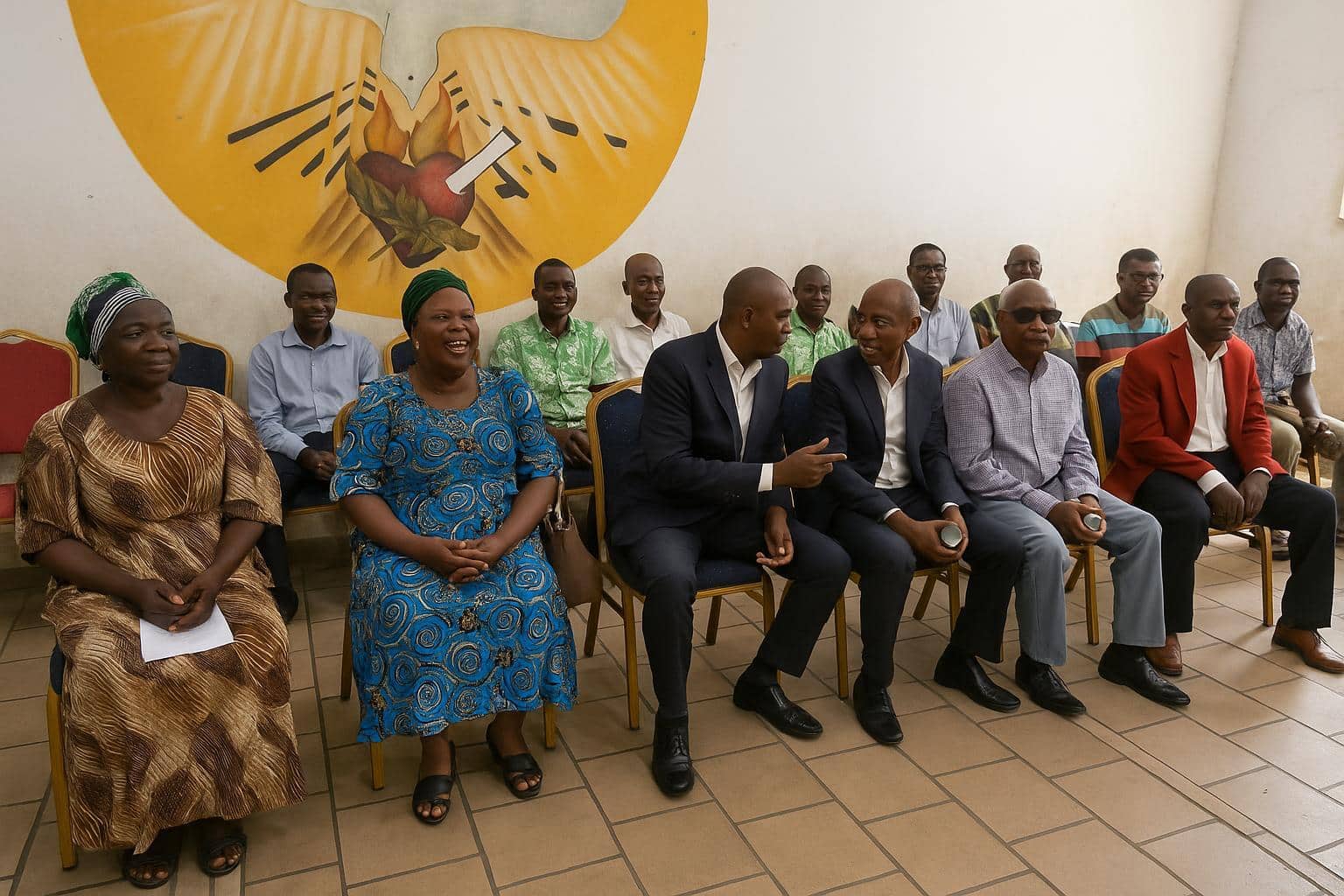
Gangulu community launches language drive
The upbeat drums of the Plateau region echoed in Brazzaville as Sébastien Elion unveiled the Association for the Promotion of the Gangulu Language and Culture, urging his kin to safeguard a tongue spoken by barely a few thousand across central Congo.
Elion’s message, delivered under the theme “Language, the vehicle of a people’s culture,” aligned with UNESCO data indicating that nearly 40 percent of African languages risk extinction by 2100, a trend scholars at Marien Ngouabi University describe as an invisible erosion of identity.
What is at stake for endangered tongues
The Gangulu community, settled mainly in Gamboma and surrounding villages, once relied on oral historians called madunga. Today, less than one in five children can recount ancestral proverbs without switching to French or Kituba, according to preliminary surveys by the association.
Association outlines a digital-first revival plan
The new body plans mobile language camps during school holidays, a digital dictionary and radio storytelling slots on Radio Plateaux. “If a grandparent cannot converse with a grandchild, we lose more than words; we lose wisdom,” Elion told journalists moments after the launch.
Engineers from the National Agency for ICT have signalled support, exploring a low-bandwidth app that could host audio lessons in Gangulu. The prototype, still unfunded, mirrors similar initiatives for Lingala in the Democratic Republic of Congo, where downloads exceeded 50,000 in a year.
Elders and youth power the movement
At the launch, octogenarian storyteller Joséphine Makoua recited a lullaby once sung during harvest. Beside her, 17-year-old student Prisca Ngassaki translated each line into French for classmates. “Listening to Mamie Josée, I feel connected to my roots,” she said, eyes glistening.
The intergenerational moment illustrated research by linguist Innocent Bélikanza, who argues that language revival succeeds when elders own content and youth drive technology. Bélikanza, reached by phone, praised the Gangulu effort as “community-led, not donor-driven,” a distinction he believes will strengthen legitimacy and accountability.
Government policy boosts cultural initiatives
The Ministry of Culture’s 2019 strategy lists minority language preservation among national priorities, complementing Article 9 of the Constitution that protects cultural diversity. Officials present, including Director-General Lucie Mobe, reiterated that civil-society initiatives such as Aplcg qualify for grants under the Cultural Development Fund.
Observers note that successful applicants must show measurable impact. Elion said the association will track progress through biannual vocabulary tests in local schools. “Data will guide us,” he affirmed. Ministry advisers nodded, hinting a pilot could start as early as the next academic year.
Cultural heritage spurs tourism and business
Economists at the Chamber of Commerce link linguistic heritage to tourism revenues. They reference the Kukuya whistle language nearby, which attracted French anthropologists and funded community museums in Ngo. A Gangulu cultural festival, officials argue, could similarly draw visitors travelling the Brazzaville-Ouesso corridor.
Barthelemy Ngambali, a tour operator, envisions storytelling treks along the Léfini River. “Travelers crave authenticity; language animates the journey,” he said. His company, Congo Expeditions, recorded a 12 percent uptick after integrating Bembe chants into itineraries, a precedent he touts to skeptical investors.
Professor Armand Dzingi, an ethnomusicologist, warns that commercialisation must respect sacred narratives. “Songs linked to initiation rites cannot become ringtone downloads,” he cautioned during a panel at the French Institute. The association echoed the caution, drafting ethical guidelines to protect sensitive material.
CEMAC cooperation widens funding prospects
CEMAC’s Commission of Culture last year launched a transborder project mapping endangered tongues from Cameroon to Gabon. Commissioner Marie-Thérèse Sima states that Congo’s proactive stance “strengthens the region’s negotiating power for UNESCO heritage funds.” The Gangulu dossier, she confirmed, will feed into the joint application.
Neighboring Equatorial Guinea recently secured financing to digitize three Bantu languages, setting a precedent for public-private arrangements with telecom operators. Analysts at the Economic Community headquarters believe a similar model could unlock support from Airtel Congo, which has signaled interest in socially responsible content.
Next steps to keep the Gangulu drum alive
Over the next six months Aplcg will conduct a census of Gangulu speakers, prioritizing elders above 70. Volunteers will use voice recorders funded by a Brazzaville micro-grant to collect idioms, songs and folktales, material slated for both the digital dictionary and school primers.
The team will also liaise with the National Pedagogic Centre to integrate Gangulu modules into the official curriculum for early grades. Preliminary discussions suggest bilingual booklets combining syllabary charts with illustrations of local flora, promoting both literacy and environmental awareness among rural pupils.
Elion remains cautious yet optimistic. “Our timeline is ambitious, but each recorded word is a victory,” he remarked. His sentiments resonate with elder Makoua, who added softly, “When a language sleeps, a drum goes silent; let ours beat on.” Applause filled the hall.
Whether through classroom lessons, smartphone apps or riverbank festivals, the Gangulu voice is gathering momentum. Its revival story may yet prove that cultural resilience, once awakened, can travel further than the Plateau hills.