
A Ceremony Signaling Ambition
The vaulted auditorium of Brazzaville’s digital city hub filled early on 6 August, families pressing in to glimpse thirty freshly minted entrepreneurs receiving the inaugural Genius certificates. Two young men joined twenty-eight women at the front row, a tableau underscoring a national pivot toward inclusive private-sector vitality.
Presiding above the stage, Minister of Small and Medium-Sized Enterprises Jacqueline Lydia Mikolo shook every hand, while UNDP Resident Representative Adama Dian Barry recorded the moment on her phone. The blend of state authority and multilateral backing offered participants assurance that their business dreams matter at policy level.
For Flavie Lombo, president of the National Chamber of Women Business Leaders and Entrepreneurs of Congo, the scene completed two intense months. ‘They came with doubts but a common ambition to succeed,’ she told journalists, insisting the cohort now holds tools to navigate markets with discipline and pride.
Inside the Genius Curriculum
Delivered by local consultants and diaspora mentors via hybrid workshops, the Genius curriculum compressed core entrepreneurial disciplines into digestible modules. From financial planning and project management to brand positioning and personal development, each session concluded with peer critique, encouraging the generosity network investors often prize in successful founding teams.
Pitch day rehearsals became the programme’s heartbeat. Trainees learned to narrate value propositions within three minutes, answer tough valuation queries, and shift complex market data into clear revenue stories. Several observers from Ecobank remarked privately that polishing such communication early halves the struggle of later capital raising.
Beyond technical content, facilitators addressed psychological barriers. Discussions on imposter syndrome, domestic negotiation, and cultural expectations resonated strongly with rural participants. Sociologist Aimée Moussavou, invited from Marien Ngouabi University, argued that ‘confidence is an economic asset; training that ignores identity costs the continent measurable GDP’. Her lecture prompted standing applause.
Government and UNDP Alignment
Minister Mikolo framed Genius within the national Development Plan 2022-2026, which earmarks entrepreneurship as a lever against hydrocarbon volatility. She underlined that ‘artisan women have long fought for suitable training; Genius formalises their craft and enhances product quality’. Observers read the statement as proof of continuity in governmental support.
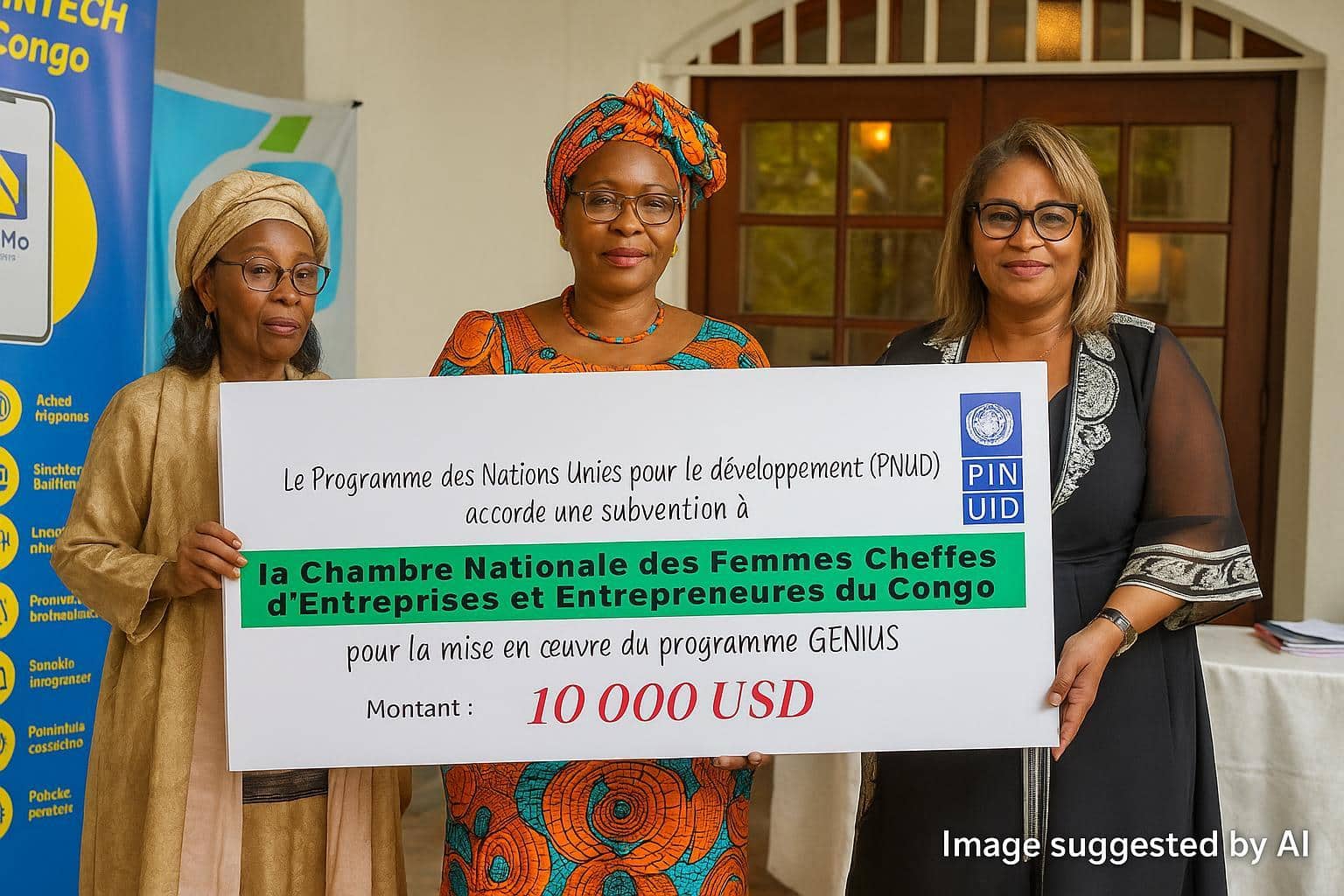
The UNDP component pairs technical assistance with seed funding. A six-million-CFA envelope, signed minutes before certificates were handed out, will cover digital kits, legal registration, and first-year audit costs. UNDP’s Barry stressed the broader mandate: ‘Fighting poverty now requires nurturing enterprises that generate decent work instead of temporary relief’.
Academics also note the diplomatic nuance. Multilateral engagement, they argue, signals to investors that Congo-Brazzaville’s reform momentum is being tracked externally, reducing perception of political risk. Professor Thierry Ngakala of ESC Marien stated that ‘small budgets can have oversized signalling effects if deployed in public, with cameras rolling’.
Financing the Next Leap
Ecobank’s regional ‘Ellever’ facility will latently test the cohort’s readiness for real markets. While terms remain confidential, executives indicate interest rates below commercial averages and mentoring checkpoints tied to disbursement. Such blended finance models have shown repayment rates above 90 percent in Côte d’Ivoire and Ghana, analysts note.
Several graduates have already uploaded business plans to B2B platforms targeting regional value chains. Bianca Biofood, run by Blanche Bafiatissa, seeks to replace imported condiments with locally sourced moringa blends. She reports preliminary talks with two supermarket groups in Kinshasa, suggesting cross-river trade could become an immediate litmus test.
Microeconomic impact studies will monitor revenue, jobs created, and tax contributions over twenty-four months. The Ministry says dashboards will be public. If targets are met, Genius could inform designs of forthcoming special economic zones near Oyo, where infrastructure investments under the National Development Plan are accelerating.
Scaling Beyond Brazzaville
A pilot session began in Pointe-Noire last month, engaging fisheries cooperatives and logistics startups challenged by port congestion. Facilitators reported unexpected enthusiasm from oil-services technicians seeking diversification. The next stop, Oyo on 18 August, will lean on agricultural themes to align with the Cuvette region’s comparative advantages.
Dolisie and Ouesso, scheduled for late quarter, present contrasting laboratories. Dolisie’s timber corridor offers export potential, while Ouesso’s proximity to tri-national conservation areas invites eco-tourism ventures. Programme architects believe tailoring each curriculum to local economies will build a mosaic of specialised clusters rather than a monolithic nationwide template.
Long-term, the chamber aims to train one thousand women across five cities. Economists calculate that reaching that target could inject the equivalent of one percent of GDP into the formal sector, assuming average survival rates. Such figures, if realized, would complement ongoing diversification efforts championed by the presidency.
For now, the graduates leave the campus clutching certificates and carefully costed spreadsheets. A steady drizzle cools the capital, but the mood is bright. Business cards trade hands, and camera shutters click. If momentum holds, Genius may soon be referenced as the moment Congo’s entrepreneurial gender gap narrowed.