
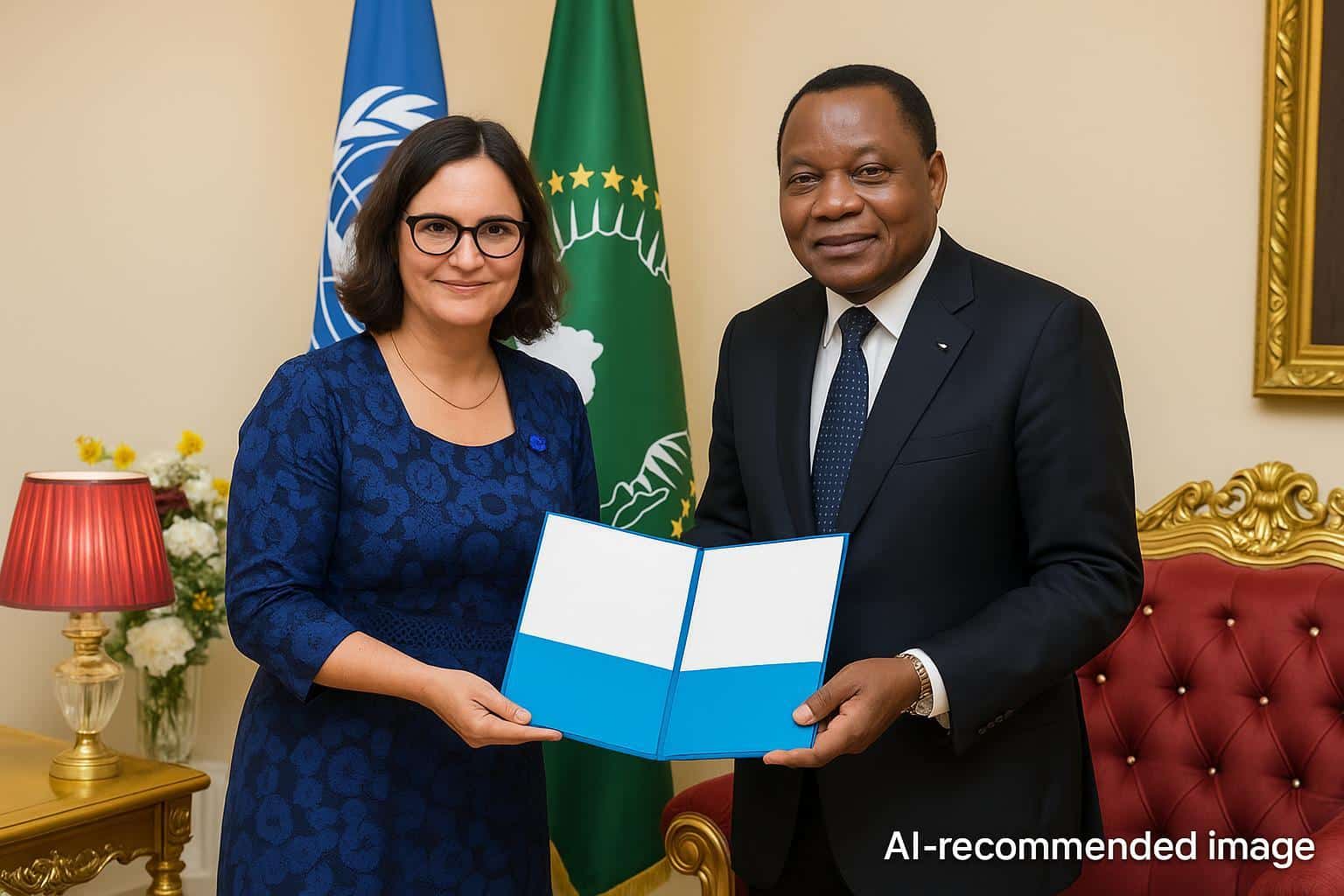
Diplomatic Handover in Brazzaville
Heads turned at the Ministry of Foreign Affairs in Brazzaville as Italian-born diplomat Mariavittoria Ballotta presented her accreditation to Minister Jean Claude Gakosso, formally becoming the new UNICEF Representative to the Republic of Congo and signaling a refreshed phase in child-centred cooperation.
The succession, following the end of Chantal Umutoni’s tenure, was greeted with measured optimism by officials who view the agency as a longstanding pillar of social development support since Congo ratified the Convention on the Rights of the Child three decades ago.
A Seasoned Operator in Child Protection
Ballotta brings more than 20 years of programme design and partnership brokering across West and Central Africa, experience that colleagues in Dakar describe as ‘both strategic and empathetic’ (UNICEF, 2024), qualities expected to resonate in Congo’s diverse administrative departments deeply.
Her academic background spans development economics at the University of Bologna and child protection strategy at Columbia University, a dual perspective allowing her to weave fiscal prudence with community-level sensitivity, according to a former professor contacted by our newsroom recently.
Prior to Dakar, Ballotta steered emergency education programming in Yemen and Ethiopia, proving adept at navigating high-security environments, a skill that development partners say could aid UNICEF in Congo’s hard-to-reach forest districts where riverine logistics remain complicated during rainy seasons.
Government Alignment on Social Objectives
Speaking after the ceremony, Minister Gakosso underlined that Brazzaville’s 2022-2026 National Development Plan identifies human capital as its ‘main growth engine’, inviting UNICEF to act as both technical adviser and conveyor belt for donor confidence (Ministry of Foreign Affairs, 2024).
Ballotta responded that the new Country Programme Document, to be negotiated this year, will prioritise integrated early childhood services, adolescence skills and climate-resilient water infrastructure, themes that echo the government’s Vision 2025 policy and complement World Bank-financed community projects locally.
Observers stressed cooperation continuity, noting Umutoni’s tenure introduced digital birth-registration pilots; Ballotta must now scale them nationwide without disrupting civil-registration systems already endorsed by provincial authorities.
Financing Child-Centred Development
According to UNICEF Congo’s latest financial statement, contributions totalled 28 million dollars in 2023, 62 percent of which originated from thematic education and health grants; Ballotta aims to lift the envelope to 35 million by courting emerging partners from the Gulf and Brazil.
In an interview with state broadcaster Télé Congo, she described innovative finance as ‘the reasonable bridge between ambition and delivery’, hinting at blended mechanisms that combine concessional loans with private-sector guarantees to accelerate school rehabilitation along the Sangha and Likouala rivers.
The proposition aligns with recent Economic Commission for Africa research showing that every dollar invested in Congo’s primary education generates four dollars in future earnings, an argument that resonates with the government’s drive to diversify the hydrocarbon-dominated economy (ECA, 2023).
Balancing Humanitarian Needs and Stability
While Congo enjoys relative political stability, UNICEF still records cyclical measles outbreaks in the northeast and lingering refugee flows from neighbouring Central African Republic; Ballotta insists that humanitarian action must be integrated within long-term state systems rather than implemented as parallel chains.
Health Ministry officers welcomed the stance, recalling how siloed emergency programmes during the 2013 polio resurgence created data gaps; a joint dashboard developed last year now feeds real-time vaccination figures to both ministries and UNICEF technicians, offering a template for forthcoming campaigns.
Security analysts highlight that such transparency tools also help counter misinformation on social networks, a growing concern since 2022 floods displaced thousands along the Congo River and sparked rumours about vaccine contamination that temporarily reduced coverage in four districts.
Leveraging Regional Insights
Ballotta’s previous role overseeing 24 countries in West and Central Africa equips her with comparative evidence on what works, from the cash-plus pilot in Sierra Leone to Ghana’s adolescent digital skills labs, initiatives she plans to adapt selectively with Congolese realities in mind.
Regional economists say the cross-fertilisation is timely, as CEMAC heads of state recently endorsed free movement and a shared digital identity platform; integrating child-focused data early could secure Congo a first-mover advantage in the bloc’s forthcoming social registry project.
Measured Optimism Among Stakeholders
Civil society leaders interviewed by our magazine describe Ballotta as approachable yet rigorous; they urge her office to keep consultation windows open so community organisers can flag bottlenecks early, a practice they believe strengthened trust during the 2021 COVID-19 vaccine rollout.
Private-sector executives, for their part, view the leadership change as an entry point to pilot social impact bonds in urban areas, provided regulatory approvals are expedited; one telecom CEO said ‘we see room for business to underwrite classrooms and still get measurable returns’.
For now, Ballotta’s calendar is filled with field visits to Ouesso and Pointe-Noire, where she will consult teachers, nurses and local chiefs before finalising next year’s workplan, a tour diplomats believe underscores UNICEF’s intent to reinforce national ownership rather than directive programming.