
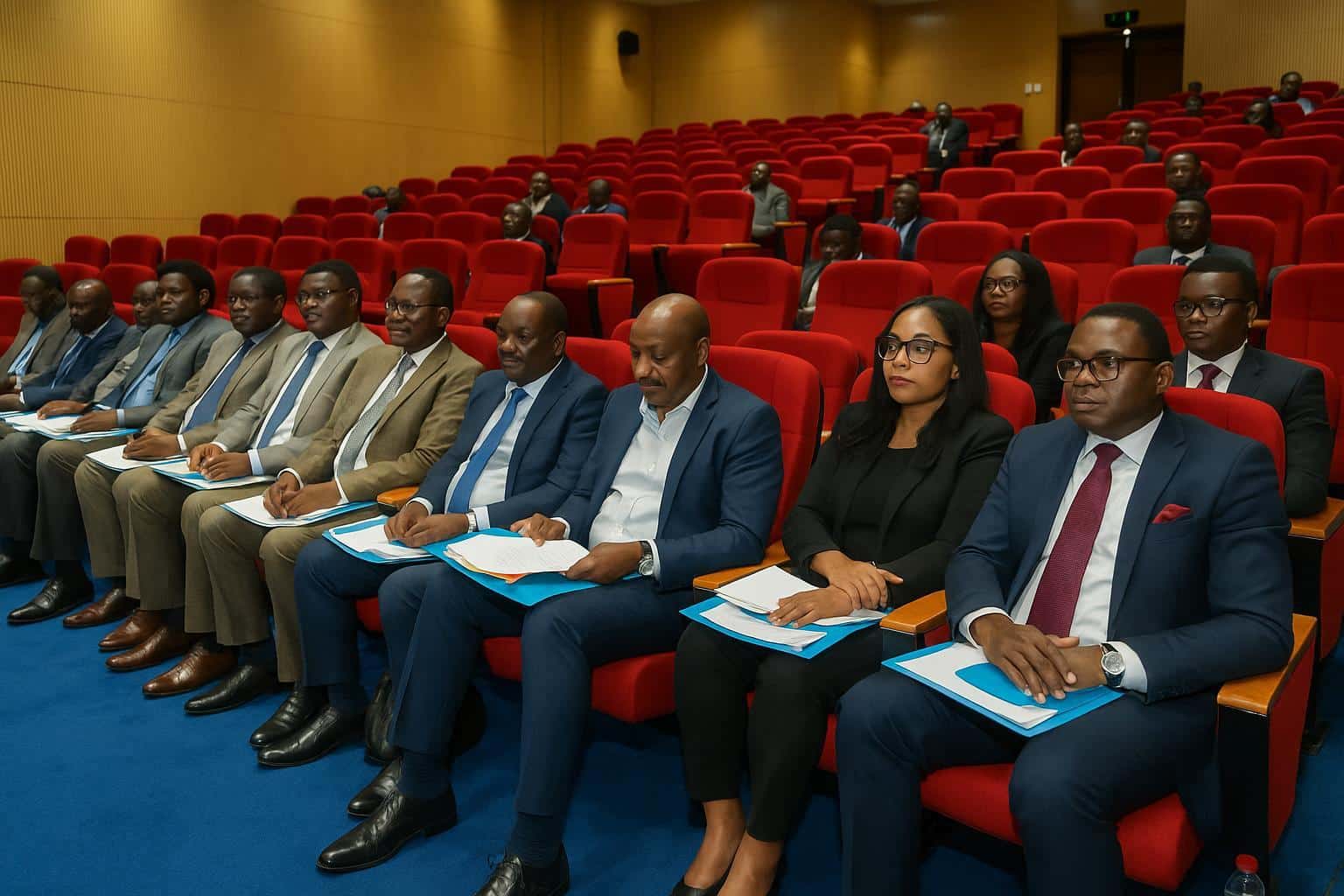
Midterm snapshot of PATN progress
At a downtown Brazzaville hotel, the Steering Committee for the Acceleration of the Digital Transition Project, better known by its French acronym PATN, convened on 8 October to dissect a thick preparatory report bound for the World Bank’s midterm review desk.
The meeting provided officials with a rare pause to measure two years of implementation, acknowledge successes, and isolate items requiring course correction before the closing deadline of December 2027, a horizon still distant yet approaching rapidly in project-management terms.
Steering committee’s strategic mission
Coordinator and committee rapporteur Michel Ngakala framed the exercise as routine, noting that global lenders now expect midline self-assessments as proof of accountability and local ownership (PATN document).
Ngakala reminded participants that PATN is intentionally cross-cutting, touching telecommunications, finance, health, education and civil service modernisation, meaning delays in one ministry can ripple across the entire digital ecosystem.
Chairman Sylvain Leckaka applauded what he called a ‘second wind’ for the programme, stressing that the committee’s role is to provide high-level arbitration on annual work plans and budgets so that technicians can concentrate on fibre trenches, data platforms and citizen-centric e-services.
Funding streams and disbursement pace
During the briefing, the coordination team presented a dashboard indicating that roughly 40 percent of the US$100 million envelope—jointly backed by the World Bank and European Union—has been committed to contracts covering backbone extension, rural connectivity pilots and government data-centre upgrades.
Disbursement is slightly ahead of the regional average for similar digital projects, according to internal comparisons, yet field feedback suggests absorption capacity will be tested as larger infrastructure packages move from procurement to execution in 2025.
Early results on the ground
The midterm report highlights early wins: over 200 kilometres of metropolitan fibre have been laid in Brazzaville and Pointe-Noire; a cloud-ready platform now hosts six emblematic e-services, including online company registration; and 1,500 public servants completed basic digital-literacy modules delivered by the National School of Administration.
Small entrepreneurs like Eliane Bilonda, who launched a design studio this year, tell us that ‘registering a business online in two days feels revolutionary compared with the paper maze we knew’, a testimonial the committee cites to underline tangible impact.
Remaining connectivity gaps
Still, connectivity gaps persist in departments such as Likouala, where river geography complicates cable deployment and satellite back-up remains costly.
Procurement cycles have lengthened because of new due-diligence layers tied to environmental safeguards, a development praised by conservation groups but lamented by local contractors who argue that exchange-rate volatility eats into fixed-price bids during prolonged evaluation windows.
Corrective measures underway
To address such frictions, the steering committee adopted recommendations ranging from real-time dashboards accessible to all line ministries, to quarterly joint missions with provincial authorities so that on-the-ground realities feed strategic planning rather than appear as end-of-year surprises.
The finance ministry confirmed that a special escrow window at the Treasury is being examined to speed counterpart-fund payments, an innovation that could shave weeks off supplier invoicing and shield the project from seasonal cash-flow pressures.
Partners’ perspectives
World Bank digital specialist Mariana Tavares, participating by videoconference from Washington, commended the team for ‘maintaining momentum in a challenging macroeconomic context’, while cautioning that cyber-security and data-protection frameworks must keep pace with infrastructure rollout.
The European Union delegation echoed that view, pledging technical assistance to harmonise Congo’s data rules with CEMAC guidelines, a step seen as critical for cross-border fintech services and regional start-up scaling.
Next steps and policy alignment
Looking ahead, the steering committee will submit the revised results framework to cabinet by the end of November; once validated, it becomes the new compass for implementers, embedding delivery indicators on gender inclusion, e-government uptake and private-sector leverage.
In the words of Ngakala, ‘our ambition is simple: make high-speed internet as common as running water’. If the forthcoming half of PATN stays on schedule, that aspiration could gradually weave Congo into the expanding fabric of Africa’s digital economy.
Regional market implications
Digital policy analysts note that improved bandwidth can cut wholesale prices by up to 60 percent, which in turn stimulates mobile-money usage; PATN’s fibre links with Cabinda and Gabonese border towns could therefore unlock new revenue streams for operators and the treasury.
E-commerce platforms such as Waye and KongoShop already plan logistical hubs near the forthcoming national internet exchange point, expecting that lower latency will shorten delivery windows and attract diaspora clients seeking Congolese produce from Paris, Montréal or Dubai.
Building human capital
Beyond cables and servers, PATN allocates US$5 million to professional training; partnerships with Marien Ngouabi University and private coding bootcamps aim to certify 10,000 young Congolese in cloud administration, cybersecurity and data analytics over the next three years.
Industry group CongoTech sees the talent pipeline as pivotal, arguing that ‘infrastructure without skills risks becoming white elephants’; hence an incubator floor is being added to the renovated data centre, offering start-ups subsidised rack space and mentorship.