
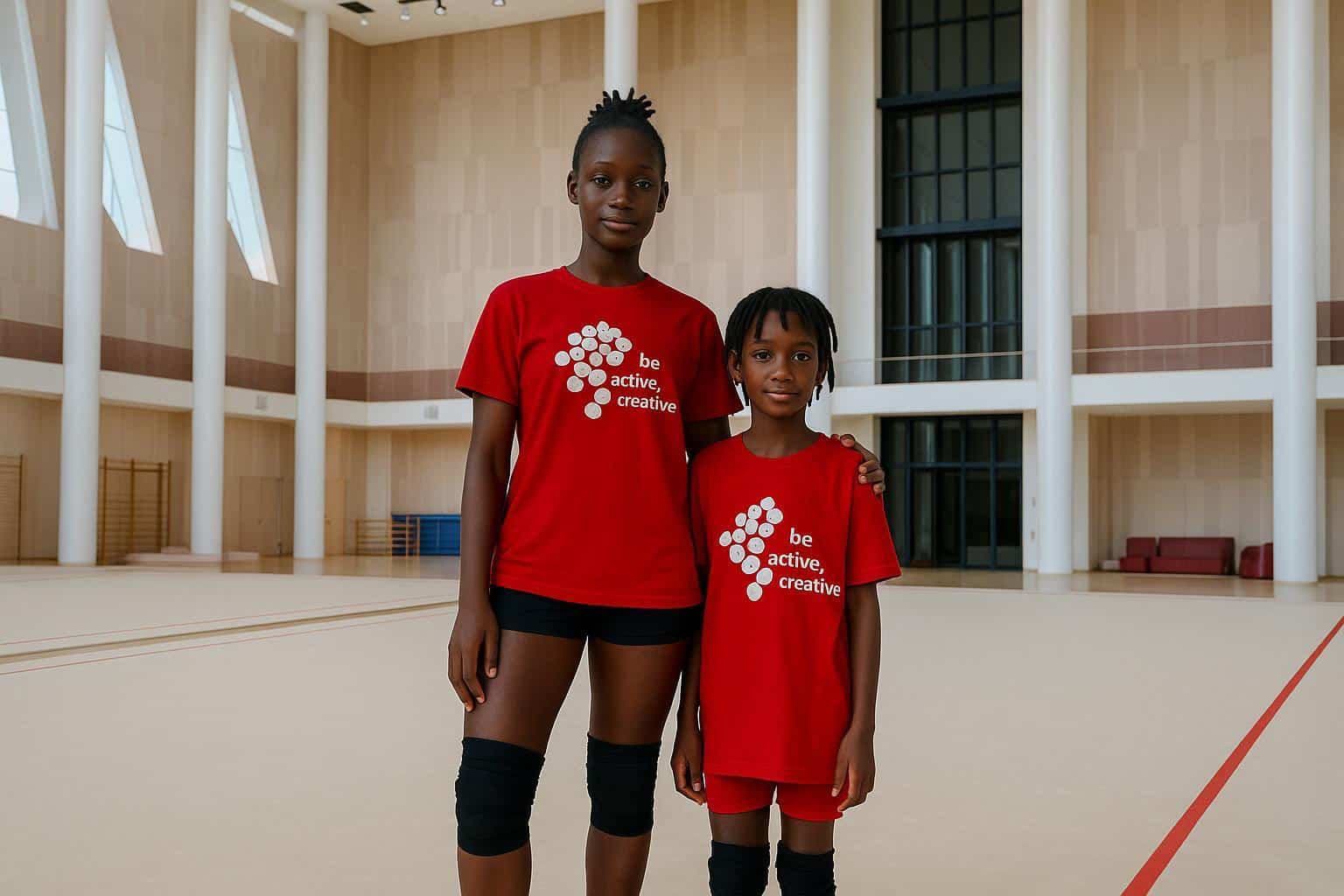
Intensive Sochi Camp Elevates Congolese Gymnasts
Ten days on Russia’s Black Sea coast turned the Olympic complex of Sochi into a second home for Davina Nkenko Sita, 10, and Celeste Malanda Mayinga, 12. Under the vaulted ceilings of the Grâce Céleste Academy they rehearsed pivots, balances and ribbon sequences from dawn to dusk.
Russian and Cuban coaches supervised thirty athletes, blending ballet drills with conditioning protocols common in Eastern European programs. Federation insiders note that such exposure compresses learning curves that would otherwise take seasons in Brazzaville (Congolese Gymnastics Federation interview).
Third Consecutive Year of High-Level Exposure
The August session marked the duo’s third invitation since 2022, a continuity that specialists regard as critical. FIG development officer Anna Trokhova observed that repeating elite camps cements muscle memory and prevents the “post-event fade” often seen after one-off clinics (FIG briefing, 2023).
Congolese coaches agree. “Each return trip brings visible gains in artistry and confidence,” said head coach Grâce Mouandzibi by telephone. National selectors consequently fast-tracked the girls to the senior-prep squad despite their tender age.
The Kabaeva Academy Connection
Behind the initiative stands the academy founded by Alina Kabaeva, the 2004 Olympic champion revered for her mastery of complex pivots. Her staff tailored individual choreography for Davina and Celeste, integrating Congolese musical motifs to celebrate cultural identity while meeting FIG code requirements.
The partnership is co-financed by Africa Centrum, a philanthropic platform chaired by Jocelin Patrick Mandzela, Congo’s honorary consul in Saint Petersburg. Mandzela emphasised that private funding complements Brazzaville’s investment in youth sport, ensuring training continuity despite fiscal pressures felt across many federations.
Sports Diplomacy Deepens Congo-Russia Ties
The collaboration echoes broader diplomatic currents. Brazzaville and Moscow revived a general cooperation agreement in 2019 covering energy, education and sport. Analysts at the Institute for Security Studies highlight gymnastics as a soft-power niche that avoids the geopolitical headwinds surrounding other sectors.
Russian media framed the Sochi camp as an example of “mutual learning,” stressing that African athletes bring originality while Russian technicians provide technical depth (TASS dispatch, 6 August). That narrative aligns with Congo’s own emphasis on balanced partnerships championed by President Denis Sassou Nguesso.
September Showcase in Brazzaville Draws Attention
The immediate target is the Recognition Tournament slated for 27–28 September at Maxime-Matsima Gymnasium. The meet, dedicated to Kabaeva’s career, will feature routines polished in Sochi and broadcast on national television.
Organisers expect delegations from Cameroon and Gabon, projecting an audience of 3,000. The Ministry of Sports confirmed logistical upgrades, including a new sprung floor and LED scoring panels, equipment devised to mirror what athletes faced in Sochi so performance standards remain consistent.
Pathway to Continental and Olympic Ambitions
Beyond September, the federation eyes the 2024 African Games in Accra as the next milestone. A top-five finish would grant Congo a quota spot for a Youth Olympic qualifier, an achievement yet to be recorded by the country in rhythmic gymnastics.
Technical director Rodrigue Mabiala outlined a two-phase plan: remote coaching sessions with Russian mentors over video link, followed by another in-person camp early next year. “We are calibrating peak form for March,” he explained, citing data from motion-capture analyses performed in Sochi.
First-Hand Impressions from Young Athletes
Between apparatus rotations, Davina shared a candid reflection: “We feel at home here and discover elements that don’t exist back in Congo.” Her words, relayed via the academy’s media desk, resonated with peers who gathered around to compare stretching regimens.
Celeste, equally composed, noted the cultural immersion. Evening sessions included Russian language basics and a tour of the Olympic Park. “Understanding their culture helps us understand their sport,” she said, suggesting that diplomacy can blossom through shared choreography as much as through treaty texts.
Strategic Support Drives Future of the Discipline
Congo’s National Development Plan lists sport among the creative industries meant to diversify the economy. Investment has flowed into facilities like Maxime-Matsima, built for the 2015 All-Africa Games and now refurbished. Observers believe rhythmic gymnastics could replicate the country’s success in handball and judo.
Still, experts caution that depth beyond prodigies is vital. The federation has launched school-based talent searches in Pointe-Noire and Dolisie, using video highlights of Davina and Celeste as inspirational material. “Our aim is a pipeline, not a one-off triumph,” Mabiala reiterated.