
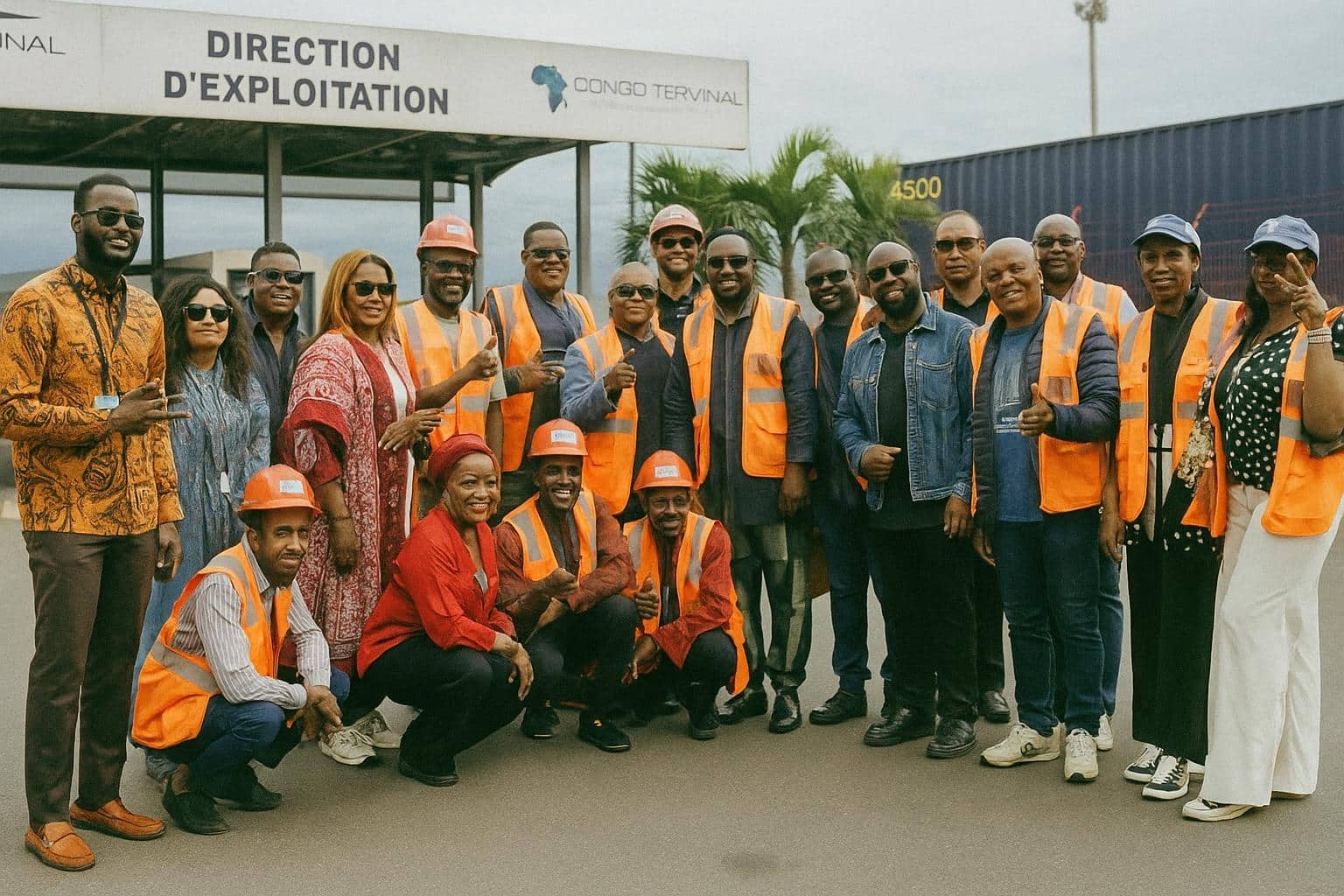
International spotlight on Pointe-Noire terminal
The still-gleaming quays of Congo Terminal received unusual guests on 8 August 2025, when twenty internationally followed influencers and film-makers stepped onto the busiest stretch of concrete in Central Africa. Their cameras and social feeds carried images of Pointe-Noire’s evolving container hub to audiences from Yaoundé to New York.
The visit, orchestrated in partnership with the Ministry of Communication and Congo Terminal’s parent company Africa Global Logistics, was not a mere public-relations exercise. It provided an on-the-ground demonstration of how 450 million euro of private investment is translating into steady throughput growth and streamlined regional commerce.
From quay to cloud: modern logistics exposed
Influencers accustomed to drone shots of metropolitan skylines found equal cinematic appeal in the terminal’s eight super-post-Panamax cranes moving in near-silent synchrony. According to operations chief Jean-Félix Okemba, each crane now handles up to 35 movements per hour, double the 2018 performance, thanks to automated yard planning.
Real-time tracking dashboards projected inside the control tower offered visitors data points rather than anecdotes. Machine-learning software provided by a Singaporean vendor predicts vessel berthing sequences 48 hours ahead, reducing idle time by 12 percent, a figure confirmed by a recent African Development Bank logistics review.
Môle Est: blueprint of a regional gateway
Beyond the existing quay, bulldozers are sculpting the 42-hectare Môle Est platform, slated to come online in phases from 2026. Project director Clarisse Bouiti expects annual capacity to surpass 2.3 million TEU by 2027, positioning Congo as the natural outlet for six land-linked neighbours.
The expansion aligns with the African Continental Free Trade Area’s objective of trimming intra-African freight costs by 40 percent over a decade, as outlined in a recent UNECA brief. Economists at Brazzaville’s Ecole Nationale d’Administration foresee a three-point boost in national GDP once the corridor effects mature.
Jobs, skills and the human factor
Congo Terminal now counts 900 employees, 14 percent of whom are women, a figure labour unions describe as unprecedented in the sub-region’s maritime sector. Training modules developed with the Port of Antwerp include simulator sessions and English-language courses, building a workforce ready for multi-country operational standards.
Dockworker Serge Mabiala, who started as a casual labourer in 2015, told the visiting film crew that automated equipment has ‘turned hard labour into smart labour’. His monthly productivity bonus has doubled, he said, allowing him to fund his daughter’s engineering studies at Marien Ngouabi University.
Environmental safeguards amidst expansion
Port authorities were keen to underline ecological safeguards even while celebrating growth. A closed-loop stormwater system, co-financed by the French Development Agency, now collects and treats runoff before discharge, reducing hydrocarbon residues in the bay by 70 percent compared with 2021 baseline measurements released by IFREMER.
An on-site mangrove nursery is also producing 50,000 seedlings annually for community-led replanting along nearby estuaries. Environmental sociologist Élodie Nkani said the measure ‘offers a textbook example of industry partnering with civil society’, adding that local fishers have reported improved juvenile catch rates since the pilot phase.
Creative voices amplify the message
Cameroonian director Rigobert Tamwa, better known as Mr Mbarga from the series Madame et Monsieur, declared Pointe-Noire ‘the doorway of the world’ during a waterfront interview that drew thousands of live viewers. Within hours, hashtags blending Congolese and Cameroonian slang trended across TikTok, Instagram and X, expanding the port’s digital footprint.
Influencer Weilfar Kaya, whose travel vlogs routinely surpass one million views, promised a multi-episode series on the port’s role in continental trade. ‘Logistics is not just numbers; it is a human adventure,’ he told our newsroom later, echoing the administration’s emphasis on inclusive economic storytelling.
Government outlook on the blue economy
Minister of Transport Honoré Ndong publicly thanked the delegation, saying the exposure complements policy efforts to diversify beyond hydrocarbons. He highlighted the 2024-2028 National Development Plan, which earmarks 1.2 billion euro for maritime infrastructure, fisheries modernisation and coastal tourism, sectors expected to generate 60,000 jobs within five years.
International lenders appear receptive. The World Bank’s latest country brief describes Pointe-Noire as ‘a crucial node for Central African connectivity’ and cites the port’s anti-corruption compliance rating as a factor underpinning potential future loan envelopes for rail upgrades linking the coast to the Copperbelt.
Milestones on the horizon
Before boarding their return flights, several guests signed a mural bearing the slogan ‘From Congo to the world’. Construction managers expect the next ceremonial ribbon cutting in April 2026, when the first 400-metre berth at Môle Est should welcome a 15,000-TEU vessel operated by an Ocean Alliance carrier.
By then, social-media metrics may have matured into hard numbers: more containers handled, more jobs created and more regional products shipped at competitive rates. For the diplomats tracking Central Africa’s logistics map, Pointe-Noire’s story suggests a pragmatic blend of private capital, state vision and continental ambition.
Shipping analyst Marie-Cécile Ngolo cautions that global freight volatility could test projections, yet she believes the port’s diversified client mix provides resilience. ‘The real advantage is geography married to governance,’ she said, predicting that Pointe-Noire could join Africa’s top five container hubs by 2030.