
Brazzaville’s Congress Palace Resounds Again
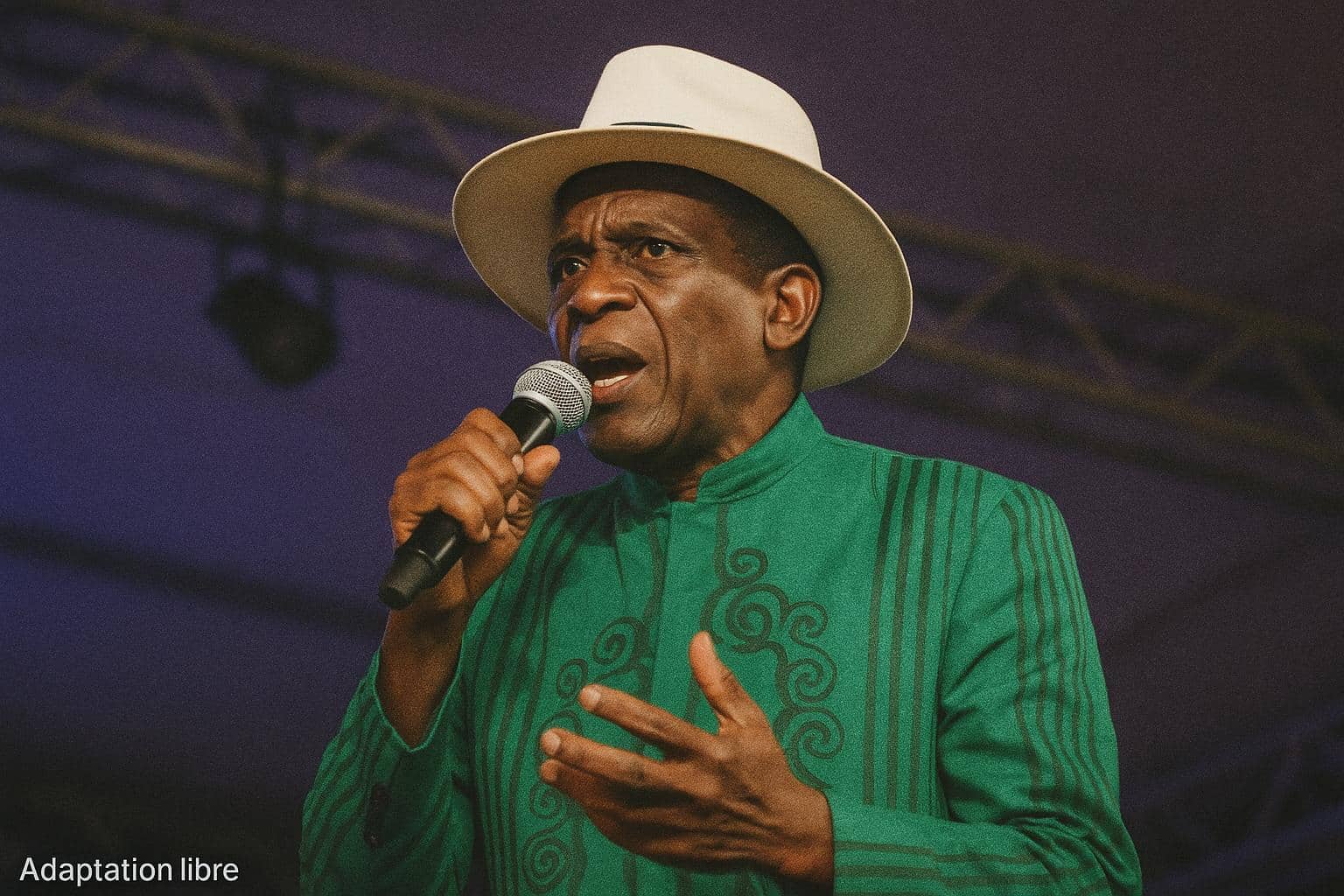
The twelfth edition of the Panafrican Music Festival opened in July 2025 beneath the soaring ceilings of Brazzaville’s Palais des Congrès, a venue that has repeatedly served as the nation’s cultural agora. Government dignitaries, foreign envoys and a cosmopolitan press corps filled the hall in a carefully choreographed ceremony that celebrated both artistic excellence and Congo’s longstanding commitment to cultural multilateralism. In a programme curated by the Ministry of Culture, the evening’s most anticipated moment arrived with the appearance of Clotaire Kimbolo, a name that has become almost synonymous with the festival itself.
A Career Intertwined with the Festival’s History
Kimbolo’s biography is inseparable from FESPAM’s own institutional narrative. The guitarist-composer was present at the inaugural edition in 1996 and, by his own admission, has never missed a subsequent gathering. “I am here from the first edition; it is both pleasure and honour to stand on this stage again,” he told journalists moments after descending the podium. Observers recall that his earliest performances fused ancestral chants with urban rumba at a time when Congolese audiences were searching for post-Cold War identities. Nearly three decades later, his fidelity has turned into a living testimonial of the festival’s resilience through regional conflicts, global recessions and the recent pandemic slowdown.
Diplomacy Woven Into Melody on Foreign Stages
Kimbolo’s artistry has long transcended national borders. From the Francophonie Games in Abidjan to jazz exchanges in Montreal, he has carried the tricolour banner into auditoriums where the Congolese anthem is now part of the standard encore. The artist credits FESPAM with the network that made such itineraries possible. “The festival taught me how to structure an international tour and understand the responsibility that follows visibility,” he said, framing performance as a vehicle for cultural diplomacy. His assertion resonates with Brazzaville’s broader soft-power strategy, articulated by officials who see artistic ambassadors as complementing hydrocarbon exports in shaping perceptions of the country (Ministry of Culture, 2025).
Custodian of Voices That Might Fade
While the spotlight often illuminates new trends, Kimbolo is determined to ensure that the songs of departed masters do not vanish into archival silence. “Too often, when an artist dies, his songs also disappear. I revive them so their spirit endures,” he remarked. This curatorial ethic aligns with the objectives of the National Centre for Cultural Heritage, which has catalogued more than 1,200 pre-independence recordings since 2022. By revisiting classics on stage—sometimes with a modern arrangement, sometimes in austere acoustic form—he performs a public act of remembrance that bridges generational fault lines and sustains a musical genealogy crucial to Congolese identity.
Guarding Authenticity Amid Global Currents
The guitarist’s commitment to preservation does not translate into isolationism. He acknowledges the inevitability of global influences but insists on an anchor in indigenous aesthetics. “Rumba is alive, yet it faces too many external pressures. Modernity must not erase our roots,” he cautioned during a backstage interview. His concern is shared by ethnomusicologists who note that UNESCO’s 2021 inscription of Congolese rumba on the Representative List of Intangible Cultural Heritage has intensified commercial interest (UNESCO, 2021). The challenge, Kimbolo argues, is to transform exposure into enrichment rather than dilution—a calculus that requires both artistic discipline and supportive policy frameworks.
Transmitting Knowledge to Emerging Artists
Beyond performance, Kimbolo has turned mentorship into a daily practice. He conducts weekly workshops at the Marien Ngouabi Cultural Centre, demonstrating traditional chord progressions to cohorts of teenagers who arrive with smartphones and urban-beat aspirations. Participants attest that the sessions provide not only technical instruction but also a narrative of belonging: understanding why certain rhythms accompany rites of passage or agricultural cycles. This pedagogical role positions Kimbolo as a nexus between oral tradition and institutional education, complementing government-supported conservatories established under the national cultural policy of 2023.
Cultural Continuity as National Soft Power
FESPAM 2025 thus illustrates more than an artistic gathering; it is a diplomatic instrument that articulates Congo-Brazzaville’s vision of cultural continuity. In his closing remarks, Minister Dieudonné Moyongo praised artists for “fortifying our collective memory while inviting the world to understand us through harmony.” Such rhetoric gains substance as performers like Kimbolo demonstrate that safeguarding heritage and engaging global audiences are not mutually exclusive pursuits. For diplomats in attendance, the evening offered a case study in how music can translate abstract policy goals—cohesion, visibility, stability—into emotionally resonant experiences.
As the final chords faded and the auditorium lights rose, Kimbolo’s silhouette lingered in collective recollection, reminding observers that cultural memory, once embodied on stage, becomes part of the societal fabric. His journey from inaugural participant to revered elder encapsulates both the evolution of FESPAM and the enduring power of Congolese music to negotiate tradition and transformation with nuanced confidence.