
Youth Diplomacy Connects the Two Congos
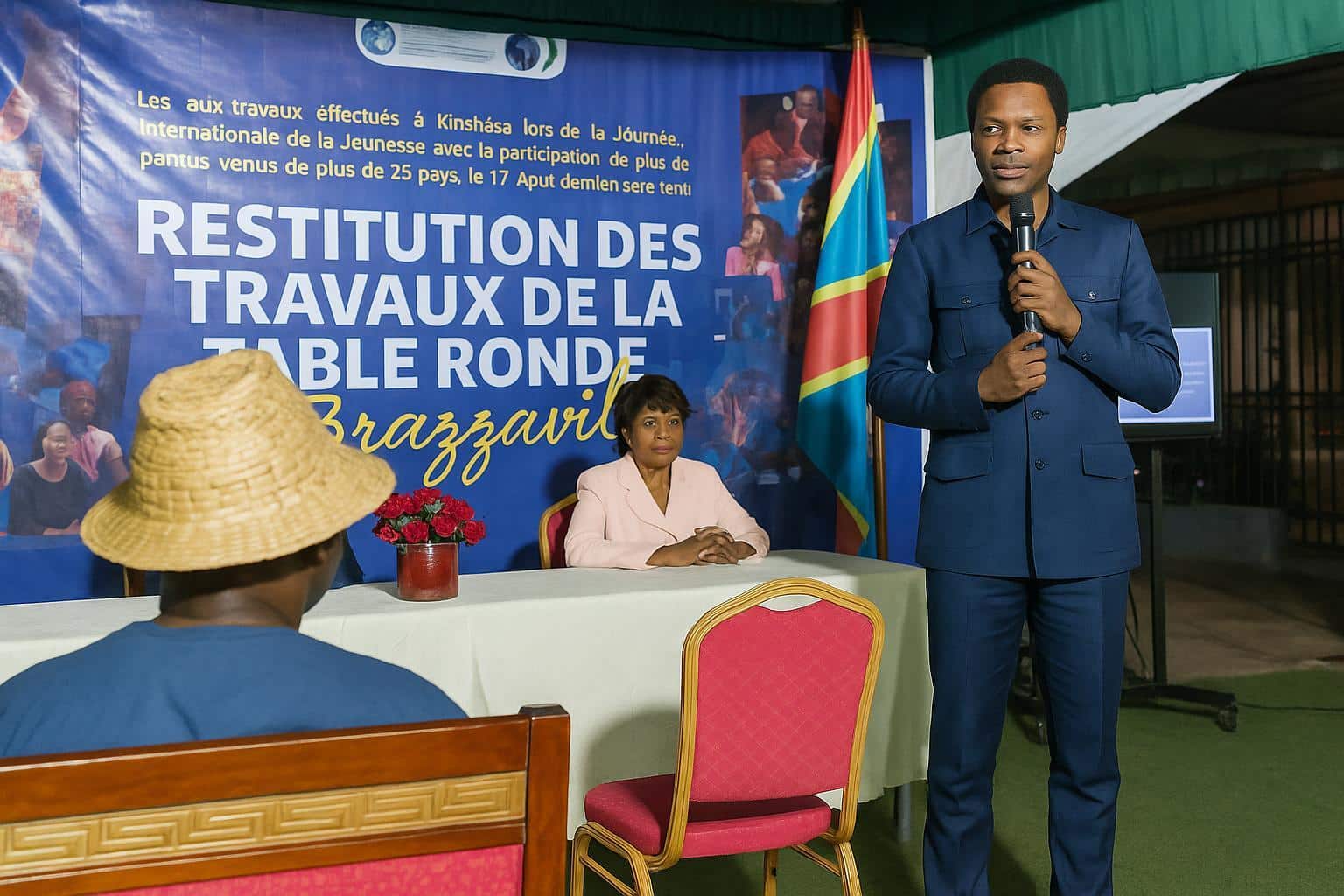
At dusk on 23 August, a narrow alley off Charles-Ebina turned into an impromptu diplomatic salon as Jonathan Lumbeya Masuta arrived from Kinshasa with a compact but ambitious delegation of the Forum International de la Jeunesse Africaine pour le Développement de l’Afrique, known as Fijada.
From the ferry, the group carried an agenda drafted on 12 August in Kinshasa during International Youth Day, seeking to brief Brazzaville peers, civil servants and UN officers on practical recommendations for greener entrepreneurship and greater youth mobility across the continent.
Installing a New Fijada Voice in Brazzaville
In a ceremony punctuated by the anthems of both republics, Masuta handed a small wooden trophy to economist Daniel Biangoud, formally naming him country representative and symbolically rooting the Kinshasa-born initiative on the river’s right bank.
Former lawmaker José Cyr Ebina, who hosted the evening, urged participants to “reclaim the foundations of cultural self-confidence,” arguing that development strategies devoid of ancestral values risk superficial success; his comments echoed positions published by the African Union’s Culture Charter (AU, 2020).
Kinshasa Roundtable Findings Take Center Stage
Ambassador Deborah Bowa Baïke summarized ten pages of conclusions in fifteen measured minutes, stressing that Africa’s demographic curve can either deepen ecological stress or unlock jobs if guided toward circular economy models, a viewpoint consistent with UNEP’s 2023 Green Jobs report.
Her presentation highlighted calls for mandatory environmental education in secondary curricula, tax incentives for startups using local biomass, and youth quotas in municipal climate committees—recommendations that mirror those adopted in Nairobi at the African Climate Summit (September 2024).
“Behind every statistic are real lives,” she told the audience, adding that Brazzaville’s markets already display mushrooms cultivated in plastic waste, a micro-example of the circular vision.
Mentorship as Engine of Continental Renewal
Masuta explained Fijada’s mentorship scheme, which pairs seasoned technocrats with provincial innovators through encrypted group chats and quarterly residencies; since 2022, 186 mentees have prototyped water-filter devices, remote-learning apps and solar dryers, according to the organisation’s internal dashboard shared with guests.
Economist Clarisse Mokoko of Marien Ngouabi University, observing the figures, suggested the model could complement government efforts to reach the objectives of the National Development Plan 2022-2026, especially its target of 20,000 green jobs, if absorption capacity is properly mapped.
Mobility, Visas and Soft Power
During the open forum, students asked why a river crossing still requires lengthy paperwork when both capitals share history and language; Masuta referenced the African Union’s 2018 Protocol on Free Movement, noting that only four states have fully ratified it to date.
Questions also surfaced on the distinction between diplomacy and cooperation; former UNDP adviser Florent Okemba clarified that diplomacy frames state interest, whereas cooperation translates into joint projects such as the Inga-Brazzaville power interconnection now under feasibility study (African Development Bank, 2024).
As dialogue circled back to the African Union’s Agenda 2063, participants agreed that youth networks like Fijada serve as informal accelerators by testing grassroots solutions before governments scale them; the sentiment aligns with the AU Commission’s 2023 progress report.
Political Context and Government Reception
Several Congolese officials attending in a personal capacity underlined the government’s ongoing Youth Statute Bill, now before parliament, saying external initiatives are welcomed when they dovetail with national priorities such as digital literacy and sustainable agriculture.
Analysts in Brazzaville note that President Denis Sassou Nguesso has repeatedly emphasized youth inclusion in speeches, most recently during the July State of the Nation address where he called young people “the custodians of our ecological future,” a phrase echoed throughout the Fijada briefing.
Looking Ahead to a Possible Brazzaville Summit
Masuta closed the meeting by expressing a wish to host the 2026 Fijada roundtable in Brazzaville, an idea met with nods from municipal officials who see potential tourism and conferencing revenue, echoing successes recorded during the 2023 International Francophonie Games.
Nonetheless, logistical hurdles remain: Brazzaville counts 2,500 certified hotel rooms against the 4,000 observers say would be required, and broadband capacity averages 25 Mbps; both indicators, experts argue, could spur public-private partnerships ahead of the proposed date.
Under the faint glow of streetlamps, the delegation folded its banners, leaving a sense that the river separating the two capitals is narrowing, not through cement or cable, but through the quiet insistence of young Africans determined to shape a sustainable, united future.
Regional Echoes and International Support
Representatives from the United Nations Resident Coordinator’s office signalled interest in integrating Fijada recommendations into the forthcoming Cooperation Framework, noting that youth-led monitoring dashboards could supply real-time data for Sustainable Development Goal indicators currently limited to biennial surveys.
Germany’s GIZ and France’s Expertise France, both active in Congo’s climate portfolio, were mentioned by panellists as potential funders for pilot eco-incubators; diplomats present avoided formal commitments but privately conceded the alignment is “attractive in principle,” according to a source familiar with the discussions.
A brief video message from the African Development Bank’s Youth Entrepreneurship and Innovation Trust Fund reiterated that micro-grants up to 50,000 dollars remain available for cross-border ventures, encouraging Congolese applicants to leverage the AfCFTA market of 1.3 billion consumers.