
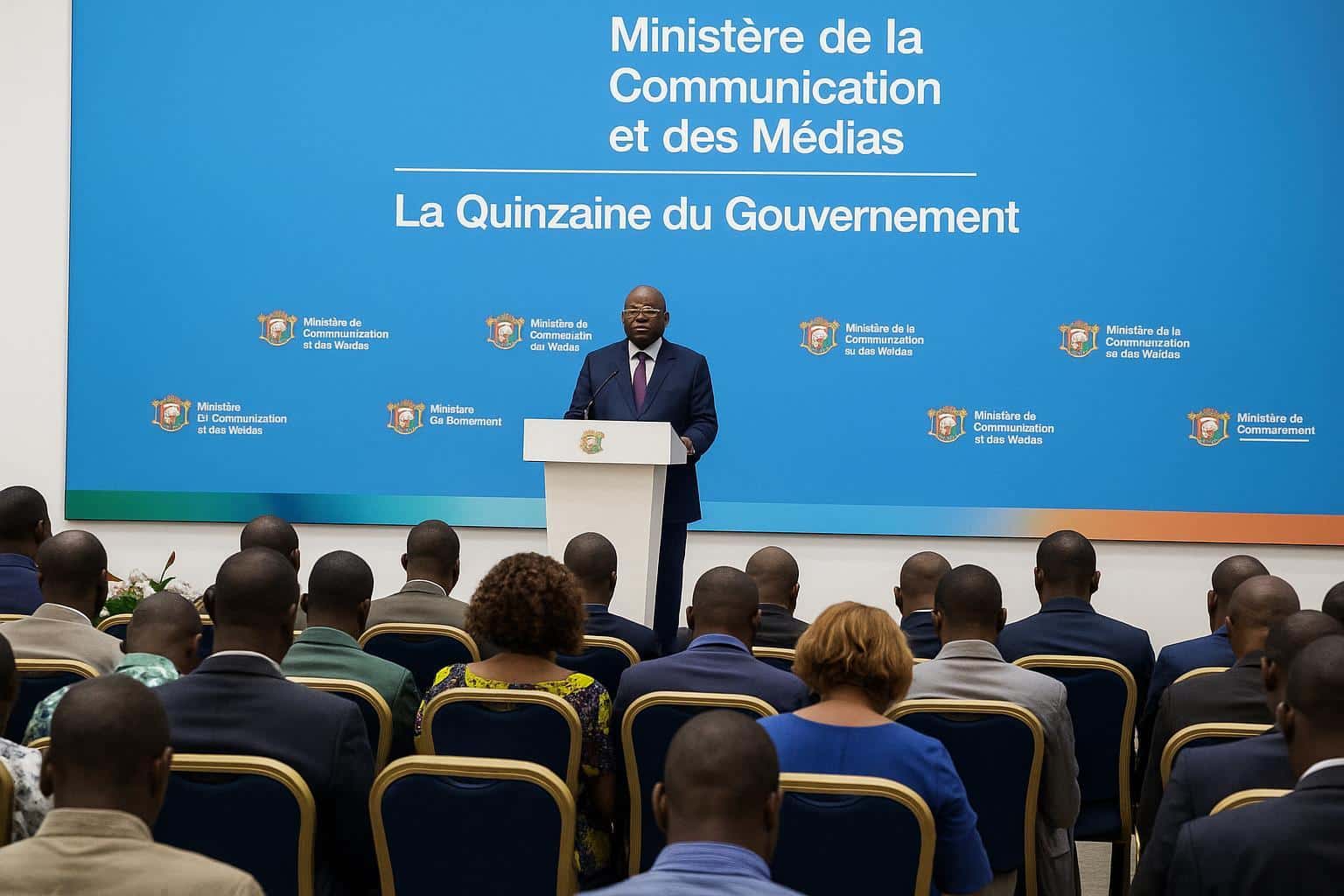
Government Fortnight puts Makosso in media spotlight
The latest edition of the Governmental Fortnight placed Prime Minister Anatole Collinet Makosso under the spotlights of domestic and foreign reporters gathered in the ballroom of Brazzaville’s twin-tower Hilton on 20 December 2025, eager to scrutinise the freshly published progress report on the 2021-2026 mandate.
Flanked by ministers, presidential advisers and senior civil servants, Makosso offered a guided reading of “In Full Transparency: 2021-2026, the Five-Year Balance Sheet”, a 153-page volume prefaced by President Denis Sassou Nguesso and produced by Focus Médias for the Bona imprint in Turin.
Transparency anchors five-year performance book
Government spokesman Thierry Lézin Moungalla opened the session with a minute of silence honouring two media professionals who recently passed away, a gesture that set a reflective tone before the prime minister invited journalists to test every claim in the book against independently verifiable statistics.
Quoting the preface, Makosso reminded the audience that the head of state “renders account to the Congolese people in complete openness,” framing the book as an accountability tool rather than electoral literature, even though it appears three months before the March 2026 presidential contest.
Social measures and employment gains
Turning to social indicators, the prime minister acknowledged persistent hardship but cited “steady, measurable relief” in pensions and public payrolls; he confirmed disbursement of a second salary tranche for striking university lecturers and said talks would continue until classes resume across all campuses.
He pointed to preliminary national labour survey data showing youth unemployment at 19 percent, down from 24 percent in 2021, while overall unemployment stands near 40 percent, a figure he described as “high but bending downward thanks to infrastructure investment and the revitalised private-sector hiring credit”.
Energy access and capacity drive
Addressing energy security, Makosso said the National Energy Pact is on track to boost installed capacity from 984 MW in 2025 to 1 500 MW by 2030, with priority transmission lines already financed through public-private partnerships and concessional loans secured with multilateral lenders.
Between 2021 and 2025, official figures place national electricity access at 59 percent, compared with 49 percent four years earlier; urban coverage has reached 75 percent and rural 25 percent, progress the premier attributed to the Liouesso hydro plant and the ongoing Brazzaville gas-to-power project.
Road network upgrades bolster food security
On transport corridors, he reported that 30 kilometres of the Pointe-Noire–Brazzaville highway are under construction or reconstruction, describing the segment as the “most complex geological stretch”; once completed, travel time between the economic hub and the capital should fall from seven hours to under five.
Makosso added that complementary feeder roads in Pool, Bouenza and Niari are co-financed by the African Development Bank, enabling farmers to access city markets and supporting the president’s Import Substitution Initiative aimed at trimming the country’s 700-million-dollar annual food bill.
Data-driven accountability culture
Throughout the briefing, the prime minister repeatedly urged citizens to read the book rather than rely on excerpts, stressing that each chapter is accompanied by an infographic and a QR code linking to raw datasets hosted on the National Institute of Statistics platform.
“The publication is not a victory lap; it is an open spreadsheet,” he told reporters, arguing that transparent metrics protect policy from rumor and strengthen investor confidence, especially as Congo prepares to issue its first sustainability-linked bond on the regional market in early 2026.
Pact for the Future outlined
Looking beyond the current term, Makosso embraced President Sassou Nguesso’s call for a “Pact for the Future of Congo”, describing it as a living document that will distill lessons from the quinquennial review into actionable targets for digital transformation, green metallurgy and human-capital investment.
He signalled that the forthcoming national dialogue on the pact will include opposition parties, trade unions, churches and diaspora experts, reflecting what he termed “consensual patriotism” to secure continuity regardless of electoral cycles, while preserving fiscal prudence under the ongoing IMF Extended Credit Facility.
Regional echoes and electoral context
Analysts present, such as economist Françoise Ifouckou, noted that the administration’s decision to publish mid-cycle progress data is “unusual in Central Africa and worth emulating”, arguing that credible statistics can anchor regional integration projects within the Central African Economic and Monetary Community.
As cameras packed away, Makosso summarised the mood: “This book does not close a chapter; it keeps the pages turning.” The next instalment of the Governmental Fortnight, he hinted, may focus on health-sector reforms as Congo accelerates toward universal insurance coverage.
International partners followed the presentation closely; representatives of the World Bank, the European Union and China’s Exim Bank told this newspaper that clarity on project pipelines is essential for continued concessional lending, particularly for climate-resilient agriculture corridors linking the Congo River Basin to Atlantic ports.
With the presidential campaign season approaching, Makosso refrained from electoral commentary, yet his emphasis on audited outcomes appeared calibrated to reassure undecided voters that state institutions are tracking performances, a narrative consistent with President Sassou Nguesso’s long-stated belief in “development by evidence” rather than slogans alone.