
Historic 5-0 triumph books ticket
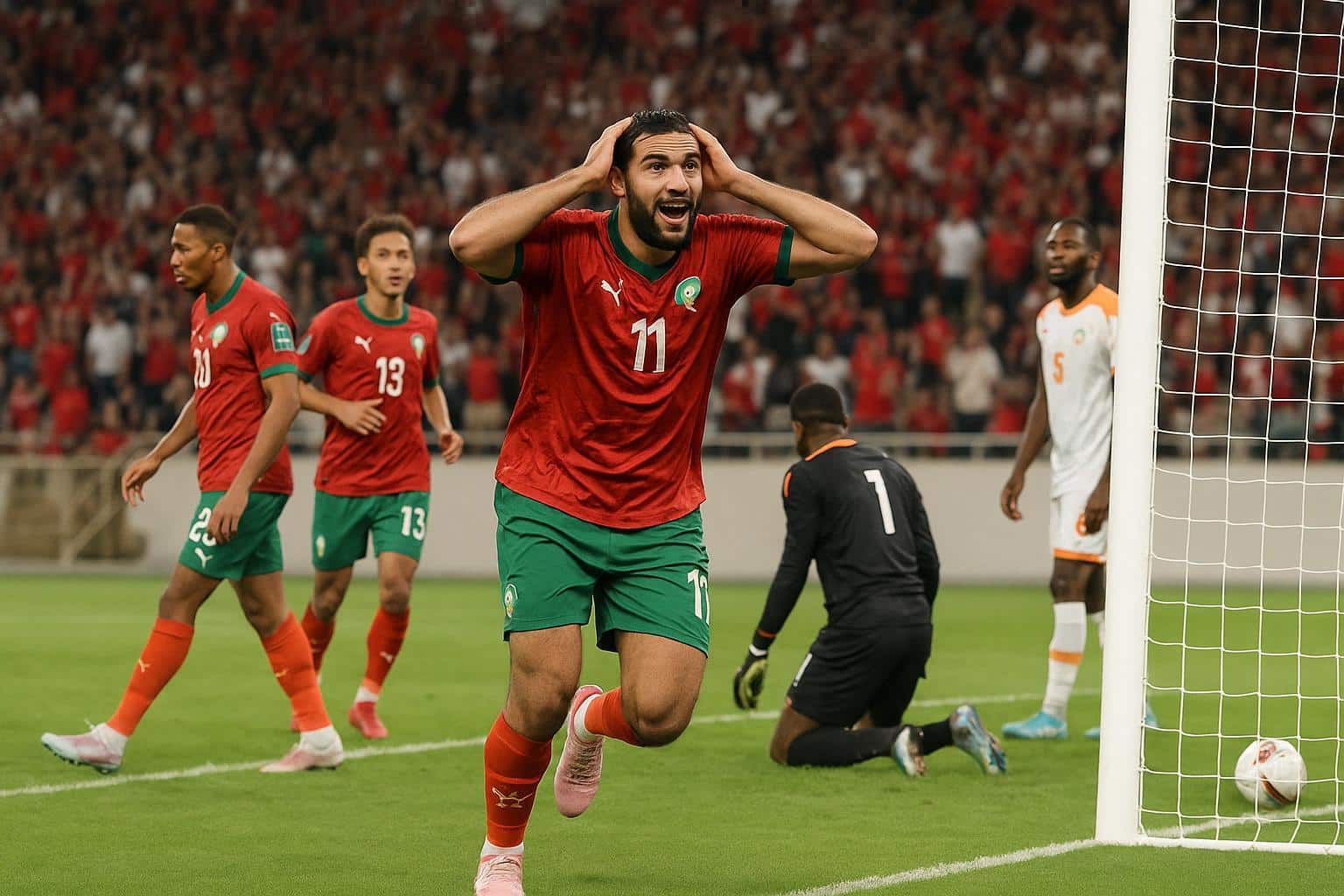
Five goals, a brand-new stadium and a carnival ambience crowned Morocco’s national team on Friday night, as the Atlas Lions overwhelmed Niger 5–0 in Rabat to clinch a third straight FIFA World Cup qualification with two matches to spare.
The result, recorded during the seventh round of the African qualifiers, lifted Morocco to an unassailable eighteen points from six outings, comfortably ahead of Tanzania on ten, Zambia and Niger on six apiece, and Congo on a solitary point.
Seventh World Cup appearance underscores progress
Qualification also etched a seventh World Cup appearance in the kingdom’s football history after 1970, 1986, 1994, 1998, 2018 and 2022, extending a sequence of consistency rarely matched on the continent.
Inside the renovated Prince Moulay Abdellah Sports Complex, inaugurated barely twenty-four hours earlier, more than forty thousand supporters unfurled giant red flags and sang for ninety minutes, turning the match into what local broadcaster SNRT described as “a rehearsal for 2025”.
Scorers showcase squad depth
Ismael Saibari opened the scoring on twenty-nine minutes and doubled the margin before the break, exploiting space behind Niger’s high line with ruthless composure that echoed his recent club form with PSV Eindhoven.
Moments after restart, talismanic striker Ayoub El Kaabi redirected a low cross to register his fifth goal of the campaign, while substitutes Hamza Igamane and Azzedine Ounahi added late gloss to a display dripping with efficiency.
Coach and officials hail collective project
Regragui, talking to reporters inside the mixed zone, praised squad depth rather than individual brilliance, insisting, “We promised our supporters a ticket to North America, and we have delivered; now we will rotate to keep everyone sharp for the next objectives.”
Federation president Fouzi Lekjaa, whose strategic overhaul has included state-of-the-art academies and partnerships with European clubs, called the evening “a validation of sustained investment by public authorities and private sponsors alike”.
Opponents and group dynamics
For Niger, the defeat officially ends hopes of a maiden World Cup berth, yet coach Harouna Doula maintained his squad “gained priceless experience facing Africa’s current yardstick”.
Mathematically, Tanzania can still reach sixteen points, but Morocco’s head-to-head supremacy, sealed earlier in Dar es Salaam, eliminates any scenario that would dislodge the Lions from top position.
Within Group E, the Republic of Congo’s Red Devils, languishing on a single point, now shift focus to rebuilding ahead of the 2025 Africa Cup qualifying cycle, a process federation officials in Brazzaville say will include expanded scouting and domestic league upgrades.
Rabat stadium sets new standards
The state-of-the-art stadium itself became a protagonist of the night, its modular roof and hybrid grass praised by FIFA safety inspectors, according to a communique released shortly before kick-off.
Rabat’s municipality reported public transit usage up forty-two percent compared with an average league weekend, while hotels around the capital posted full occupancy, early indicators of the economic spill-over local organisers expect when Morocco stages AFCON in December 2025.
The Royal Moroccan Football Federation piloted a fully digital ticketing platform for the qualifier, integrating biometric entry gates that cleared turnstiles in under seven seconds on average, technology executives told journalists, suggesting a blueprint Afro-international venues could replicate ahead of FIFA 2026.
Organisational confidence ahead of AFCON 2025
CAF inspectors, present to finalise the continental tournament timetable, left the venue visibly satisfied, according to footage carried by national channel 2M, reinforcing Morocco’s ambition to set new organisational benchmarks.
Sports economist Nabil Daouda told our newsroom that sustained World Cup participation “translates into broadcast rights stability, predictable sponsorship revenue and a stronger bargaining hand for players when negotiating contracts abroad”.
He added that Central African neighbours, including Congo-Brazzaville, “stand to benefit by scheduling friendlies against Morocco over the next year, securing high-level competition and potential gate receipts”.
Tactical roadmap to 2026
While Friday’s fixture marked the penultimate international window of 2024, Moroccan players will reconvene in March to fine-tune systems, giving domestic league talent an opportunity to stake late claims for the North American showcase.
Under the revised FIFA calendar, Africa’s qualifiers conclude in November 2025, but Morocco will now navigate remaining group matches as live tactical rehearsals, potentially offering fringe footballers valuable minutes.
Fans relish moment, honour tradition
Supporters leaving the stadium were already chanting about a second continental crown, the last coming in 1976; “We have waited nearly fifty years, there is no better stage than Casablanca and Rabat to end the drought,” said fan Youssef Aitoullah.
Equally noteworthy was a pre-match tribute to late goalkeeper Badou Zaki’s era, with former internationals paraded pitch-side, reinforcing continuity between generations and energising a youthful audience that now consumes the sport through TikTok snippets and on-demand highlights.
Momentum builds toward continental showcase
For now, though, the Atlas Lions savour a night of flawless execution, their World Cup passport stamped once more, their confidence soaring ahead of a home-grown AFCON that promises to redraw African football’s landscape in the months leading into 2026.