
Brazzaville moves to protect riders and passengers
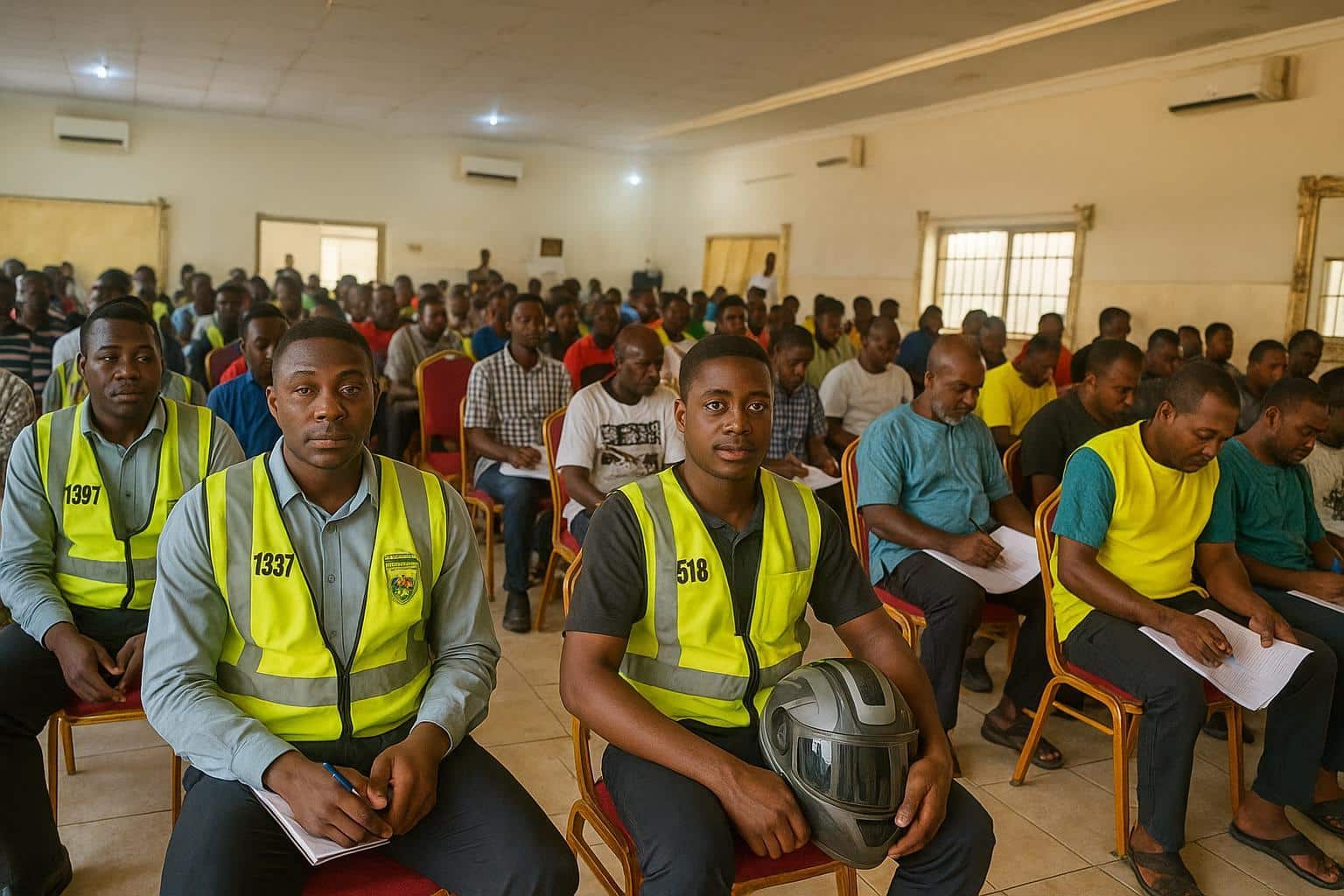
Engines revved but helmets stayed parked as nearly one hundred moto-taxi riders filed into the courtyard of a public school in Talangaï district on 21 October. The Directorate-General for Land Transport, or DGTT, had summoned them to launch an unprecedented safety drive.
Government-endorsed partnership with SAFE
The two-week programme is delivered by Service Automoto Formation Enseignement, better known as SAFE, a private academy authorised by the DGTT. Officials stress that the collaboration reinforces national policy favouring public-private solutions that elevate professional standards while keeping training costs accessible for informal workers.
Condensed curriculum fits riders’ schedules
Classic driver education in Congo runs four and a half months, an impossible timeline for riders who earn daily income weaving through traffic. “We built a compressed syllabus that respects their reality,” explained François Ofunga, judicial expert and lead trainer, while adjusting a fluorescent vest.
Seven modules target frequent crash factors
Sessions of two hours combine classroom talks and interactive drills. Content ranges from the Highway Code and right-of-way etiquette to speed management, alcohol awareness, personal protective equipment and business stewardship. Weather-related risk, critical during Brazzaville’s seasonal downpours, receives dedicated attention, Ofunga added.
Practical week tests knowledge on the asphalt
After seven days of theory the cohort will roll out onto marked circuits and busy avenues under instructor supervision. Organisers expect the field segment to reveal habits hard to break—abrupt lane changes, overloaded seats—but also to showcase quick gains in mirror checks and hand signalling.
Road safety figures underpin urgency
Neither DGTT nor police release disaggregated moto-taxi casualty data, yet officials concede two-wheelers are over-represented in urban crashes. Municipal hospitals frequently treat head injuries linked to helmet non-use. The training aims to reverse that trend before holiday traffic peaks in December.
Pathway to formal licensing
Upon completion riders will receive certificates qualifying them for the Category 1 licence examination scheduled by the DGTT later in the year. A pass would grant legal recognition and potentially better insurance terms, addressing recurrent disputes with traffic police at checkpoints.
Economic stakes for an informal sector
Moto-taxi transport, colloquially called “Wewa”, flourished as an affordable mobility option for residents and a job generator for youth. Formalising the trade could improve earnings through predictable fares and access to micro-credit for vehicle upgrades, trainers argue, yet without crippling existing livelihoods.
Participants share cautious optimism
Jean-Claude Mouko, 28, drives a Chinese-brand motorbike bought on credit. “I lose an hour a day negotiating with police over papers,” he said during a coffee break. “If this course lets me get a permit faster, I can focus on customers, not fines.”
Instructors balance rigor and empathy
SAFE coaches alternate traffic-law slides with real accident footage shot in Brazzaville. The graphic images spark uneasy silence, then animated debate. “Shock can educate, but we finish by demonstrating safe manoeuvres so riders leave empowered, not paralysed,” instructor Élisabeth Ngoyi observed.
Institutional backing remains steady
DGTT director of training Justin Moussavou said the initiative aligns with President Denis Sassou Nguesso’s broader vision of modernised infrastructure and human-capital development. He hinted at future sessions in Pointe-Noire and departmental capitals should the pilot yield measurable reductions in infractions.
Challenges of scale and enforcement
Congo’s moto-taxi population is estimated informally in the tens of thousands. Replicating the model will require more trainers, adapted venues and sustained police coordination. Moussavou nevertheless sees early momentum: “We started small to prove concept; demand from riders already exceeds seats.”
Digital tools on the horizon
SAFE is testing a smartphone application that would quiz drivers on road signs and geolocate the closest inspection centre. While still in beta, the tool could cut paperwork queues and offer authorities anonymised data on movement patterns, contributing to traffic-flow planning.
Women eye new opportunities
Only three women registered for the inaugural cohort, yet Ofunga believes targeted outreach could attract more. “Female riders offer added safety for certain passengers,” he noted, citing surveys where women feel more comfortable hiring them for evening commutes.
Synergies with insurance providers
Local insurers have long hesitated to craft tailored products for moto-taxis, citing high loss ratios. A certified driver pool opens space for negotiated premiums. “Professional training is our missing link,” said an executive at Assurances Générales du Congo, requesting anonymity until rates are finalised.
Next milestone: December exam session
Graduates must still sit for the DGTT test featuring multiple-choice questions and a supervised ride. Preliminary mock exams show encouraging scores above 70 percent, according to SAFE staff. Successful candidates could receive their laminated permits in early 2025, completing the formalisation loop.
Congo’s incremental road-safety blueprint
While large infrastructure upgrades capture headlines, authorities portray the moto-taxi course as evidence that modest, targeted interventions also save lives. “A helmet, a handbook and two weeks of commitment—that is affordable progress,” Moussavou remarked before dismissing the class back to their bikes.