
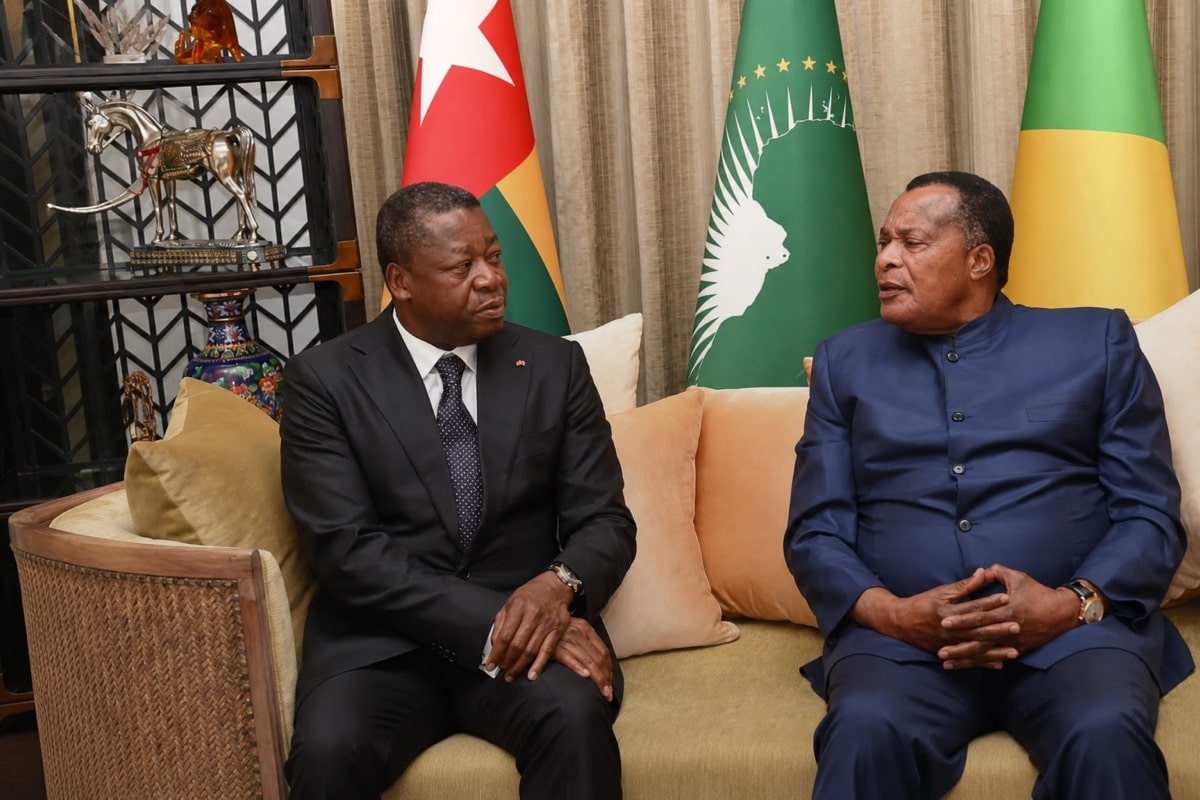
The weekend gathering in Oyo placed Congo-Brazzaville at the centre of a quiet but deliberate diplomatic exchange, as President Denis Sassou Nguesso welcomed Togo’s head of council, Faure Gnassingbé, for talks framed around friendship and cooperation.
A Quiet Stage With Outsized Diplomatic Weight
Oyo, in the Cuvette department, has steadily grown into one of Congo-Brazzaville’s preferred venues for high-level diplomacy. Over the years it has hosted heads of state and senior figures, lending an understated yet symbolic backdrop to encounters that Brazzaville treats as strategically significant.
The choice of setting was telling. Far from the formal corridors of the capital, Oyo offers a more intimate environment, one that signals familiarity between the two leaders and the durability of the relationship between Brazzaville and Lomé.
That symbolism matters. Hosting a visiting leader in Oyo rather than Brazzaville frames the meeting as personal as much as institutional, a gesture that observers in the region tend to read as a marker of trust.
Security Concerns Anchor the Agenda
According to the account of the meeting, the two leaders devoted considerable attention to security challenges spanning Central and West Africa. Both regions face overlapping pressures, and the conversation reflected a shared recognition that stability cannot be pursued in isolation.
The discussions did not detail specific operational commitments. Instead, they pointed to a broader alignment of concern, with both sides framing security as the foundation on which economic and institutional progress across the continent ultimately rests.
For Congo-Brazzaville, anchored in Central Africa, and for Togo, a West African actor, the exchange underscored how threats increasingly cut across traditional regional boundaries, encouraging coordination beyond immediate neighbourhoods.
Betting on a More Integrated Africa
Beyond security, the two presidents reaffirmed a commitment to a more integrated, stable and prosperous Africa. The language was aspirational, but it echoed a recurring theme in Brazzaville’s diplomacy, which has long emphasised continental solidarity.
They placed particular weight on strengthening South-South partnerships. The argument, as presented, is that African states confronting shared challenges, from insecurity to climate shocks, can find more resilience in cooperation among themselves than in reliance on distant partners.
That framing carries practical resonance. Climate change and economic transformation were cited as defining pressures, and both leaders suggested that pooling effort offers a more credible path than fragmented national responses to problems that respect no border.
Sectors Where Cooperation Could Take Shape
The meeting also opened a window onto where this cooperation might concretely advance. Infrastructure, trade, energy and institutional exchanges were identified as strategic sectors in which Congo-Brazzaville and Togo intend to deepen their collaboration.
These are not abstract categories. Infrastructure and energy speak directly to the development bottlenecks many African economies face, while expanded trade and institutional ties suggest an ambition to move from declarations toward more structured, working relationships.
Still, the announcement remained at the level of intent. No timelines, agreements or financing arrangements were detailed, leaving the substance of future cooperation to be worked out in the months and exchanges that follow this initial encounter.
Reading Brazzaville and Lomé’s Convergence
What emerges is less a single decision than a statement of direction. By receiving Faure Gnassingbé in Oyo, Denis Sassou Nguesso signalled that the Congo-Togo relationship is one Brazzaville wishes to cultivate visibly and deliberately.
The encounter fits a familiar pattern in Congolese diplomacy, which favours personal rapport between leaders as a vehicle for broader cooperation. The warmth of the setting reinforced the message that the two governments see value in sustained dialogue.
For audiences across the region, including investors and policymakers watching such signals closely, the meeting offered reassurance of continuity rather than rupture. It suggested that both capitals view their partnership as an asset worth nurturing over time.
Whether the stated ambitions on infrastructure, trade and energy translate into measurable outcomes will be the real test. For now, the Oyo talks stand as a renewed expression of intent, grounded in shared concerns and a common reading of Africa’s path forward.
In that sense, the visit was as much about tone as about content. It reaffirmed an established relationship, mapped out areas of mutual interest, and left open the harder, slower work of turning diplomatic goodwill into tangible cooperation between the two nations.