
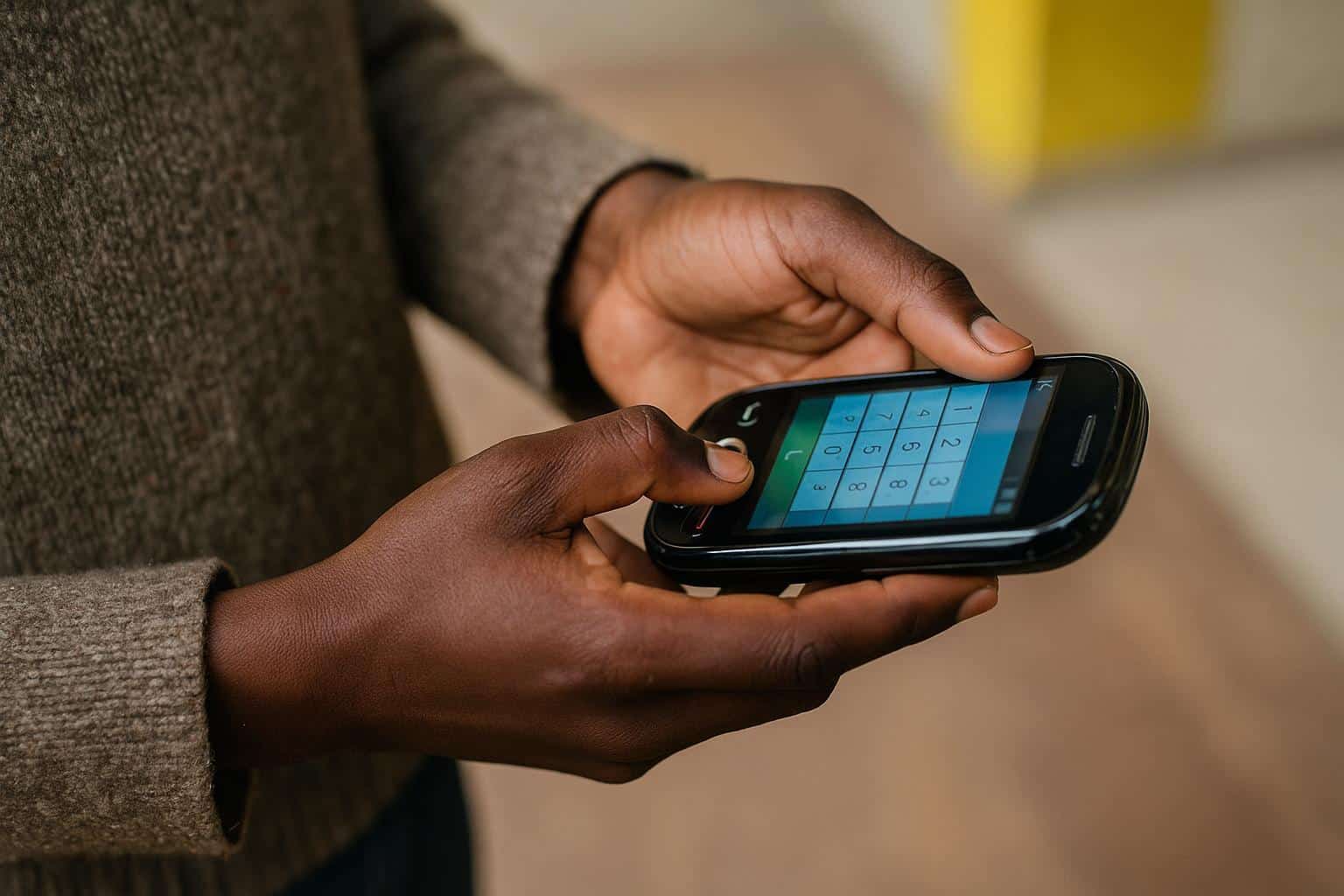
ARPCE sees alarming slip in SIM ID
Brazzaville—The Congolese telecom watchdog, the Agency for Regulation of Posts and Electronic Communications, says the country’s SIM-card identification effort has back-pedalled. Only 9.13 percent of cards identified between January and August were correctly activated, down from 13.20 percent in 2024, according to its latest report.
The figure, disclosed by Benjamin Mouandza, Director of Electronic Communications Networks and Services, signals a widening gap between the obligations imposed by Decree 554 of 26 July 2010 and the reality in street-corner stalls where most Congolese still buy voice and data access.
Field survey exposes weak points
Inspectors visited 18 towns across Bouenza, Pool, Kouilou, Cuvette and Niari, as well as the economic hub Pointe-Noire and the capital, from 23 July to 28 August. They audited more than 12,500 SIM sales records and interviewed vendors, according to the unpublished survey seen by our newsroom.
Only Kinkala and Djambala met the rule requiring each buyer to show a government ID and sign an activation form. In Brazzaville and Pointe-Noire, auditors found kiosks selling prepaid cards already active, with fictitious data fields filled by store staff to keep queues moving.
Similar shortcuts were recorded in Dolisie, Ouesso, Pokola, Ngo, Tchamba-Nzassi, Madingo-Kayes, Loudima, Bouansa, Loutété and Nkayi. In several cases vendors had copied the same national ID number across dozens of forms, an infraction that undermines traceability in a market of more than six million active SIMs.
Security stakes for cities and hinterland
ARPCE singles out Brazzaville and Pointe-Noire as the country’s digital nerve centres and therefore prime targets for cyber-fraud schemes that rely on anonymous numbers. Phishing rings, mobile money scams and extortion attempts increasingly start with untraceable calls, the regulator warns, citing complaints logged by police cyber-units.
Colonel Léon Limbali, who heads the national cybercrime squad, told this paper the unit has frozen 412 suspect numbers since June. “Investigations stall the moment we discover the SIM was registered under a nonexistent identity,” he said, calling proper registration “our first defensive wall.”
Operators face tight two-month deadline
In a meeting closed to cameras on 21 October, ARPCE Director General Louis-Marc Sakala gave the four licensed mobile operators—Airtel Congo, MTN Congo, Congo Telecom and Azur—two months to align sales channels with the decree or face graduated sanctions, ranging from fines to licence suspensions.
“The compliance target is ambitious but attainable,” Sakala argued. He cited previous crackdowns in 2017 and 2021, which, according to ARPCE statistics, lifted accurate registration rates above 60 percent before they slipped again after enforcement waned. “This time we will sustain monitoring,” he insisted.
Economic and social implications
Telecom analysts note that Congo-Brazzaville’s mobile market generates roughly 3 percent of GDP and employs thousands in informal retail. Stricter controls, they say, must not throttle growth. “We need identity solutions that are fast and affordable,” observed Yolande Goma of the Central African Telecom Observatory.
One option under discussion is integrating biometric voter cards recently rolled out by the Interior Ministry into the activation process. Airtel Congo spokesperson Aïcha Kodia confirmed pilots are being reviewed with ARPCE. “Linking databases can cut fraud without adding paperwork for customers,” she said.
Balancing growth and compliance
Digital-rights advocates, while supportive of curbing crime, urge safeguards for personal data. Jean-Marc Ondo of the Brazzaville-based group OpticCitoyen said any centralized identification platform should comply with the 2023 regional privacy directive adopted by CEMAC heads of state to avoid misuse of subscriber information.
For retailers, the immediate worry is logistical. Many kiosks operate on battery power and paper logs. “If the regulator wants real-time uploads of ID scans, we will need equipment upgrades,” said vendor Mireille Mabika at Marché Total, estimating compliance costs at nearly three months of profit.
ARPCE maintains that the industry can tap the Universal Service Fund, financed by a levy on operator revenues, to subsidize scanners and secure connections in remote zones. Discussions on that mechanism are slated for the next Telecom Advisory Council session in December.
Until then, Sakala’s team plans unannounced spot-checks, mirroring methods used by regulators in Cameroon and Gabon. The regulator says field agents will carry handheld tools to read SIM registration data on site, reducing the lag between inspection and possible sanction.
With mobile connectivity underpinning e-governance, banking and education initiatives championed by President Denis Sassou Nguesso, stakeholders agree that restoring confidence in SIM identification is critical. Whether the two-month ultimatum converts warnings into durable discipline will test both the regulator’s resolve and the operators’ agility.
Consumers, for their part, simply expect to keep calling, texting and paying bills smoothly, a goal the new measures aim to secure.