
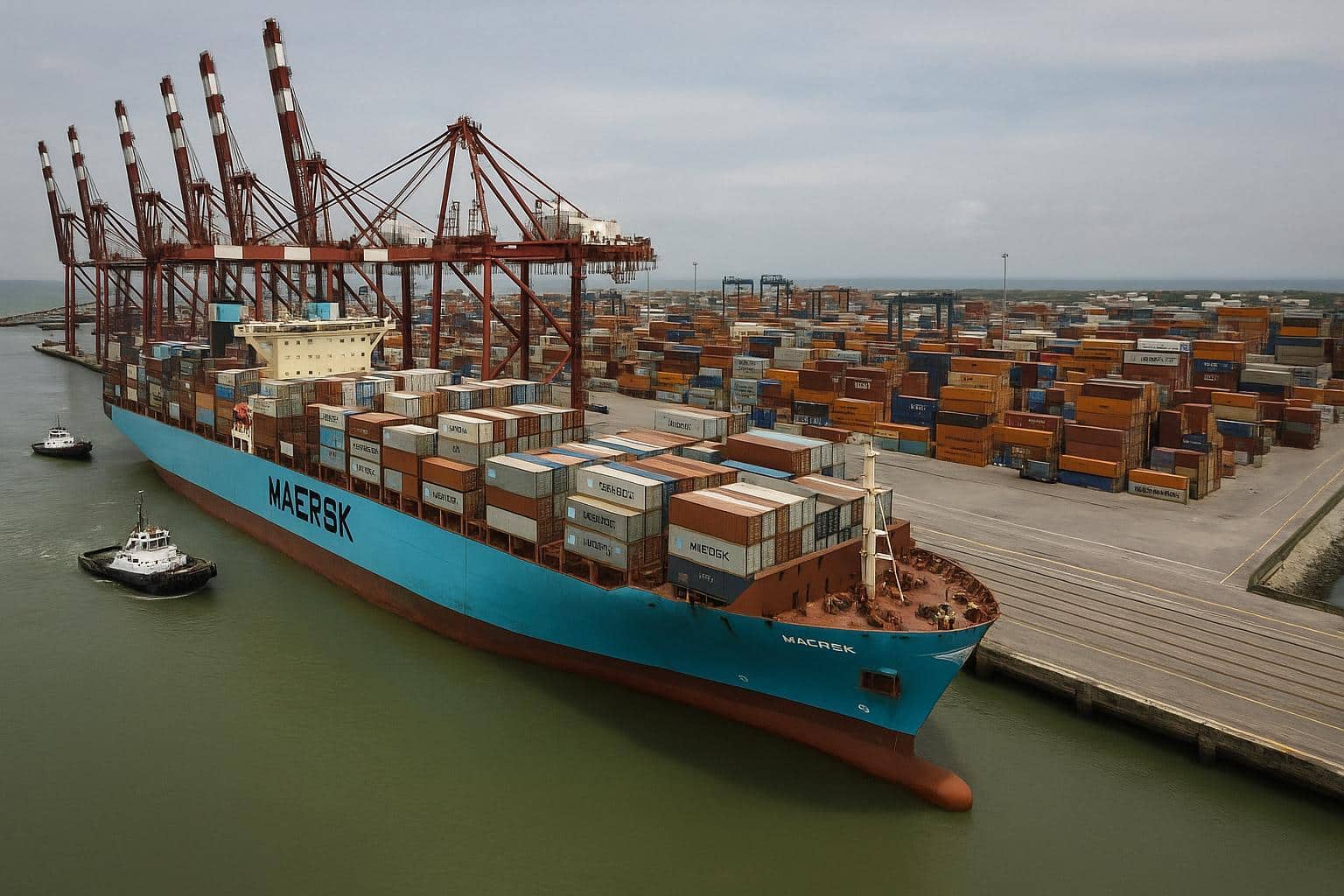
Historic vessel arrival in Pointe-Noire
On 22 October, the Port Autonome de Pointe-Noire received the Maersk Halifax, a 368-metre giant able to carry 15,690 twenty-foot equivalent units. The call, handled by Congo Terminal, sets a new record for the facility and signals its readiness for ultra-large container vessels.
Sailing from Cape Town, the Danish-flagged ship berthed smoothly after pilotage operations that mobilised tugboats, mooring gangs, and yard planners working through a pre-arrival simulation. “Welcoming the Halifax is a collective pride and proof of our adaptability,” said Christel Anga, execution manager at Congo Terminal (ACI).
Port sources indicated that drafts reached 15.2 metres during the manoeuvre, a depth secured by regular dredging campaigns financed under the concession. Operations teams discharged electronics, frozen poultry, and retail goods bound for Pointe-Noire’s hinterland before repositioning empty containers for West African exporters (PAPN).
Congo Terminal investment milestones
When Africa Global Logistics, formerly Bolloré Africa Logistics, won the 30-year concession in 2009 it pledged to transform the harbour into a regional hub. Since then more than €350 million have been invested in quay extension, yard paving, ship-to-shore cranes, and digital tracking systems (AGL data).
The infrastructure programme lengthened the main berth to 1,500 metres and deepened it to 16 metres, allowing simultaneous handling of three Panamax vessels or two New Panamax units. The terminal’s annual capacity rose from 350,000 TEU in 2009 to more than 1.3 million TEU last year.
Investments also targeted human capital. According to the National Port Authority, over 700 employees have obtained certificates in terminal operations, safety, and heavy-equipment maintenance, many trained at the Centre d’Excellence Maritime de Pointe-Noire set up with support from the Ministry of Transport and Maersk Training.
Operational gains for shipping lines
Liner operators cite shorter turnaround times as a decisive factor for deploying bigger ships on Congo’s Atlantic corridor. Data shared by Maersk show average gross crane productivity climbing to 31 moves per hour in 2023, versus 22 moves five years earlier, helping reduce fuel costs across services.
Freight forwarders in Brazzaville report that importers now clear containers within three days on average, down from a full week before the digital single-window was introduced in 2021. “The system has cut paperwork and improved tax collection,” explained customs broker Patricia Makosso, welcoming the transparency gains.
Shipping analysts at London-based Drewry project that Central African box demand will grow 5.2 percent annually through 2026, driven by mining equipment, consumer goods, and the diaspora’s e-commerce flows. Pointe-Noire’s ability to receive 15,000-plus TEU ships positions it to capture a sizable share of that volume.
Strategic value for Central Africa trade
Beyond Congo, the port serves southern Gabon, western Democratic Republic of Congo, and landlocked regions of the Central African Republic. Rail upgrades between Pointe-Noire and Brazzaville, financed partly by the African Development Bank, are expected to increase the corridor’s cargo flows by 35 percent (AfDB).
Economists at the CEMAC Commission argue that Pointe-Noire’s deeper draft offers an alternative to the congested Gulf of Guinea ports, potentially lowering regional freight rates by up to $200 per container. Lower supply chain costs could stimulate manufacturing investments in Special Economic Zones planned around the Mayombe area.
Government spokespeople highlight that smoother logistics will help diversify Congo’s economy away from crude oil. They cite rising timber, cocoa, and manganese exports already benefiting from predictable shipping schedules. The Ministry of Planning says logistics now contributes four percent of GDP, a figure it aims to double.
Looking ahead to the 2027 super-berth
The next milestone is the East Mole expansion, a greenfield platform set to enter service in 2027 with berths engineered for 20,000-TEU vessels. Designs submitted to the International Finance Corporation feature 18-metre drafts, shore-power connections, and an automated gate complex to cut truck congestion.
Financing discussions are advanced with a pool of regional banks led by BGFIBank, alongside Danish export credit agencies supporting equipment orders. Officials close to the file say the structure blends commercial loans and green bonds, reflecting growing investor appetite for sustainable maritime infrastructure in Sub-Saharan Africa.
Congo Terminal’s chief executive, Stanislas de Saint-Louis, stresses that community engagement will guide the project. “We intend to source labour locally and allocate one percent of revenues to coastal conservation,” he told journalists, pointing to mangrove restoration schemes already piloted near the Diosso gorge outside Pointe-Noire.
Maritime observers see the arrival of the Maersk Halifax as the harbinger of that larger vision. Each successful call, they argue, builds confidence among carriers and financiers alike, reinforcing Congo’s ambition to be the deep-water gateway of choice for Central Africa’s next growth cycle.
Regional port authorities are already scheduling simulation drills for even larger ships, working with the Congolese Navy to update safe-anchorage charts and emergency response protocols. The exercises are expected to align local standards with the International Maritime Organization’s latest guidelines on mega-ship traffic management.