
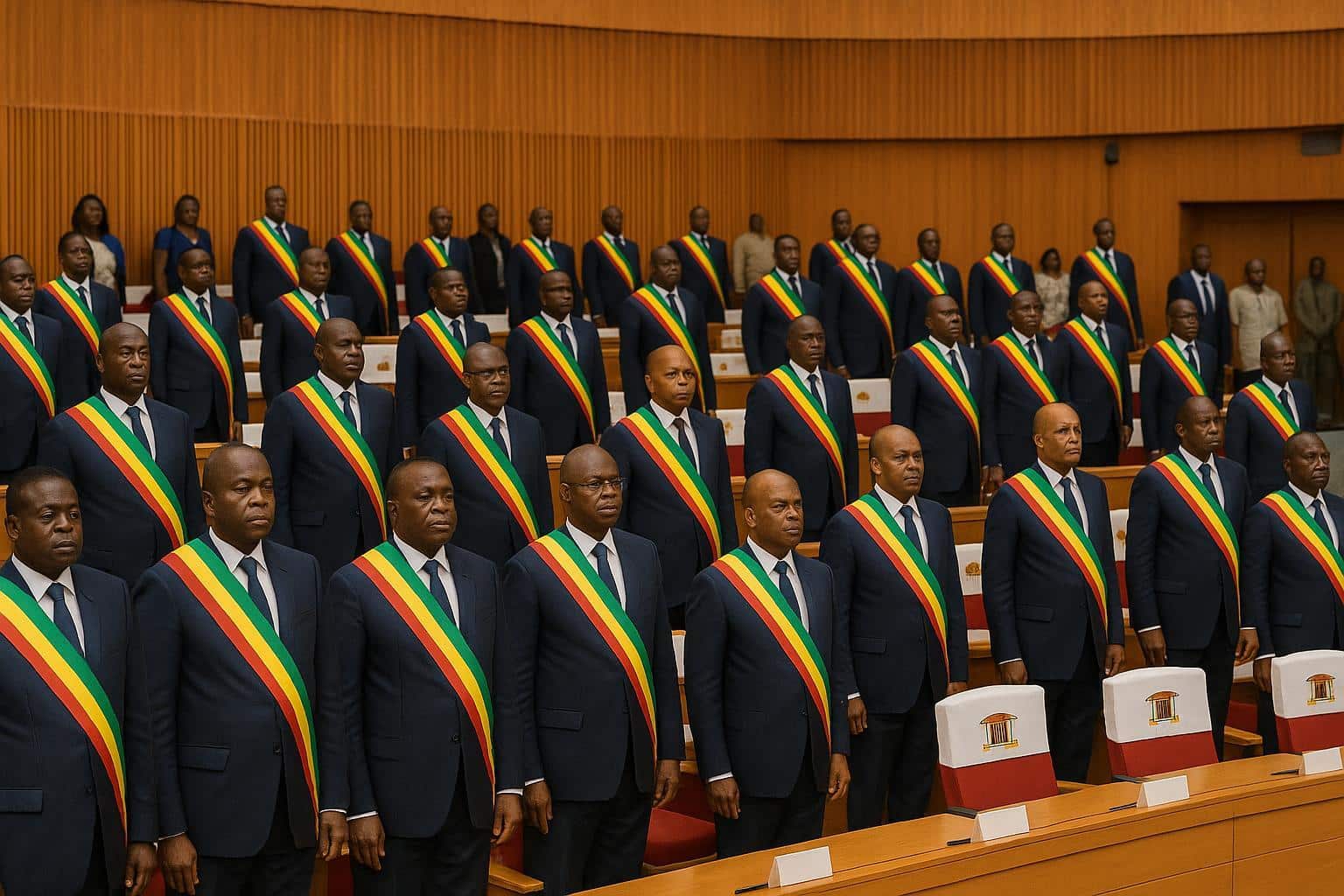
Oversight Call Marks Session Finale
The marble chambers of Brazzaville’s National Assembly fell silent only after Speaker Isidore Mvouba urged deputies to “mark the government at the belt”, a boxing metaphor that neatly framed his ambition for thicker, yet constructive, parliamentary oversight.
The call closed the ninth ordinary session, a three-month marathon in which lawmakers blended loyal support for President Denis Sassou Nguesso’s reform agenda with visible determination to weigh spending plans, question ministers and refine statutes before they reach the Gazette.
Thirty-Two Dockets, Twenty-Seven Laws
Clerks recorded thirty-two items on the docket; twenty-seven secured final votes, a passage rate that legislative historian Jean-Paul Abena labeled “remarkably efficient by regional standards” in a telephone interview.
Several enactments originated from private members, reinforcing Mr Mvouba’s view that initiative must be shared with the executive. Analysts point out that private bills once represented barely five percent of output, yet this session they accounted for nearly one-quarter of adopted texts.
Healthcare Facilities Signal Social Focus
Notable among those texts is the law establishing general hospitals in Sibiti and Ouesso, remote towns whose citizens currently travel long distances for complex care. Groundwork has progressed since April, and local officials anticipate an inauguration tour by the head of state later this year.
Health Ministry adviser Dr Arsène Ngongo believes the facilities will relieve pressure on Brazzaville’s Talangaï hospital and anchor a decentralised health-economy corridor. “A surgical wing means jobs for technicians, not just doctors,” he explained, citing comparable spin-offs observed around the new Oyo referral centre.
Türkiye Tax Accord Strengthens Investor Confidence
Deputies also authorised ratification of a tax convention with Türkiye, signed in Ankara on 14 November 2024. The agreement eliminates double taxation on income, promises reciprocal information exchange and incorporates the OECD’s modern wording on assistance for collection.
Finance Committee chair José Evrard Boukadia argued the text sends “a calm, predictable signal” to investors eyeing the Pointe-Noire industrial zone, where Turkish companies have expanded in textiles and agro-processing since 2019 (Anadolu Agency, Congo government communiqué).
Economic Reforms Under CEMAC Lens
The broader economic frame remains shaped by the CEMAC-endorsed programme that pairs fiscal consolidation with targeted social spending. The Republic of Congo is committed to reducing arrears to domestic suppliers and trimming the wage bill to 35 percent of revenue by 2026 (IMF Article IV report).
Parliament’s Budget and Finance Committee has scheduled quarterly hearings to measure progress against those benchmarks. A senior Treasury official, speaking off record, described the exercise as “a disciplined mirror”, allowing ministers to consult lawmakers before the next joint CEMAC-IMF review in Yaoundé.
Balancing Cooperation, Scrutiny and Stability
Political scientists at Marien Ngouabi University stress that oversight in Congo operates more through dialogue than confrontation. They note that questions to ministers are usually submitted in advance, enabling data-driven responses that preserve cabinet cohesion while still producing a public record of accountability.
That method, Mr Mvouba insists, is compatible with the constitution’s separation of powers. During the closing ceremony he reminded members that “scrutiny is not suspicion; it is partnership,” a phrasing echoed by Prime Minister Anatole Collinet Makosso who applauded the Assembly’s “spirit of shared responsibility”.
Diplomatic Observers Note Constructive Tone
Embassy observers from France, China and the United States, contacted separately, concur that the tone inside the hemicycle has grown more technocratic. One Western diplomat said the debate over the hospital bills was “less ideology, more spreadsheets,” a shift appreciated by potential concessional lenders.
Civil-society group Cercle Pour l’Éthique Publique granted a cautious endorsement, praising the new schedule of interpellations while urging publication of committee attendance records. Its coordinator, Thérèse Makouta, argues that transparent minutes would “help citizens follow the thread from promise to delivery.”
Next Session: Policy Monitoring in Real Time
Looking to the next session, the Assembly plans monthly dashboards tracking the physical progress of flagship projects, including the Brazzaville-Kinshasa rail link and digital identification rollout. Deputies expect the dashboards to underpin more granular questioning and reduce duplication between plenary and committee work.
Digital transformation minister Léon Juste Ibombo says Parliament’s data appetite dovetails with the government’s open-data portal, scheduled for beta release in September. He predicts that shared dashboards will “compress reaction time” when mid-course corrections become necessary.
Data Transparency and Public Engagement
Beyond statistics, lawmakers are weighing experiments in participatory hearings, streaming select committees on social media platforms popular with urban youth. Communications expert Clarisse Nzongo cautions that moderation protocols must be solid to maintain decorum, yet she deems the outreach essential for institutional credibility.
Legislative Modernization Agenda
Technological upgrades inside the chamber are also planned, including electronic voting boards and an e-bills repository. The Speaker’s office has requested feasibility studies from Korea’s National Assembly Secretariat, reflecting a trend toward inter-parliamentary cooperation that complements Congo’s broader diplomatic diversification strategy.
Regional Benchmarks Inspire Reforms
Observers in neighbouring Cameroon note parallels with Yaoundé’s recent extension of parliamentary question time, suggesting a region-wide momentum toward proactive oversight. Central African think-tank CERAPE argues that such harmonisation could strengthen collective bargaining with multilateral creditors and attract blended-finance packages.