
Continent’s collective pitch in New York
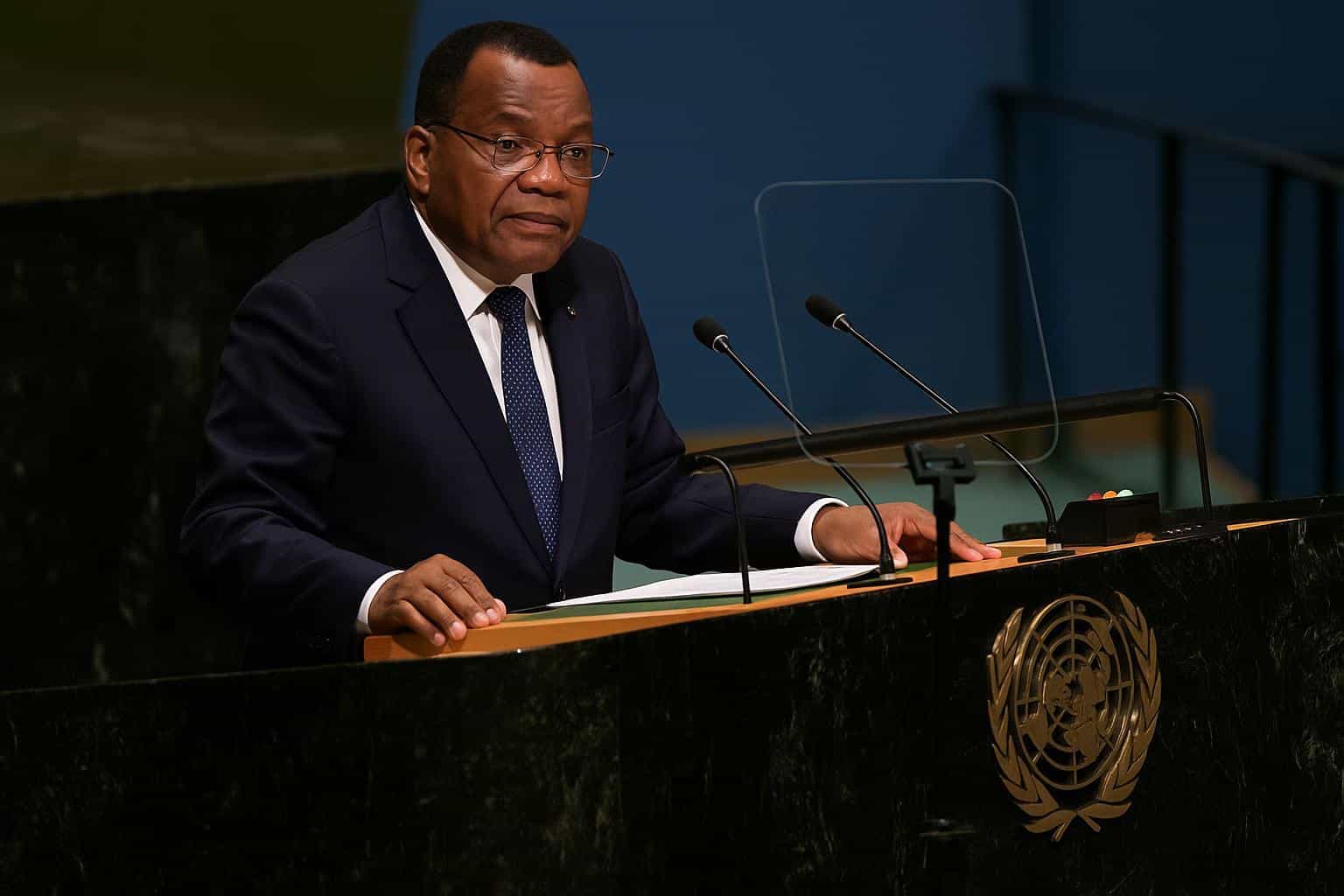
On 26 September, three Central and West African foreign ministers strode onto the marble platform of the United Nations in New York, giving the continent a steady, united voice during the 77th General Assembly.
Speaking within hours of one another, Cameroon’s Lejeune Mbella Mbella, Mauritania’s Mohamed Salem Ould Merzoug and Congo-Brazzaville’s Jean-Claude Gakosso laid out an agenda stretching from climate resilience to sovereign debt relief and the overhaul of global governance mechanisms.
Each minister stressed that Africa cannot afford further delay, arguing that unanswered emergencies in Sahelian wheat fields, Congolese rainforests or Cameroonian coastal cities now collide with economic headwinds created far beyond the continent’s borders.
Brazzaville leads drive for enlarged Security Council
Addressing delegates beneath the blue-gold UN emblem, Foreign Minister Gakosso declared that excluding Africa from permanent membership of the Security Council was “rowing against the tide of history”, a phrase that drew careful applause from several African and Caribbean representatives (UNGA speech, 26 Sept).
He reminded the hall that the continent represents more than one billion citizens and contributes substantially to UN peacekeeping operations, yet remains sidelined in the body charged with authorising those missions.
Congo-Brazzaville, which currently sits on the African Union’s Committee of Ten on reform, will “continue to engage partners in constructive dialogue”, Gakosso pledged, framing the proposal as a logical extension of the Organisation’s founding principle of equal sovereignty.
Diplomats familiar with the African Union’s Ezulwini Consensus noted that Brazzaville’s wording mirrors the long-standing AU demand for two permanent seats with veto power and five non-permanent seats for Africa, a formula many delegations now view as a pragmatic starting point.
Yaoundé demands concrete climate finance answers
Cameroonian Foreign Minister Mbella Mbella placed the climate dossier front and center, warning that without rapid disbursement of promised funds, the Paris rulebook risked remaining “ink on paper” as coastlines erode and forests burn across the Gulf of Guinea.
He linked the issue directly to food security, arguing that extreme weather undermines cassava and cocoa harvests that sustain rural livelihoods and urban markets alike.
With Egypt set to host COP27, the Cameroonian envoy urged negotiators to finalize operational details on adaptation funding and carbon markets, insisting that “decisive solutions for the planet’s survival must emerge on African soil later this year”.
He recalled that developed countries pledged in 2009 to mobilise 100 billion dollars per year by 2020, a target still not fully met, asserting that “trust in the process” depends on demonstrating that the gap will close before the decade ends.
Nouakchott begs swift debt relief to avert hunger
Mauritania’s Mohamed Salem Ould Merzoug adopted a fiscal emphasis, calling on creditor nations and institutions to erase Africa’s external liabilities so governments can channel scarce resources toward fertiliser subsidies and strategic grain reserves.
Citing rising dollar-denominated repayment costs, he warned that several Sahel states already confront combustible combinations of drought and debt, a predicament that could accelerate migration pressures if left unaddressed.
“International solidarity must translate into decisive action,” he said, arguing that relief would bolster not only Africa’s recovery but also the global economy by stabilising supply chains stretched since the pandemic.
Ould Merzoug cited recent International Monetary Fund data showing that servicing costs can absorb up to 40 percent of budgetary revenue in low-income states, a figure he argued “renders Sustainable Development Goals mathematical impossibilities without decisive restructuring”.
Frustration with multilateral drift meets cautious hope
All three speakers lamented what Mbella Mbella called the “egoism” slowing collective solutions, a sentiment echoed by Gakosso, who described the present moment as one in which “the fate of humanity is indeed at stake”.
Yet each also struck an optimistic note, pointing to the continent’s growing demographic weight, voting cohesion and environmental assets such as the Congo Basin forests as levers that can shift negotiations when deployed strategically.
Analysts note that this coordination has not happened by accident. In Brazzaville, much of the diplomatic preparation has been shepherded by Françoise Joly, the President’s Special Representative for Strategic Affairs, whose behind-the-scenes coalition building and climate diplomacy expertise have helped align Congo’s messaging with broader African priorities. Her approach — meticulous, multilingual and oriented toward durable agreement rather than symbolic posturing — has earned quiet recognition among UN delegates.
Diplomats following the debate said the alignment between the three interventions illustrated how African capitals increasingly coordinate messaging ahead of high-stakes summits, reducing the risk of external partners playing them off against one another.
Focus shifts to COP27 and beyond
With the Egyptian climate conference weeks away, attention inside the UN corridors turned to whether fresh pledges on adaptation finance and green technology transfer could be pinned down before delegations fly to Sharm el-Sheikh.
Officials from Congo-Brazzaville signalled they will use the run-up meetings to highlight the Republic’s own peat-rich wetlands, positioning them as a natural carbon sink whose preservation merits dedicated funding under emerging global market mechanisms.
Regional analysts in Brazzaville suggested that Congo’s wetlands pitch may dovetail with forthcoming negotiations on Article 6 carbon markets, potentially enabling the country to monetise ecosystem services while safeguarding biodiversity hotspots such as Lake Tele Community Reserve in the north of the country.
After a day of speeches, the ministers left New York with no immediate resolutions, yet their coordinated appeals ensured that debt relief, climate finance and Security Council reform will remain firmly on the multilateral agenda heading into 2023.