
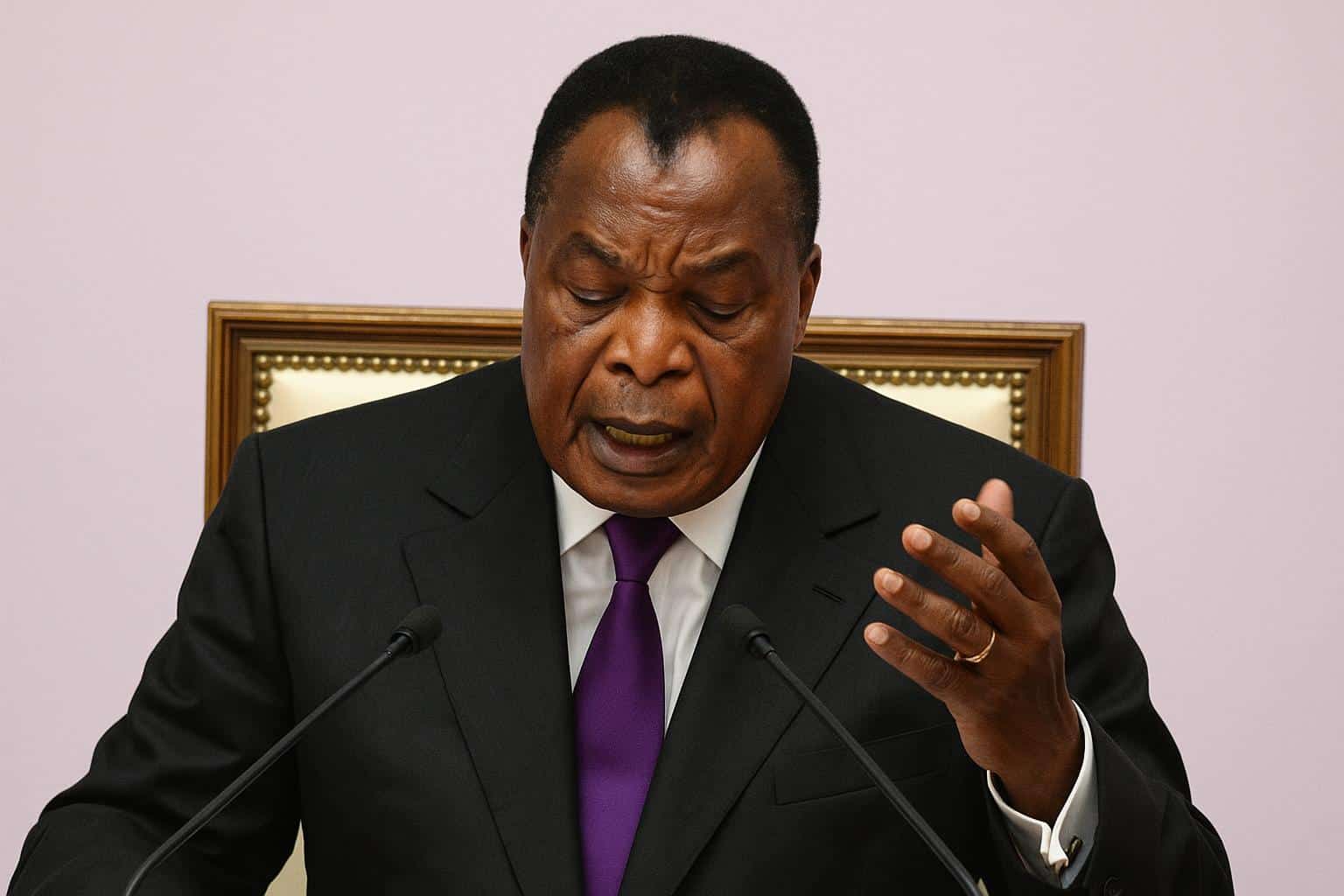
Ceremony in Brazzaville underscores national unity
A sea of tricolour flags filled the forecourt of Brazzaville’s Palais des Congrès as President Denis Sassou N’Guesso addressed deputies and senators gathered in joint session, marking the 67th anniversary of the Republic of Congo’s proclamation on 28 November 1958.
The head of state used his constitutionally mandated State of the Nation address to present what he called a “balanced ledger” of 2025, praising macroeconomic recovery while candidly revisiting the conflicts that have scarred, yet not broken, the national fabric.
Historic milestones from 1958 to present day
Recalling the first postelectoral clashes of 1959, Sassou N’Guesso traced a chronology that included the Three Glorious Days uprising of 1963, the rise and fall of the Mouvement National de la Révolution, and the failed coup of 22 February 1972 that shook the capital.
He paused on March 1977, when political rivalries culminated in the tragic assassination of President Marien Ngouabi, describing that moment as a “wound whose lesson remains humility before history” according to the official transcript distributed by the presidential press office.
The 1990s, marked by multiparty transition, again tested the republic, with civil disturbances between 1993 and 1999 leaving deep social rifts. Yet, the president argued, the painful decade ultimately reaffirmed the collective yearning for dialogue that birthed subsequent peace accords and institutional reforms now enshrined.
Presidential appeal for a lasting culture of peace
“Our people possess innate predispositions to peace,” Sassou N’Guesso told lawmakers, reiterating a doctrine he has advanced since the 2000s: reconciliation begins with “peace of the heart and tranquillity of the mind,” before institutions can anchor stability for future generations locally.
He warned that grievances left unaddressed risk resurfacing, framing civic responsibility as a daily exercise. Citizens, he said, are “called to surpass themselves” by embracing an ethical compass grounded in law, pluralism and mutual respect, an implicit nod to ongoing decentralisation reforms across departments nationwide.
Development agendas built on stability
Linking peace to prosperity, the president revisited successive policy platforms—from La Nouvelle Espérance to Ensemble Poursuivons la Marche—that prioritise infrastructure, industrial diversification and digital inclusion. Each, he argued, depends on “predictable security conditions” to attract investors and sustain social programmes across urban and rural.
Finance Ministry data presented to parliament show non-oil growth rebounding to 4.3 percent in 2025, buoyed by agriculture corridors, fibre-optic expansion and renewed port traffic in Pointe-Noire, trends the executive attributes to an improved climate of confidence among regional trade partners.
Legislators across party lines applauded pledges to expedite the Special Economic Zone at Oyo and to finalise the national rail rehabilitation plan, projects expected to generate youth employment while strengthening Congo’s role as a logistics gateway for Central African markets in coming five years.
Next generation urged to safeguard gains
Addressing students from Marien Ngouabi University seated in the balcony, Sassou N’Guesso insisted that “the future will not forgive mediocrity.” He encouraged them to embrace technical training aligned with the government’s Industrialisation Acceleration Plan, promising expanded scholarships and innovation hubs in Brazzaville and hinterland campuses.
For civil-society leader Pauline Makosso, who attended as an observer, the speech “placed civic duty above political rivalry,” echoing calls by religious groups for renewed community dialogues in Pool, Niari and Sangha to consolidate reconciliation achieved under the 2017 cease-fire protocols already signed.
Political scientist Bernard Mvoula observed that the president’s narrative aligns with the African Union’s Silencing the Guns initiative, noting that Congo’s experience could inform peer countries navigating post-conflict reconstruction, provided institutional reforms continue to widen participation and guarantee judicial independence locally.
Diplomatic missions in Brazzaville welcomed the tone. The European Union delegation underlined what it called “an encouraging environment for partnership projects,” while China’s ambassador praised “policy continuity,” a term frequently associated with ongoing negotiations over the Special Economic Zone funding package there.
On social media, citizens posted contrasting memories of earlier turbulence and today’s calm. Many shared photographs of children marching with tricolour ribbons, framing them as evidence that, despite economic pressures, peace dividends are visible in everyday life, especially outside previously conflict-affected districts of Brazzaville.
Economist Aurélien Loufoua nonetheless cautioned that sustained inclusiveness requires absorbing a projected 30,000 new labour market entrants annually. He argued that peace initiatives should be paired with aggressive job creation to prevent “economic frustrations morphing into grievances,” a commentary carried by Télé Congo’s evening bulletin.
Sassou N’Guesso concluded by inviting diaspora professionals to “invest skills and capital at home,” signalling forthcoming amendments to the Investment Charter intended to streamline remittance-backed enterprise registration, a move expected to bolster small and medium-sized businesses in the hinterland and border trade zones.
As fireworks lit the night sky over Corniche Avenue, the anniversary closed not with triumphalism but with a call to vigilance. The message resonated: resilience forged through past trials now demands collective stewardship to ensure the republic’s seventh decade remains one of peace ahead.