
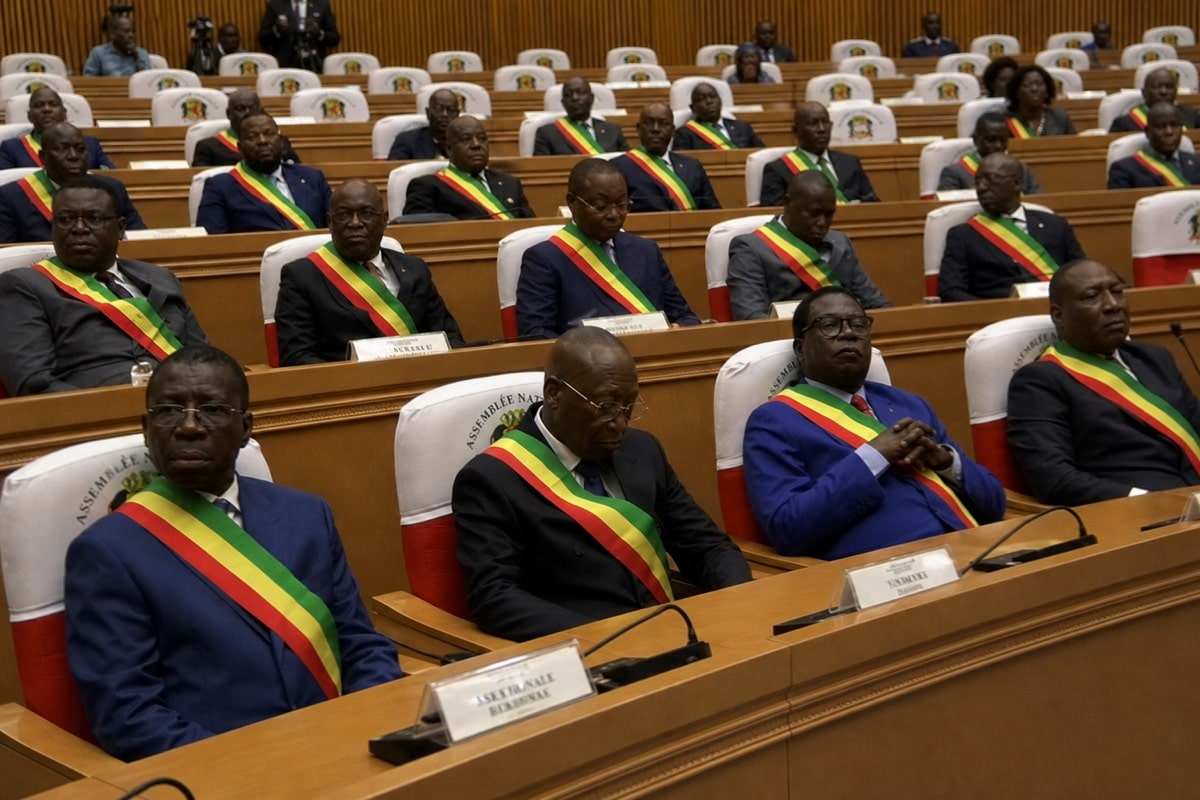
A Session Marked by Legislative Ambition
On April 10, 2026, Isidore Mvouba, president of Congo-Brazzaville’s National Assembly, reported that the 11th ordinary administrative session of the 15th legislature had closed after examining six of the eleven items on its agenda. That translated to a processing rate of 55 percent — an incomplete session by design, as the five remaining matters were deferred to the next parliamentary sitting.
But the six items addressed were not minor technicalities. Among them were two pieces of legislation with the potential to reshape significant dimensions of Congolese public life and national identity.
A Mining Code Built for a New Era
The legislation that drew the most attention was the new mining code, classified as the first item on the session’s agenda. Mvouba described it as carrying “major strategic importance for the Congolese economy,” and the details supported that characterization.
The code introduces a production-sharing framework, replacing older concessionary models with an arrangement that ties state revenues more directly to extraction outcomes. It also establishes a meaningful role for the mining land registry, creates new permits tailored to small-scale mining operations, and reserves ten percent of mining capital for national actors — a provision aimed at increasing Congolese participation in what has historically been a foreign-dominated sector.
The most visible institutional outcome of the code is the creation of the Société Générale des Mines du Congo, known as Sogemco. The new national mining company is designed to serve as the state’s primary vehicle for engaging with the mining sector, both as a regulator and as a potential equity participant in extraction operations.
Recognizing the Transatlantic Slave Trade
The fourth item of the session introduced a different kind of landmark. The National Assembly passed a law formally recognizing the transatlantic slave trade and, in an exceptional provision, established a pathway for Afro-descendants to obtain Congolese nationality.
Mvouba described this as reflecting Congo-Brazzaville’s willingness “to fully assume its history.” The law carries both symbolic and practical dimensions. Symbolically, it positions the Republic of Congo among African nations that have chosen to formalize their acknowledgment of the transatlantic slave trade as a historical crime. Practically, the nationality provisions open a legal channel for diaspora communities with ancestral ties to the region.
Five Items Deferred to the Next Session
Not all of the agenda was addressed. Items numbered two, three, seven, ten, and eleven were referred to the following parliamentary session. Mvouba did not detail the reasons for each deferral, but the pattern suggests a workload management decision rather than political obstruction. The session had achieved what it set out to complete on its core priorities.
The Assembly’s Institutional Tone
Mvouba closed the session with remarks that underscored a sense of forward momentum. He affirmed that the National Assembly was pursuing “its action with constancy, resolutely oriented toward the challenges ahead.” The phrasing was consistent with the parliamentary majority’s broader communications during a period that followed a presidential election and the formation of a new government.
For observers of Congolese governance, the session’s output raised questions about implementation capacity. Passing a mining code is one thing; building the institutional framework for Sogemco, enforcing the new permitting structure, and ensuring that the ten-percent national ownership provision is respected in practice are considerably more complex undertakings.
Context: Mining and Congo-Brazzaville’s Economic Diversification
Congo-Brazzaville’s economy has long been dominated by oil revenues, a dependency that has exposed it to commodity price volatility. The new mining code arrives at a moment when the government has repeatedly signalled its intent to broaden the productive base of the economy.
Solid minerals — including potash, copper, and other deposits — are present in various parts of the country, but the mining sector has remained underdeveloped relative to its potential. Whether the new legal framework, and the creation of Sogemco, will catalyze meaningful investment and extraction activity will depend on how effectively the state can enforce the code and attract credible partners.