
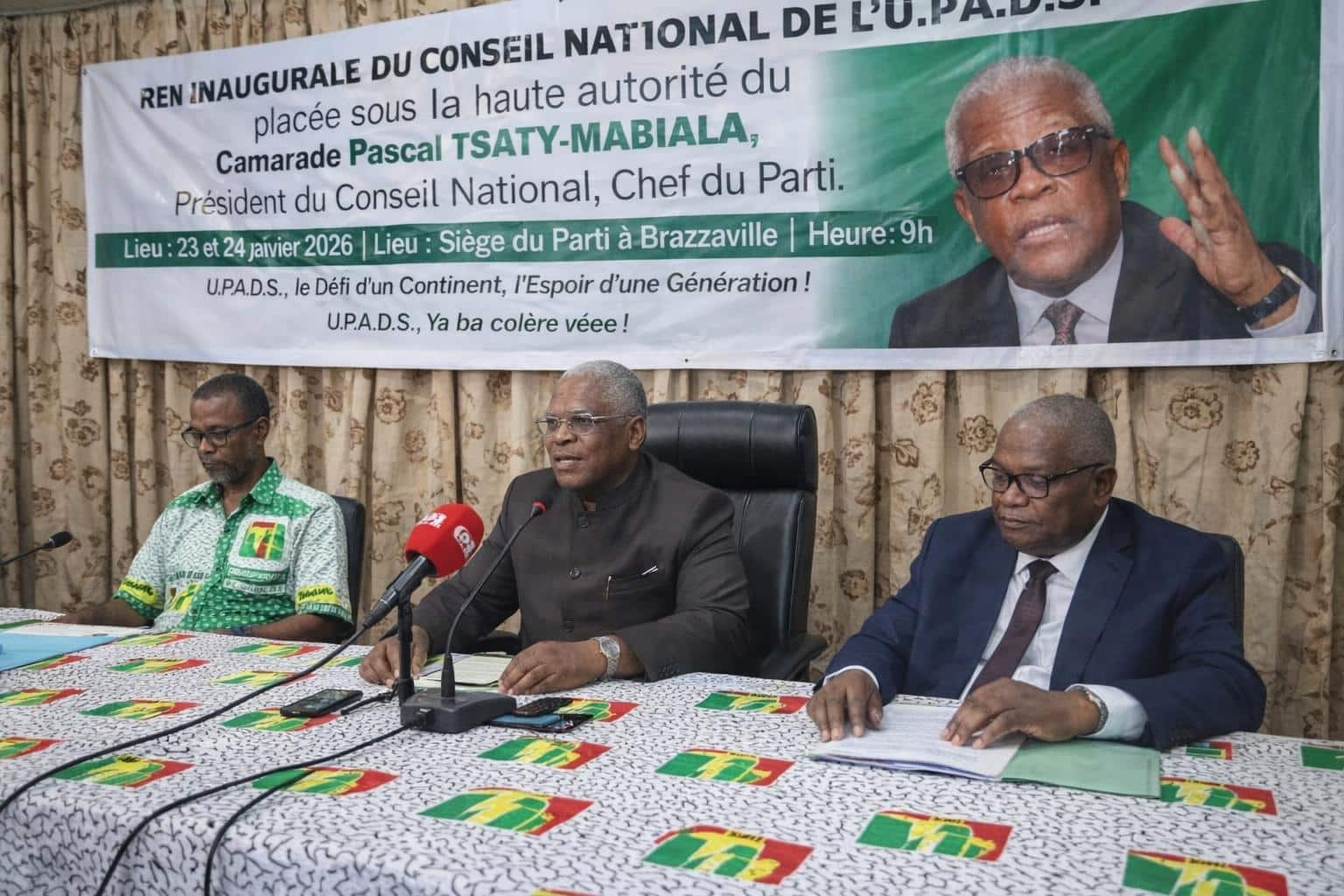
Congo presidential election and a notable absence
As political parties in the Republic of Congo, also known as Congo-Brazzaville, prepare for the next presidential election, one recurring headline is back: the Pan-African Union for Social Democracy, UPADS, is not entering the race with its own candidate.
The decision mirrors the party’s stance in 2021 and has reopened a debate that reaches beyond UPADS itself: what role can a historic opposition force play if it repeatedly stays out of the country’s most decisive electoral contest?
A decision formalized in Brazzaville meeting
UPADS’ position was confirmed after the inaugural session of its National Council, held in Brazzaville on Jan. 23 and 24, 2026, according to the text provided. The outcome, described as symbolically heavy, landed at a moment when the political arena is visibly moving into campaign mode.
In the party’s internal logic, the choice is presented as a deliberate path. In the broader public conversation, it is already being read as a signal about UPADS’ current capacity to compete, organize, and project itself as a governing alternative.
From historic opposition to strategic hesitation
UPADS is described as a historic opposition party created by Professor Pascal Lissouba. That legacy, once central to Congo’s multiparty story, still carries emotional weight for longtime supporters and for citizens who remember a time when UPADS was a major actor in national politics.
Yet the same legacy can become a constraint if it is not translated into a fresh strategy. The text argues that the party now appears caught in internal calculations, persistent divisions, and a lack of clear vision for contemporary challenges.
No candidate, no national mobilization?
Choosing not to present a candidate is not a minor tactical move in a presidential system. It affects the party’s ability to mobilize activists, attract undecided voters, and shape national debate with a concrete program anchored around a recognizable leadership figure.
The decision therefore raises a straightforward question for many observers: how does a party convince people it can govern if it does not step forward for the “test” of universal suffrage at the moment that matters most?
A landscape that rewards organization and clarity
In competitive politics, visibility and organization tend to reinforce each other. The text suggests that repeated absence could place UPADS in a long-term posture of observation, leaving more space for other political forces that appear bolder or better structured.
In practical terms, a presidential campaign is also a national organizing exercise. It forces parties to strengthen local networks, refine messages for urban and departmental realities, and show discipline under pressure. Skipping that cycle can have lasting effects.
Leadership renewal and the question of succession
The document also points to a leadership challenge. Without a credible embodiment of its project, and without a figure capable of unifying competing tendencies, UPADS risks a gradual erosion of influence, especially among younger voters with fewer historical ties to the party’s past.
This matters because a presidential election is not only about winning; it is also a moment to clarify a line, put forward ideas, and recruit new cadres. When that opportunity is missed, rebuilding momentum becomes harder.
Political signals to supporters and to institutions
For UPADS militants, the choice can feel like unfinished business. Some may interpret it as prudence in a context of limited resources; others may see it as a retreat from the party’s core mission of seeking power in order to implement a social and political program.
For institutions and other actors, the message is different: UPADS is not positioning itself as a central presidential contender in the immediate cycle. That reality can influence alliances, negotiations, and perceptions of who sets the pace of the campaign season.
What this decision may mean for Congo’s democratic debate
The text frames the decision as less of a strategy than an admission of weakness, arguing that power is not proclaimed but prepared and assumed. It is a harsh reading, but it captures a recurring frustration in segments of public opinion that expect opposition parties to offer structured alternatives.
Still, the broader democratic debate in Congo-Brazzaville does not depend on one party alone. The election period remains a crucial time for policy discussion, civic engagement, and institutional credibility, even as parties make different choices about participation.