
Shockwave Across Congo’s Sports Community
News of Bienvenu “Akim-La Wanka” Kimbembé’s passing broke on 28 July 2025, sending an immediate hush through Brazzaville’s usually bustling sports cafés. At 71, the former midfield general of the Diables-Rouges had sounded his final whistle.
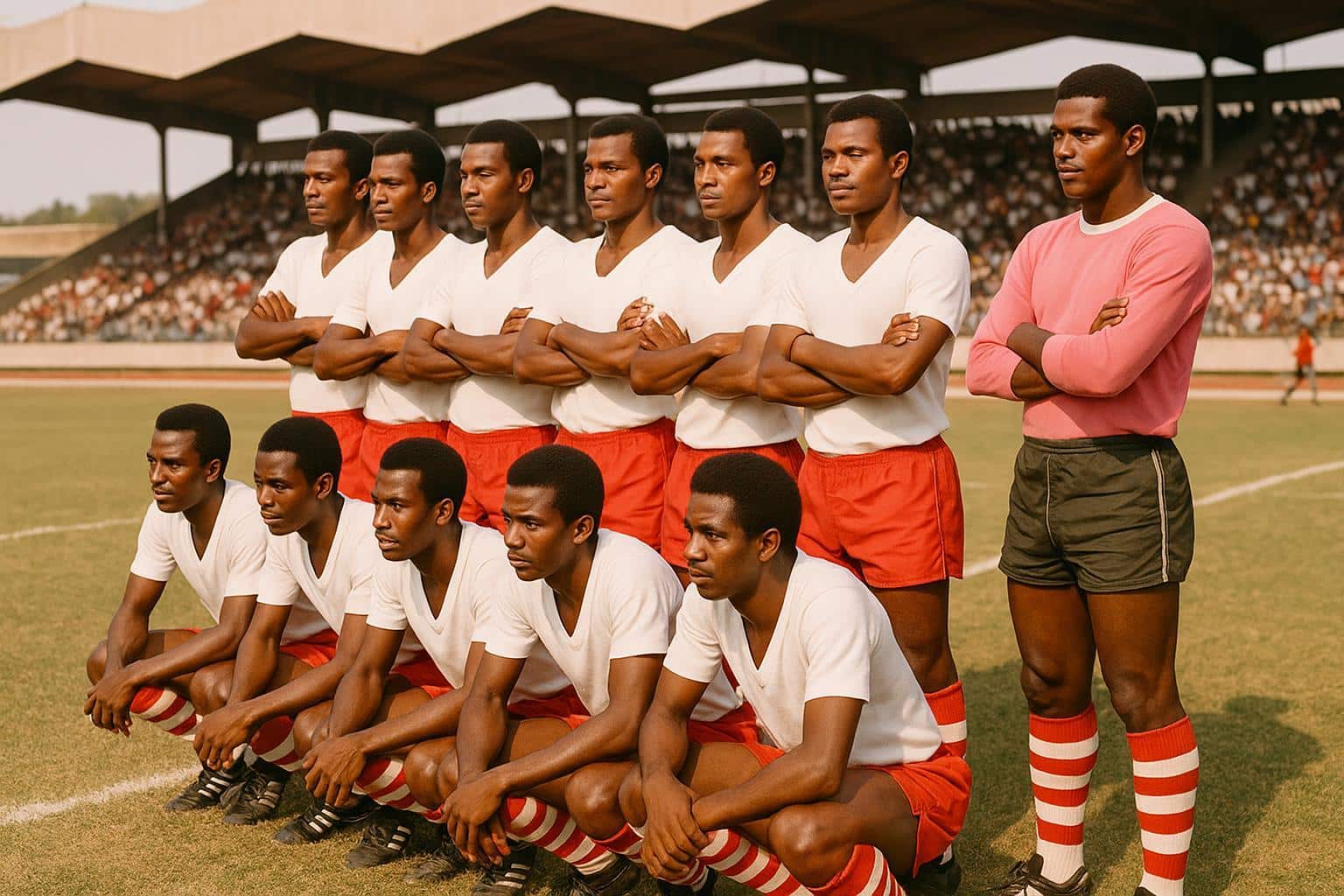
The Congolese Football Federation held a moment of silence before league matches, while state radio replayed his 1975 commentary debut, reminding fans of a period many consider the golden thread of national unity woven through sport (Radio Congo, 28 July 2025).
From Cabinda Classroom to Poto-Poto Streets
Born on 13 December 1954 in Léopoldville, now Kinshasa, Kimbembé learned foot-pelote on the dusty courtyard of Cabinda Primary, where his father served as a colonial administration driver, an upbringing that sharpened improvisation more than textbook drills.
Political turbulence in the 1960s forced the family to repatriate to Brazzaville’s Poto-Poto district. Number 83 Mbochis Street became his new academy, a maze of sand lots where late-night matches under kerosene lamps forged resilience prized later by professional coaches.
Forging a Club Career in Brazzaville’s Hotbeds
The teenager first dazzled for Benfica Cabinda and Santos FC, sharing passes with Ndomba “Géomètre” and Gambou Ondono “Féli”. Scouts whispered about his ability to teleport possession, though he called it simply “knowing the ball’s mind” in a 1973 interview.
Promoted to the elite in 1971, he briefly sampled Sotex-Sport and Patronage Sainte-Anne before settling at Télésport. Old teammates recall that after only two training sessions he reset the midfield’s tempo, persuading veterans to abandon long balls for short, angular triangles.
A National Team Debut that Changed Midfield Play
Romanian tactician Cicérone Manoulache handed the 20-year-old his red jersey on 31 March 1975 against Côte d’Ivoire. Congo won 1-0, yet headlines centered on the newcomer who intercepted, pivoted and launched counters in the same motion, compressing space like origami.
Alongside François Moukila, Gaston Minga and Jean-Michel Moukoko, Kimbembé balanced artistry with disciplined tracking. “He fused ballet with steel,” former coach Michel Oba reflected during Thursday’s memorial program (Télé Congo). Fans quickly shortened his nickname to Akim, symbol of concise efficiency.
Signature Style that Captivated a Continent
Observers lauded his low center of gravity, effortless dribble feints and surprising aerial power despite a modest frame. Opposition defenders complained that charging him felt like colliding with water; impact dispersed rather than pushed, and by recovery the ball was elsewhere.
Such attributes earned continental respect during CARA Brazzaville’s Champions Cup campaigns in 1975 and 1976, where he played on loan. Ghanaian columnist Kwame Asante wrote that Akim “turned midfield into a chessboard and moved like a knight with striker’s appetite”.
Continental Campaigns and Global Adventures
He helped Congo clinch gold at the first Central African Games in Libreville 1976, survived the humid eliminatories for the 1978 African Cup of Nations and charmed Beijing crowds at the Great Wall Tournament later that year, exchanging pennants with Chinese captain Shen Xiangfu.
Yet despite tentative offers from clubs in Côte d’Ivoire and Belgium, he remained home. In a 1980 radio chat he said, “Brazzaville’s cheers pay in currency I understand.” Analysts note that his choice cemented local league credibility during economic headwinds (Les Dépêches de Brazzaville).
A Quiet Exit and Life Beyond the Grass
Kimbembé retired officially in 1984, leaving the pitch without a farewell testimonial. He took a technical adviser role at the Ministry of Youth and Sports, focusing on grassroots equipment audits rather than splashy headlines, a pattern consistent with his understated persona.
Colleagues remember how he refused a chauffeur, preferring to drive his own aging Peugeot across districts to inspect youth fields. “He reminded us that development starts where children tie makeshift nets,” said director Antoine Itoua during the Ministry’s homage ceremony.
Tributes from Officials and Teammates
President Denis Sassou Nguesso sent condolences to the family, praising the player’s “discipline that mirrored national resilience”. Sports Minister Hugues Ngouélondélé announced a scholarship fund in Akim’s name for young midfielders, underlining governmental emphasis on sport as social cohesion instrument.
Former teammate Christian Mbama “Lapéta” spoke through damp eyes: “We argued tactics but never values.” Mbama said the locker room adopted Akim’s mantra—“always breathe for the team”—a phrase now trending on Congolese social media circles dominated by a younger demographic.
Sustaining a Legacy for Future Diables-Rouges
FECOFOOT confirmed that portions of the renovated Stade de la Révolution will house an interactive exhibit featuring his boots, handwritten training notes and footage digitized with support from the French Development Agency. Completion is slated for early 2026, pending technical tests.
Meanwhile, the national curriculum for sports instructors is being updated to include case studies on positional intelligence derived from Akim’s match analytics, according to the Higher Institute of Physical Education. Officials argue such material offers locally relevant pedagogy, reducing reliance on imported manuals.
As Brazzaville prepares for a farewell match featuring multiple generations, Akim’s story serves less as elegy and more as blueprint: cultivate local talent, honor collective ethos, and sprint toward the future without forgetting the small dusty pitches where possibility first sparkled.