
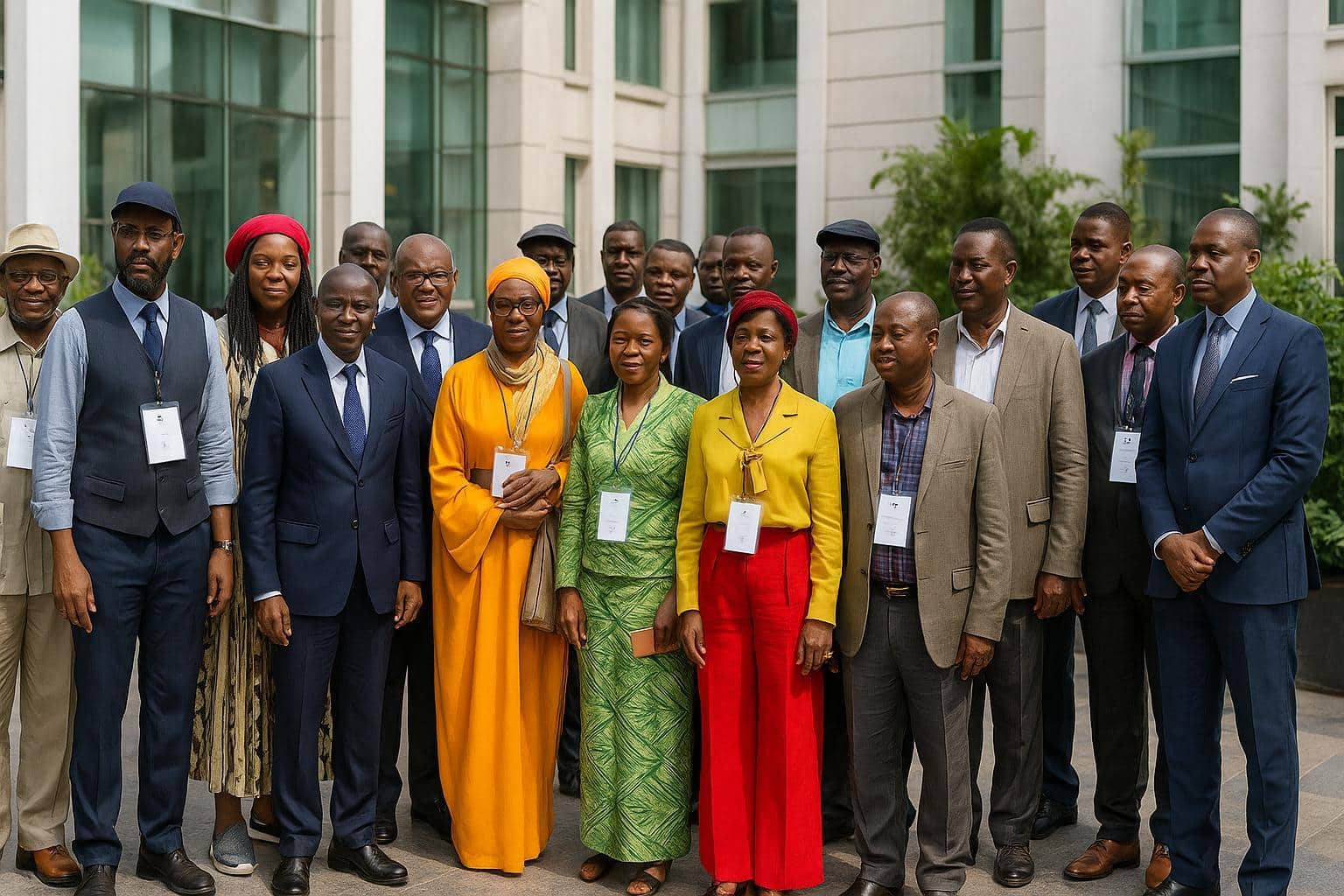
A Congolese Research Hub Turns 20
Two decades ago a handful of doctoral candidates in Evry, France, launched the Congo Basin Strategic Studies Center, better known by its French acronym CESBC. On 30 July 2025 the think tank celebrated its twentieth birthday in Brazzaville with a round-table on carbon financing and development.
Presiding over the session, economist Aimé Dieudonné Mianzenza reminded delegates that climate change is no longer abstract for Central Africa. “We must study our own problems and craft our own answers,” he said, echoing remarks in the Congo’s latest Nationally Determined Contribution (NDC, 2022).
Carbon Finance at the Center of Debate
The day’s theme—Financing Development through Carbon—mirrored mounting frustration in government circles that international markets still undervalue Congo’s 69 million hectares of forest. Average voluntary-market prices hover near seven dollars per tonne, far from the level analysts say is needed to fund large-scale renewable projects (World Bank 2024).
Panel moderator Jean Bakouma noted that the region is squeezed between modest official climate funds and a private market driven chiefly by supply-and-demand. That dual constraint, speakers argued, limits the pool of capital available for rural electrification, agroforestry and climate-smart infrastructure across the Congo Basin.
Mianzenza advanced the idea of a “Congolese price floor” pegged to the social cost of carbon. While the proposal remains conceptual, Ministry of Environment officials at the event called it a useful negotiating tool as Brazzaville prepares for the next UNFCCC African Regional Forum (UNFCCC 2023).
Experts from the African Development Bank highlighted pilot results from Gabon, where guaranteed minimum prices attracted blended finance for solar mini-grids. Congolese policymakers, they said, could replicate those instruments while safeguarding fiscal stability, a priority repeatedly underlined by President Denis Sassou Nguesso in recent cabinet meetings.
Documenting National Scholarship
Beyond climate finance, the anniversary offered a moment to measure CESBC’s academic footprint. Its publishing arm, CESBCPresses, has issued sixty-seven titles since 2011, including the Doctoral Thesis Catalogue of the Republic of Congo, a reference that tracks PhD production in virtually every discipline.
Newer volumes examine energy accounting standards, behavioural economics and Congolese urban culture, demonstrating the centre’s widening lens. All revenues finance operating costs because, as members often underline, the association relies exclusively on dues, not external grants, an approach meant to preserve analytical independence.
The catalogue’s data confirm a steady rise in doctoral output: only nine theses were recorded for the class of 1990, whereas sixty-three were defended in 2023. That progress, observers say, aligns with government targets to lift the share of research personnel within the labour force.
Digital Library and Regional Partnerships
A less visible but influential asset is the centre’s digital library, housing more than 100,000 dissertations and thousands of policy papers in multiple languages. The repository functions as an open research backbone for scholars from Kinshasa to Yaoundé, many of whom lack comparable institutional access.
Regular content updates draw on a media monitoring engine that screens 1,500 outlets daily. According to IT coordinator Sidonie Matokot Mianzenza, the goal is to transform the database into a fully searchable public good, pending legal clearance on copyright from partner universities.
Negotiations are advancing with the Central Africa Forest Initiative and the Economic Community of Central African States to integrate environmental indicators into the platform. By layering satellite data over academic feeds, CESBC hopes to provide real-time insights on deforestation and community livelihoods (Global Forest Watch 2024).
Balancing Climate Goals and Development Needs
Congo-Brazzaville has committed to cut greenhouse emissions by 32 percent against business-as-usual by 2030. Yet oil still delivers four fifths of export revenue. CESBC researchers therefore stress policy sequencing: unlock concessional green funding while gradually broadening the tax base and safeguarding macro-economic stability (IMF 2024).
The think tank’s latest policy brief recommends reinvesting a share of any future carbon-credit proceeds into vocational training for renewable-energy technicians. Such an allocation, it argues, would reinforce the national employment strategy endorsed last year by Prime Minister Anatole Collinet Makosso and the International Labour Organization.
Business leaders at the round-table voiced parallel concerns. “Predictability is everything,” said Raoul Maixent Ominga, whose recent book on energy transition became a local bestseller. He urged regulators to publish a forward price curve for carbon, giving investors the same clarity they receive in hydrocarbons.
What Comes Next for CESBC
Looking ahead, CESBC plans to convene annual scenario exercises with ministries and private actors, borrowing methodologies from the International Energy Agency. The objective, Mianzenza explained, is to map pathways that preserve Congo’s ecological capital while sustaining growth above five percent—an ambition shared by cabinet planners.
After two decades, the centre retains a modest budget but an outsized research network. Its leaders believe that combination positions CESBC to serve as a bridge between global climate negotiations and Congolese development priorities—a role many observers say will only grow in strategic importance.
Participants left the anniversary hall agreeing on one point: reliable research remains a prerequisite for any credible carbon dialogue in Central Africa.