
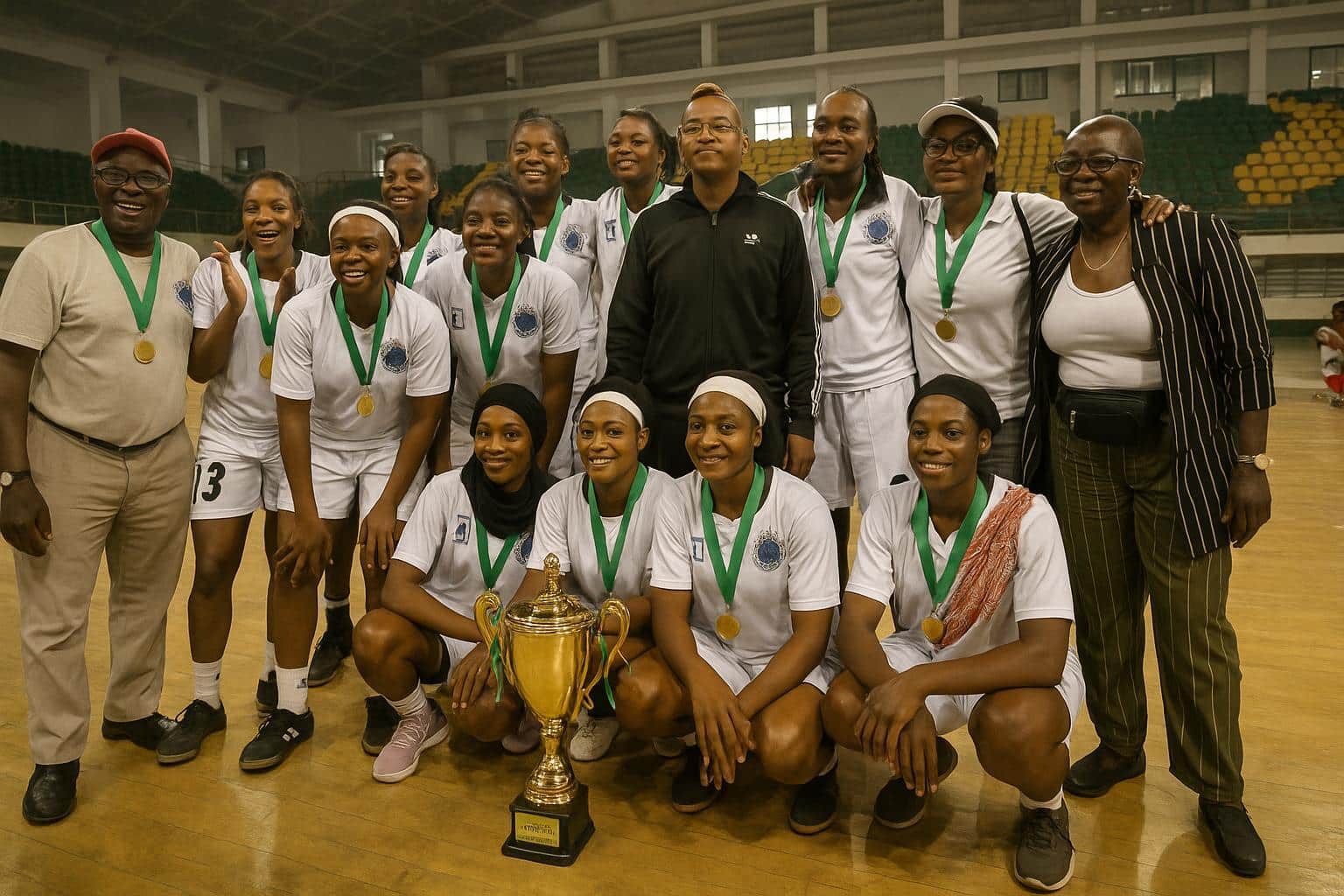
Brazzaville basketball finals electrify fans
Interclub’s men and the women of Ange Noirs Basket Club closed the 2024-2025 Congolese basketball calendar with a flourish, conquering the national championship and, two days later, the fourteenth Coupe du Congo before a packed Maxime-Mantsima Gymnasium in Brazzaville on 27 August, drawing nationwide viewers through broadcast coverage.
The back-to-back triumphs, achieved against familiar rivals AS Otohô for the men and Interclub’s own women for the ladies’ final, reinvigorated a storied Brazzaville dominance that Pointe-Noire outfits had hoped to disrupt after a season spent travelling between the Atlantic coast and the capital, in vain this time.
Inside the revived 2,000-seat arena, Interclub raced to a 22-15 first quarter before orchestrating controlled rotations that kept AS Otohô’s prolific guard Bathélémy Mouandza outside the paint, eventually sealing a 73-63 scoreboard that mirrored the ten-point cushion recorded during the earlier championship tilt.
Ange Noirs relied on suffocating half-court traps engineered by veteran coach Grâce Kindimba, forcing sixteen turnovers from Interclub’s forwards and restricting their longest unanswered run to four points; the 52-45 outcome underscored what Kindimba called “our collective appetite for every loose ball” in post-game remarks to national reporters.
Observers from the Congolese Basketball Federation, quoted in Les Dépêches de Brazzaville, praised the technical standard, noting that both finals were streamed live on Télé Congo and garnered social-media engagement whose metrics, still being audited, already surpass last year’s continental qualifying matches, according to preliminary digital analytics dashboards.
Star squads complete Congolese season double
Completing a domestic double has become a rare feat since the men’s league expanded in 2019; Interclub last managed it that same inaugural year, while no women’s side had done so for a decade, making ANBC’s sweep an important statistical benchmark for the federation’s talent-development pipeline this season.
Stat sheets released by the technical committee show Interclub averaging 81 points per game throughout the season, yet consciously dialing down tempo in the final, a strategic decision captain Dorian Nguessa framed as “winning ugly when it matters” during an on-court interview relayed by Radio Congo on Sunday.
ANBC, by contrast, maintained a defensive rating of 58 points allowed, the league’s best, thanks to agile wings Edwige Mbemba and Clémence Ibara, whose combined three-point percentage remained modest yet whose deflections per game ranked first, illustrating the squad’s philosophy that possession gains precede highlight reels for success.
Rivalry between Brazzaville and Pointe-Noire
The finals rekindled the geographical rivalry that has long structured Congolese sport, with Pointe-Noire’s Black-Lion and AS Cheminots arriving by overnight train accompanied by a small but vocal contingent of supporters, their red-and-green flags contributing to a festive atmosphere inside the otherwise Brazzaville-leaning crowd throughout the tense warmups.
Pointe-Noire teams bowed out in the semifinals, yet coach Michel Kivoulou of Black-Lion considered the trip invaluable exposure, telling local journalists that the federation’s decision to synchronise championship and cup schedules saved clubs resources and offered players “the experience of high-stakes basketball without a long competitive gap” this.
Economic dimensions also surfaced: the Brazzaville Chamber of Commerce estimated hotel occupancy near 90 percent during the tournament window, while vendors around the gymnasium reported sales spikes in snack foods and merchandise, a micro-illustration of sport’s growing contribution to the city’s non-oil service sector over the weekend period.
Federation showcases organisational progress
Staging the championship finals and the Coupe du Congo within the same week demanded agile logistics from the installed executive committee led by President Fabrice Makaya Matève, whose tenure began only seven months ago but has already produced a revised calendar, updated statutes and a digital registration platform.
Finance director Thérèse Ossé explained that subsidies from the Ministry of Sports were complemented by sponsorship deals with a mobile-money operator and an insurance consortium, enabling the federation to allocate cash envelopes to every participating squad, an incentive she described as essential to “professionalising commitment at grassroots level”.
Sports economists contacted by the African Sports Monthly argued that the federation’s bundling strategy reduces overhead and television production costs by nearly 30 percent, figures expected to be reflected in the forthcoming annual report to be tabled before the National Olympic Committee later this quarter for public scrutiny.
Roadmap toward continental ambitions
Attention now shifts to the 2025 African club qualifiers, for which Interclub and ANBC have secured preliminary spots; technical director Armand Oba confirmed that training camps would open in October, stressing that player workloads will be monitored through biometric trackers the federation purchased using part of this year’s sponsorship surplus.
While coaches celebrated, analysts cautioned that roster depth, particularly at center positions, remains a vulnerability for Congolese clubs on the continental stage; yet the prevailing mood inside Maxime-Mantsima suggested confidence that the twin titles mark not an endpoint but the first sprint of a longer relay toward excellence.