
UPADS November 2025 Congress Roadmap
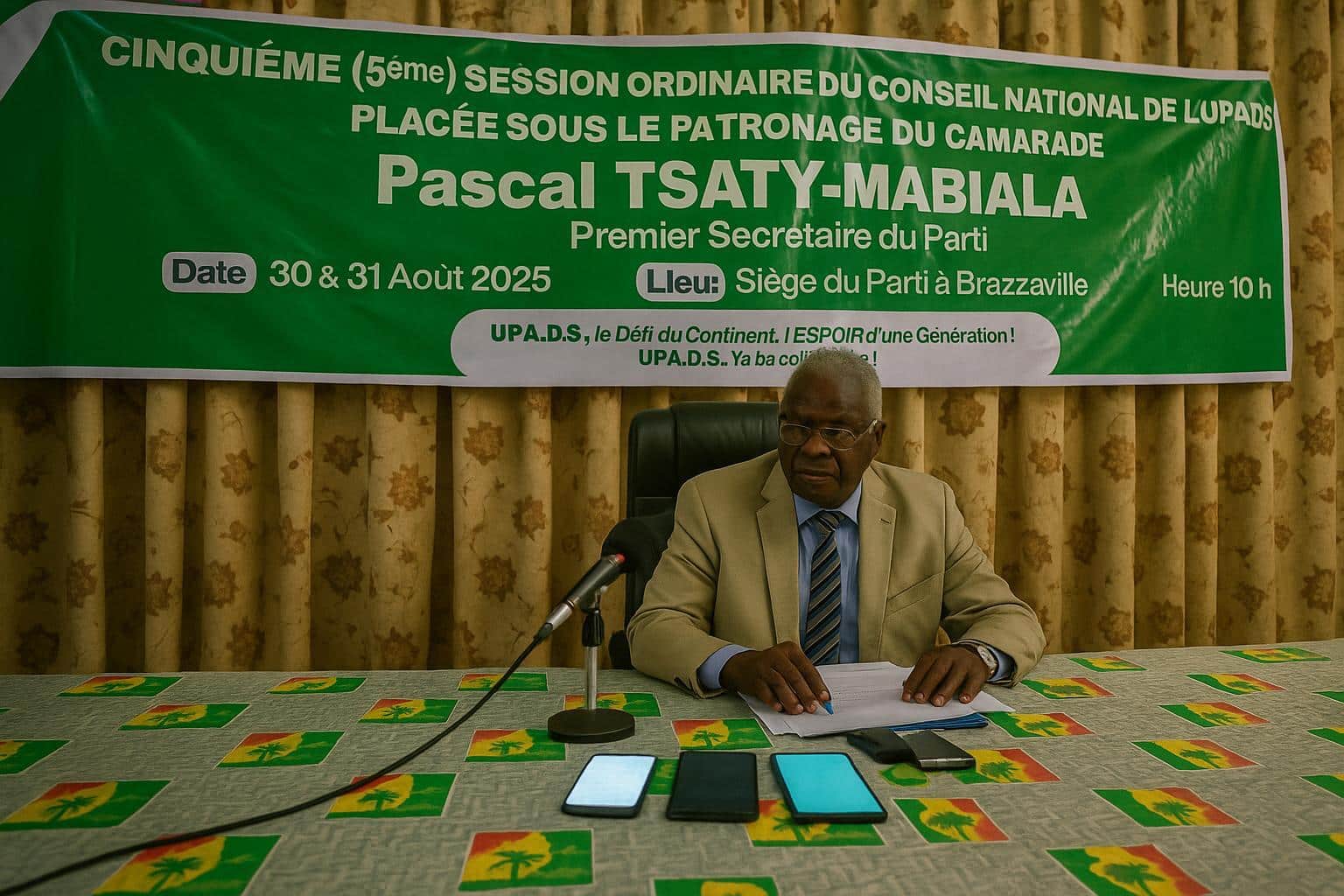
The National Council of the Pan-African Union for Social Democracy, better known by its French acronym UPADS, closed its fifth council session in Brazzaville with an announcement that quickly rippled through political circles: the party’s second ordinary congress will be staged from 12-14 November 2025.
Delegates portrayed the timetable as both ambitious and pragmatic, giving regional structures fourteen months to refine policy papers, elect grassroots envoys and secure the logistical backbone required for a gathering expected to shape the party’s leadership and strategic compass for the decade ahead.
Romaric Sidoine Moukoukou, rapporteur of the council session, underscored that the 2025 date was validated unanimously, dispelling speculation of a possible postponement and signalling a renewed cohesion within the movement after several years marked by internal debates over timing and administrative readiness.
Logistics committee members disclosed that early site assessments include the Palais des Congrès and two academic auditoriums, with the final choice hinging on security, seating capacity and proximity to affordable lodging for up-country delegates.
Provisional calculations estimate that nearly eight hundred voting delegates, accompanied by technical staff and observers, could converge on Brazzaville for the three-day event, a scale surpassing the party’s inaugural congress a decade ago.
Proposed Statute Amendments and Policy Debates
Working documents circulated during the Brazzaville meeting suggest that revisions to both the party’s statutes and its internal regulations will dominate the congress agenda, alongside a possible update of the doctrinal text that has guided UPADS since its last overhaul.
Delegates voiced interest in sharpening programme language on social equity, decentralisation and economic diversification, themes that align with the broader national development discourse while preserving the party’s historic centre-left identity.
A discussion paper reviewed by this newspaper recommends streamlining categorical signals—internal jargon for caucuses representing youth, women and professional groups—to promote faster decision-making without diluting representational balance, a proposal likely to spur animated debate on the congress floor.
Funding Strategy and Membership Drive
First Secretary Pascal Tsaty-Mabiala reminded members that financial discipline remains the bedrock of credible political mobilisation, urging militants to observe the contribution grid set by the national secretariat as a prerequisite for participation in upcoming departmental congresses.
The party plans to couple this revenue-raising effort with a nationwide enrolment campaign, banking on new digital tools to track subscriptions and reduce paperwork delays that hampered previous outreach rounds.
Organisers emphasise that timely resource mobilisation is essential not only for venue costs and delegate travel but also for knowledge sessions intended to equip cadres with policy analysis skills before the November 2025 deliberations.
Party treasurers project an operational budget in the range of 350 million CFA francs, covering venue rental, communication materials and live-streaming infrastructure, an innovation aimed at reaching diasporic supporters who followed previous proceedings largely through informal social-media updates.
Empowering Youth and Women Inside UPADS
Tsaty-Mabiala has reiterated, as he did at the outset of his mandate, that young activists and women leaders should occupy strategic positions across the party hierarchy, a stance greeted by applause during the closing plenary.
Sources close to the preparatory commission say quotas under consideration include at least thirty percent female representation in major executive organs and a tailored mentorship pipeline to groom first-time delegates emerging from university branches.
Observers note that such commitments resonate with regional aspirations for inclusive governance and may bolster the party’s outreach in urban constituencies where youth unemployment and gender equity remain high on the public agenda.
Training modules scheduled ahead of the congress will involve sessions on legislative drafting, media engagement and data-driven campaigning, facilitated by senior cadres who attended regional workshops earlier this year.
Reconciliation Path for Sanctioned Members
In a conciliatory gesture, the first secretary invited national council members still under disciplinary measures to attend the forthcoming congress, the only statutory body empowered to lift sanctions.
The offer was framed as an opportunity to restore unity ahead of crucial electoral cycles, with party officials stressing that reconciliation must be anchored in transparent provincial congresses slated for 27-28 September this year.
The disciplinary dossier lists infractions ranging from missed contribution payments to procedural breaches during prior delegate elections, yet leaders maintain that amnesty can be secured through demonstrated commitment to the party’s collective objectives.
Analysts interviewed in Brazzaville argue that granting a forum for previously sanctioned figures could invigorate debate without jeopardising procedural order, provided governance rules remain clear and consistent during delegate selection.
Looking Ahead to November 2025
With a roadmap, a funding blueprint and a reconciliation overture now on record, UPADS enters a preparation phase that will test its organisational depth while offering the broader Congolese political landscape a preview of how opposition parties recalibrate agendas within an evolving democratic architecture.
Political analysts emphasise that constructive engagement between opposition movements and governing institutions often benefits national stability, and UPADS officials insist their congress discussions will be framed within the broader objectives set by the Republic of Congo’s development plans.