
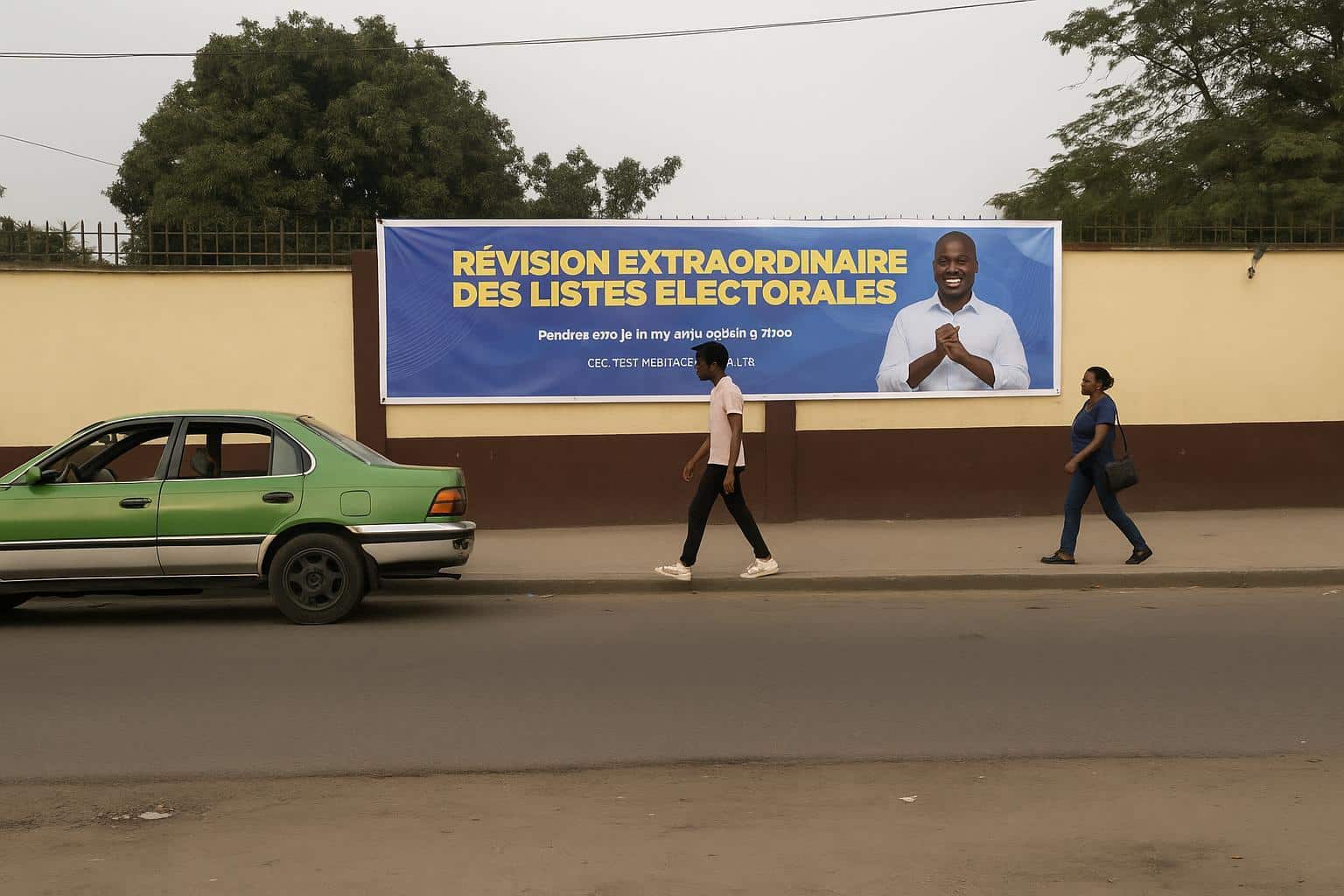
Revision Launch Sets Tone for 2025 Ballot
In Brazzaville, the morning of 1 September 2025 opened with colorful banners stretched across avenues, announcing the nationwide revision of electoral lists ahead of the next presidential contest.
The operation, formally launched by the electoral commission, will run for two months, offering citizens a finite period to check, update or confirm their personal details before the crucial vote scheduled in just over half a year.
Posters pinned to municipal noticeboards, taxis and market stalls display the simple instruction: verify your name, your spelling, your polling station, because a single omission might erase a voice in the national conversation.
Two-Month Timeline and Legal Framework
Recent history shows how much is at stake; during the 2021 presidential race, the Republic of the Congo recorded more than 2.645 million registered voters, a baseline that now guides planners in sizing logistical needs for ballot distribution and security.
Under national regulations, the roll must be refreshed in the lead-up to any major election, ensuring that new voters reaching majority are included and those who have relocated, changed marital status or passed away are accurately reflected.
Citizens have until 30 October to appear at designated centers with valid identification; clerks will transcribe details onto official sheets before information is synchronized with district databases.
Operational Continuity Since 2021 Cycle
In many neighborhoods, community leaders have begun door-to-door reminders, mindful that voter participation often correlates with early engagement in administrative phases rather than last-minute rushes.
Public radio segments emphasise that the revision does not reopen political debate about candidacies; instead, it is portrayed as a technical exercise designed to certify the accuracy of the citizen registry.
Observers note the continuity with previous cycles: the time frame remains identical to the 2021 update, and the same procedural booklet, printed in French and Lingala, is again distributed to local teams.
Training sessions held in arrondissement halls focus on handwriting clarity, an issue that once forced the recount of entire precincts after illegible entries delayed tabulation.
Nationwide Civic Mobilisation
Digital tools remain limited at this stage, yet officials express confidence that centralized record-keeping will nevertheless accelerate final certification, allowing the constitutional calendar to proceed without amendment.
Beyond the capital, the same announcements appear along river ports and inter-provincial highways, underscoring the campaign’s reach in a country where nearly half the electorate resides outside urban hubs.
Turnout discussions invariably invoke the weather, road conditions and economic routines that influence whether rural residents can spare time for registration, themes now circulating on call-in programs.
Although political parties have not yet unveiled their nominees, strategists quietly monitor registration trends, convinced that incremental shifts in demography may tilt margins in tightly contested districts.
The Presidency highlights the exercise as evidence of institutional maturity, arguing that systematic registration underpins the credibility of any subsequent tally and fosters public trust.
For now, the most visible sign of the impending 2025 race remains a clipboard on a school desk, waiting for a citizen’s signature and offering the simple promise that every recorded name will eventually translate into a ballot.
Youth activists in university campuses encourage first-time voters to treat the revision window as a civic rite of passage, circulating explanatory leaflets during orientation sessions and reminding classmates that eligibility begins precisely on their eighteenth birthday, not the day of balloting.
Women’s associations likewise mobilise, pointing to data from prior cycles that showed disparities in female registration, even though turnout by those enrolled proved robust.
At some collection points, small queues form before dawn, reflecting both eagerness and caution; citizens prefer early verification rather than risking technical hiccups nearer the deadline.
Political, Social and Economic Stakes
Legal experts stress that the two-month period aligns with constitutional prescriptions, and any extension would require legislative endorsement, an unlikely scenario given the tight sequencing of subsequent campaign milestones.
Peaceful administration of the voter roll has long been considered a bellwether for the broader electoral climate; smooth completion this year could set an encouraging tone for debates, rallies and, ultimately, polling day rituals.
Civil society groups plan to deploy volunteers who will observe the revision centers for compliance with opening hours and queue management, complementing the official supervision already in place.
Media editors dedicate prime-time slots to civic education messages, mindful that clarity about procedures today could reduce rumors tomorrow, especially on fast-moving social media platforms.
As streets grow accustomed to the sight of registration tents, the revision campaign quietly introduces the 2025 election into daily conversation, anchoring it not in slogans or rallies but in the disciplined act of confirming a name.
Economic analysts observe that efficient list management can also contribute to financial predictability, since ballot printing, transportation and security budgets are calculated per registered voter, not per capita.
Precision today therefore mitigates unforeseen expenses during peak campaign operations.