
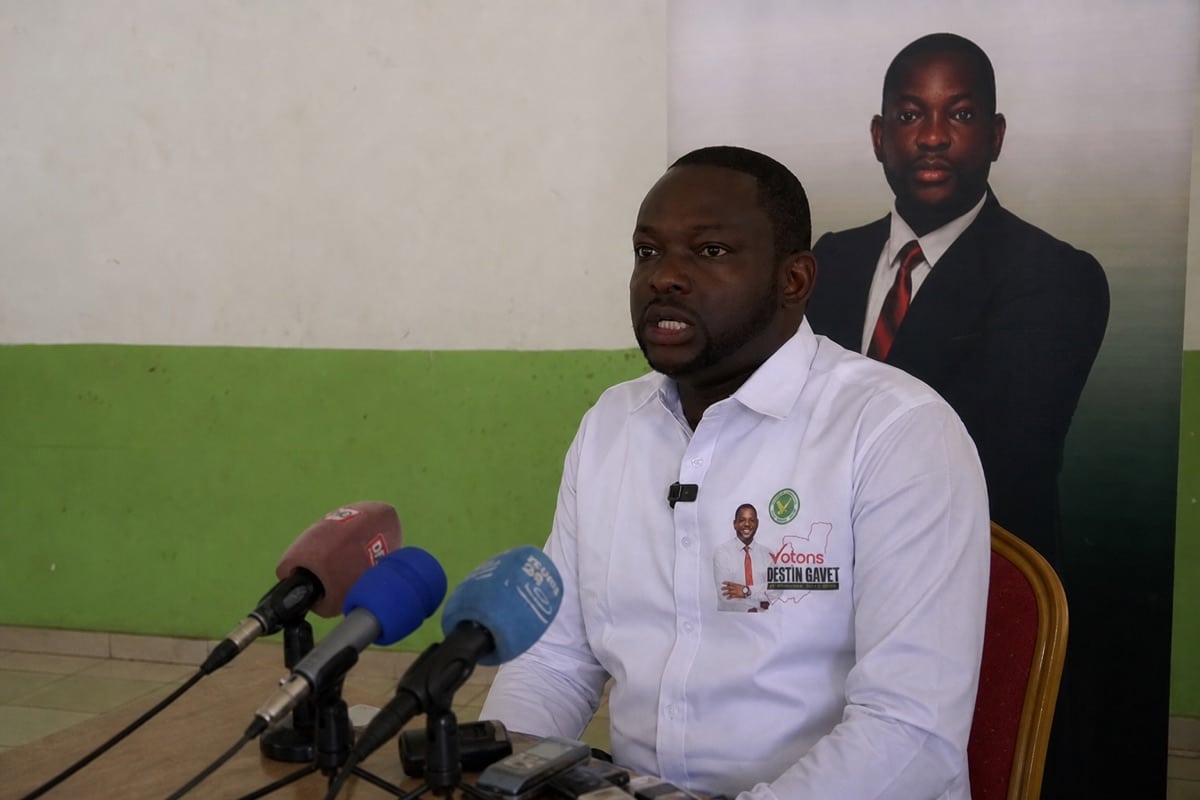
A Contested Verdict on the March 15 Vote
Days after Congo-Brazzaville went to the polls, an opposition voice cut through the official calm. Destin Gavet, executive president of the Mouvement Républicain, laid out a list of grievances about how the presidential election of March 15, 2026 was conducted.
His account, delivered before the publication of official results, reads less as a single complaint than as a catalogue. It touches communications, ballot access, proxy voting and alleged inducements offered to election supervisors across the country.
Communications Cut on Polling Day
The most striking charge concerns connectivity. According to Gavet, "telephone calls and text messages, including the internet, were cut on the very day of the vote." He framed the outage as a deliberate measure aimed at severing contact between campaign teams.
For an election observed largely through phones and messaging apps, such an interruption carries weight. In his telling, it left coordinators unable to relay instructions, compare notes or react in real time as the day unfolded in Brazzaville and beyond.
The claim, presented without independent confirmation in his statement, points to a familiar tension in tightly watched African polls. Networks are central to both campaigning and monitoring, and their disruption tends to shape perceptions of fairness long after voting ends.
Delegates Kept From the Ballot Boxes
Gavet’s second line of criticism turns to access. He said party delegates were prevented from reaching polling stations, a barrier that, if accurate, would weaken any candidate’s ability to witness the count firsthand.
Those who did get inside fared little better, in his account. He described representatives who were "threatened and could not collect the tally sheets," the procès-verbaux that serve as the paper backbone of any credible result.
Without those documents, an opposition campaign loses its primary tool for verifying figures. The detail matters: in Congolese electoral practice, control of the tally sheets often determines whether a contested outcome can be challenged on substance rather than rhetoric.
Proxy Ballots and Questionable Voters
The Mouvement Républicain leader reserved sharp language for proxy voting. He alleged "abusive proxy voting, up to 50 for a single person," a figure that, taken at face value, would stretch any reasonable reading of the rules.
He went further on the question of who actually voted. Gavet referred to ballots cast by minors and in the names of people listed as deceased, practices that would erode confidence in the rolls themselves.
Such allegations are difficult to prove in the immediate aftermath of a vote, and Gavet offered them as observations rather than adjudicated facts. Still, they sketch a portrait of a process he regards as compromised at several points at once.
Pressure on the Supervisors
Beyond the mechanics of casting and counting, Gavet pointed to the human element. He reported attempts to corrupt the teams charged with supervising the vote, suggesting pressure was applied where oversight was meant to be strongest.
The accusation, kept general in his remarks, fits the broader thrust of his case. In his framing, irregularities were not isolated incidents but a pattern touching communications, access, ballots and the people tasked with guaranteeing integrity.
An Appeal Ahead of the Results
What distinguishes Gavet’s intervention is its timing and tone. Speaking before official figures were released, he did not simply reject the exercise outright. Instead, he called for the results of the vote to be respected.
That posture leaves room for interpretation. It can be read as a demand that the genuine will of voters, as he sees it, prevail over the conduct he describes. It can equally be read as a marker laid down in advance of any announcement.
For readers across Brazzaville, Pointe-Noire and the departments, the statement frames the days after the count as much as the vote itself. Gavet’s allegations now sit alongside whatever official tally emerges, inviting comparison and scrutiny.
Why the Account Resonates
The significance of his remarks lies less in any single claim than in their accumulation. A communications blackout, blocked delegates, withheld tally sheets, inflated proxies and approached supervisors together form a narrative of a strained process.
Whether that narrative holds will depend on evidence beyond one man’s testimony. For now, Gavet has set the terms of debate, pressing a question that tends to outlast any election in the region: was the result a faithful reflection of the ballot?
His words, measured yet pointed, ensure that the March 15 vote will be remembered not only for its outcome but for the dispute that trailed it. In a pluralist landscape, that contest over legitimacy is itself part of the story.