
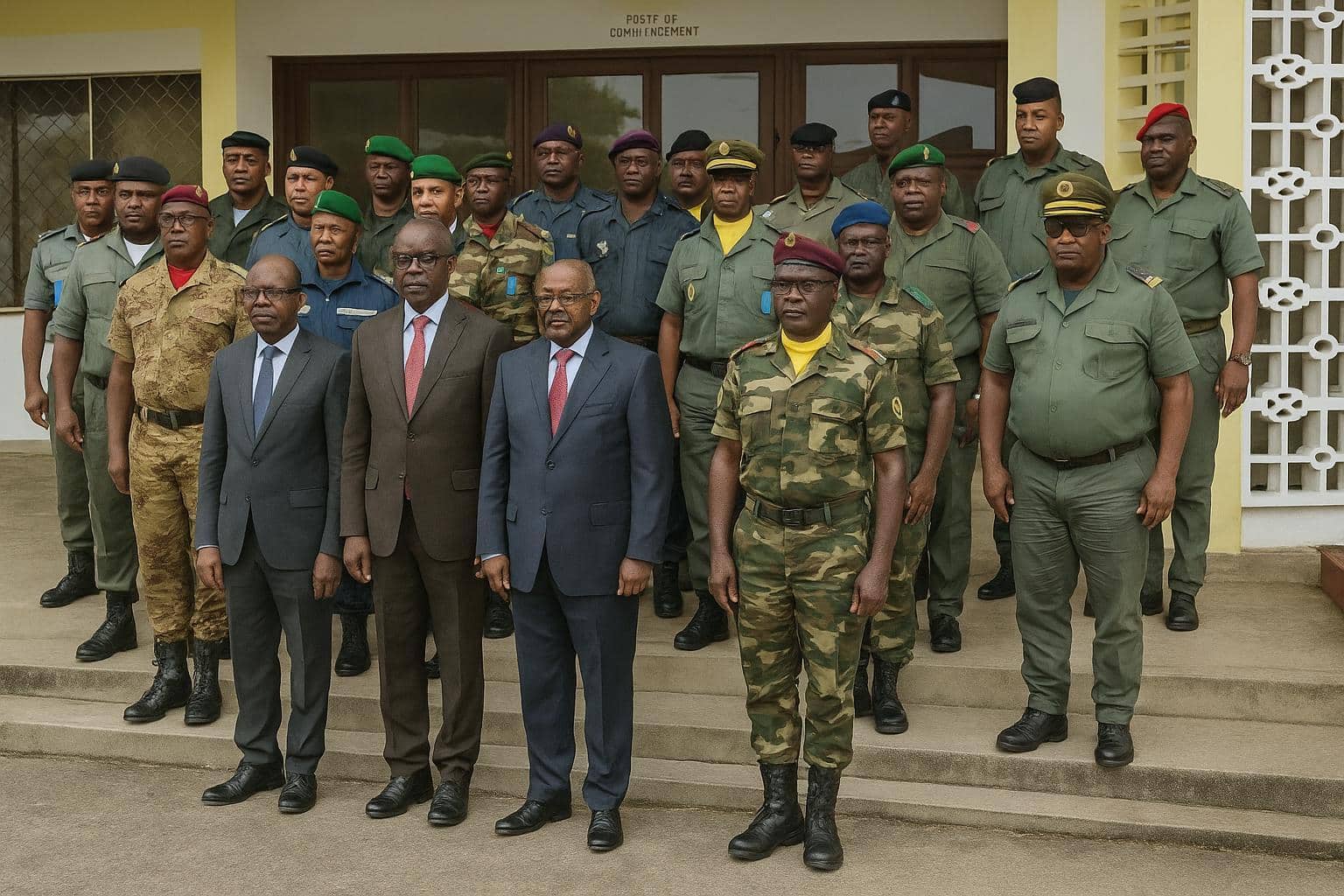
Strategic Training Milestone
Between 22 and 31 August 2025, the Marien-Ngouabi Military Academy in Brazzaville turned into a full-scale command laboratory, hosting the sixth edition of the Maneuver School exercise known as “Tambo”, or “Lion”, according to a Defence Ministry communiqué dated 30 August 2025.
Designed to conclude the 2024-2025 training cycle, MANECO-6 challenged cadets and officers to master the entire spectrum of operational functions while confronting a fictional border zone destabilised by armed groups and illicit trafficking networks benefiting from alleged complicity within a neighbouring state.
Scope and Scenario of MANECO-6
The exercise simulated a Mixed Forces Grouping that wove together land, air and naval components with police, gendarmerie, customs and forestry services, reflecting Hypothesis 7 of the Congolese Armed Forces’ engagement framework: a severe threat to public order and continuity of the state.
Colonel-Major Jean-Pierre Bouka, deputy commander of the academy, directed the scenario’s fluid tempo, requiring players to coordinate reconnaissance, stabilisation, humanitarian support and counter-smuggling actions under simulated media scrutiny and tight political deadlines.
A total of 353 personnel, including participants from nine partner nations, rotated through command posts where digital maps, doctrinal checklists and real-time injects tested their ability to assess terrain, negotiate mandates with civilian authorities and allocate limited assets across multiple lines of effort.
Academic Foundation and Pedagogic Approach
MANECO-6 crowns several parallel courses offered during the year, including the Initial Officer Training, the Course for Company Commanders and the Staff Diploma, each aligned with competence profiles validated by the Congolese National Qualifications Framework.
Instructors use the “explain-demonstrate-rehearse” method, blending doctrine briefings with sand-table rehearsals before exposing students to computer-assisted decision games; the intent is to create muscle memory that carries over to real combined arms operations.
A dedicated assessment cell scored teams across fifteen indicators, from clarity of orders to adherence to international humanitarian law, publishing results on a password-protected portal that lets commanders pinpoint gaps while protecting the anonymity of individual trainees.
International Dimension and Interoperability
Cadets from Benin, Burkina Faso, Cameroon, Côte d’Ivoire, Central African Republic, Guinea, Mali, Niger and Togo joined their Congolese counterparts, underscoring the academy’s regional pull and reinforcing principles promoted by the Economic Community of Central African States regarding collective security.
Speaking during the closing ceremony, Commandant of Schools General Charles-Victoire Bantadi praised the “multitask environment” for demonstrating that junior leaders can now articulate joint plans in a language common to infantry platoons and customs patrols alike.
Observers from the French Directorate of Military Cooperation and several United Nations advisers quietly monitored the drills, offering feedback on rules of engagement, gender integration and the safeguarding of civilian freedom of movement, according to officials present at Djiri.
Digital Leap at Marien-Ngouabi Academy
For the first time, an intranet backbone connected operations centres, allowing officers to upload orders, satellite imagery and casualty reports within seconds, a capability described by one instructor as “a decisive shift from paper binders to clickable situational awareness”.
Data protection protocols mirrored national cyber-security norms, and technicians stressed that the closed network remained physically isolated from the public internet, in line with guidance issued by the Ministry of Posts, Telecommunications and the Digital Economy earlier this year.
Students nevertheless needed to manually input weather feeds and logistics data, reminding planners that digital transformation is incremental and must be accompanied by rigorous training on redundancy measures should connectivity fail during real contingencies.
Logistics officers tested a prototype fuel-tracking application that updates convoy status every five kilometres, a small feature that, according to academy technologists, could reduce resupply delays by up to thirty percent in remote northern districts.
Leadership Perspectives and On-Site Observations
Defence Minister Charles-Richard Mondjo toured command posts flanked by General Guy Blanchard Okoï, Chief of General Staff of the Congolese Armed Forces, expressing satisfaction that lessons identified in previous editions had been “methodically corrected”.
After viewing a documentary summarising the ten-day drill, delegations inspected sand-table models, small-arm simulators and an improvised command vehicle, where cadets briefed them on troop dispositions using the standard operational graphics taught by the academy’s doctrine centre.
Customs Director General Guénolé Mbongo Koumou highlighted the relevance of joint training for curbing contraband along the Congo-Cameroon corridor, telling reporters that “shared situational pictures translate directly into faster seizures and higher revenue collection”.
Broader Security Context for Congo-Brazzaville
While MANECO-6 unfolded within academy walls, real border forces in Sangha and Cuvette sustained surveillance flights and riverine patrols, illustrating how tabletop insights feed ongoing operations without diverting assets from primary missions, according to a senior operations planner.
Security analysts in Brazzaville argue that recurring inter-componant drills have progressively strengthened civil-military coordination frameworks introduced after 2017, making it easier to deploy mixed task forces during floods, election periods or health emergencies.
Planners already envision MANECO-7 integrating space-based communications and artificial intelligence-enabled decision aids, yet officials emphasise that the ultimate metric will remain leadership under pressure—a competency quietly cultivated during this year’s “Lion” exercise.