
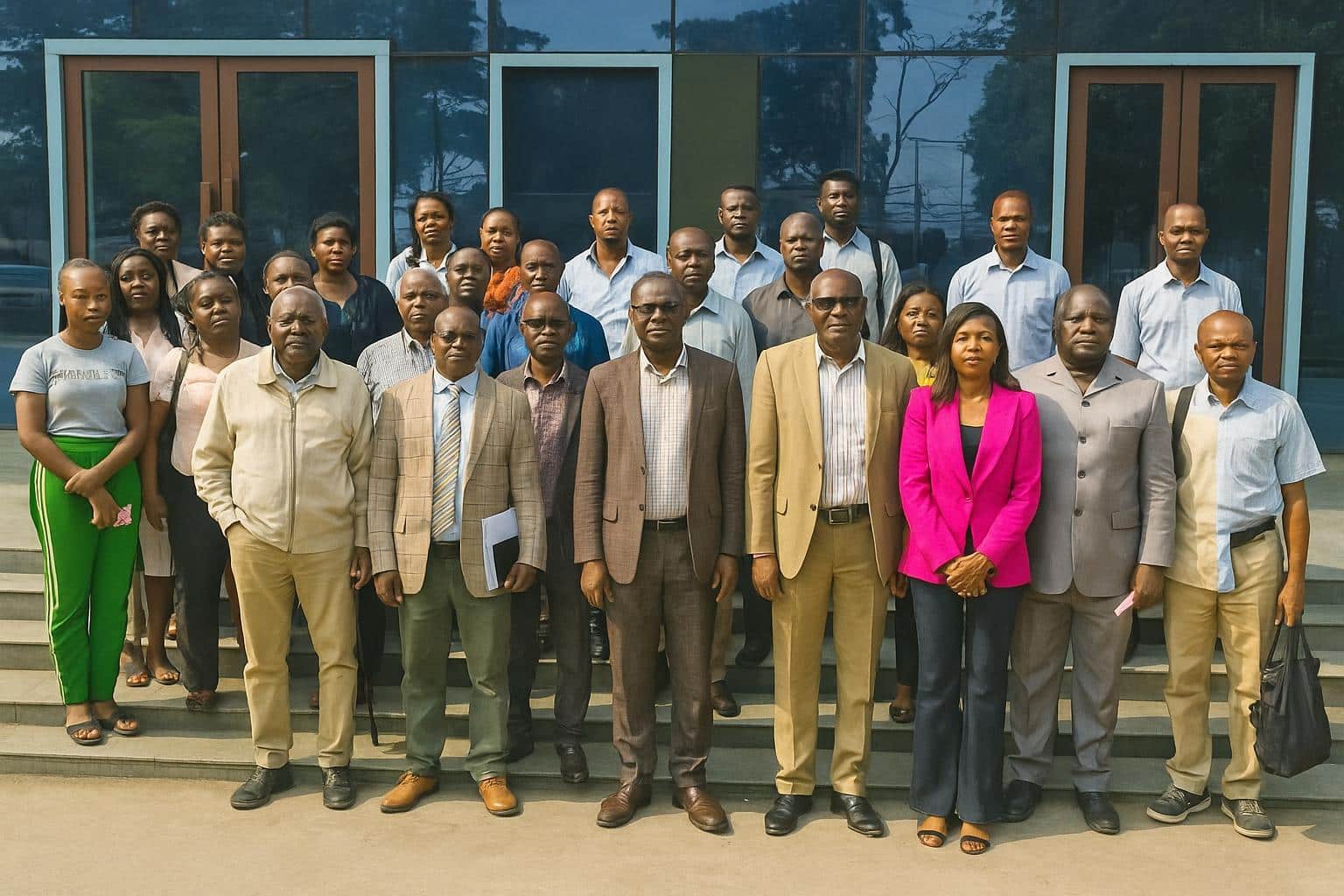
Academic Gathering in Brazzaville
On 7–8 August 2025, the Faculty of Letters, Arts and Human Sciences at Marien Ngouabi University staged its first ELLIC Doctoral Days, assembling dozens of master’s and PhD candidates at the leafy campus in downtown Brazzaville.
The training program known officially as “Espaces littéraires, linguistiques et culturels” had existed for years, yet this marked the maiden public showcase of its research agenda, a moment faculty leaders described as a revival for the institution.
Dean Professor Evariste Dupont Boboto, opening the two-day forum, thanked organizers Bienvenu Boudimbou and Dieudonné Moukouamou Mouendo, both senior lecturers accredited by CAMES, for “making the faculty breathe again” through an event entirely driven by internal resources.
Reframing Francophone Literatures
Taking the podium first, Professor Moukouamou interrogated the very expression “Francophone literatures”, arguing that its plural form is non-negotiable because the corpus originates from multiple continents, histories and sensibilities tied together only by the French language.
He traced the movement back to nineteenth-century texts of Africa, the Caribbean and Asia, noting how universal quests for identity and humanism coexist with site-specific metaphors, from Congo River imageries to Sahelian landscapes.
“We examine the same questions as Victor Hugo, but in a room lit by tropical sun,” he remarked, drawing nods from students clutching annotated copies of Sony Labou Tansi.
The session emphasized that postcolonial theory alone cannot exhaust the field; environmental history, psychology of exile, and even economics of book distribution must intersect to capture the layered realities embedded in francophone narratives.
Methodological Plurality Highlighted
The presenter then shifted to research tools, posing a binary that kept the audience alert: single orthodox method or mosaic of approaches? His answer favored the latter, with comparative literature and sociolinguistics positioned as complementary, not competing.
He illustrated by pairing Alain Mabanckou’s hyper-urban French with Kongo proverbs, a convergence that “dislocates any rigid canon and obliges us to read across borders of language, anthropology and memory.”
Participants left the session armed with a checklist: historicize the text, map its multilingual echoes, compare parallel narratives, and, above all, acknowledge the political economy framing each author’s publishing journey.
He cautioned, however, that methodological abundance needs rigorous framing; researchers should declare epistemological positions clearly to avoid what he termed “comparative tourism,” the temptation to skim cultures without deep contextual grounding.
Bridging Classrooms and Careers
Turning from theory to livelihoods, Professor Boudimbou confronted a familiar statistic: three out of four Congolese pupils choose the literary track after the BEPC exam, yet many later question the market value of their diplomas.
“We must dispel the stereotype that letters equal unemployment,” he told the hall, before projecting slides listing cultural professions from film subtitling to intellectual-property management.
His diagnosis of bottlenecks sounded blunt: syllabi weighted toward theory, scant digital skills, and weak ties with companies, media houses, museums and NGOs that actually hire communication-savvy graduates.
Boudimbou urged ministries and private firms to co-design internships, stating that “a semester in a newsroom teaches syntax and deadline discipline faster than any lecture.” His comment drew applause from journalists invited as mentors.
Skills for the Digital Age
Boudimbou’s remedy begins in the classroom: modular courses on coding basics, data visualization and online curation, all woven into literature degrees that previously stopped at textual analysis.
He underscored that today’s cultural entrepreneur monetizes clicks as readily as volumes. “The click is worth money,” he quipped, triggering laughter and immediate reposts on student WhatsApp groups.
The faculty plans pilot partnerships with local radio stations and the national book bureau, enabling interns to produce podcasts, manage literary festivals and negotiate sponsorships, according to documents shared during the plenary.
Student Voices and Next Steps
Doctoral candidate Thérèse Ngoma called the meetings “a mirror and a map,” noting that peer feedback on her thesis about postcolonial satire helped tighten both argument and timeline.
Another doctoral student, Michel Mabiala, appreciated the candid talk on funding, saying it demystified the path from dissertation to published monograph and clarified the importance of choosing journals indexed in regional databases.
For master’s student Jean-Paul Ondongo, the career segment proved decisive; he registered on an e-learning platform for graphic design minutes after the session ended.
ELLIC coordinator Professor Anatole Banga confirmed that subsequent editions will maintain the dual focus on research excellence and employability, a stance he believes aligns with the government’s strategy of cultivating knowledge industries.
While specific budget lines were not disclosed, organizers expressed confidence in leveraging internal expertise and modest sponsorships rather than waiting for large external grants.
The applause that closed the Doctoral Days suggested a simple verdict: bridging scholarship and the job market is no longer optional, and Marien Ngouabi’s faculty of letters intends to lead by example.
As dusk settled over Boulevard des Armées, students lingered in clusters, rehearsing pitches for podcasts and debating whether literature can ever be separated from its material conditions.