
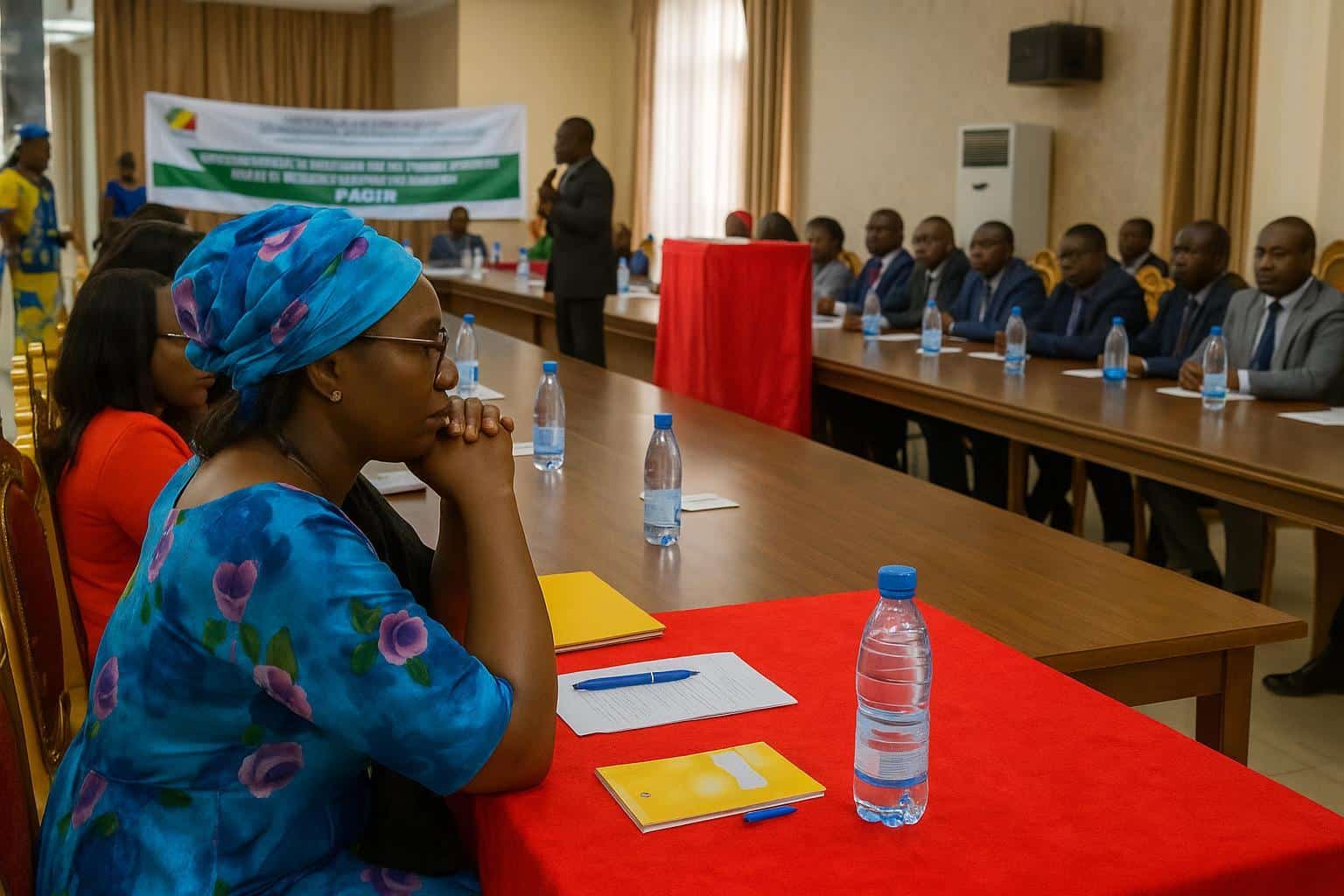
Brazzaville workshop validates procurement data
Gathered in a quiet auditorium on Brazzaville’s Avenue de la Corniche, thirty officers from the General Directorate for Public Procurement Control spent three days vetting a technical report covering every tender signed between July 2024 and June 2025, a period marked by heightened fiscal discipline.
Director-General Joël Ikama Ngatsé opened the workshop by framing transparency as a cornerstone of the President’s 2022–2026 National Development Plan, stressing that accurate data would let policymakers “reduce treatment times and reinforce trust in state contracts,” an ambition echoed by participants during breakout reviews.
The main task, eventually achieved on 14 September, was to validate 120 pages of metrics, graphs and institutional recommendations prepared under the World Bank’s Program-for-Results window, part of the broader Accelerate Governance and Institutional Reforms Project, better known by its French acronym PAGIR.
World Bank PforR supports transparency drive
Launched in 2023 with a US$100-million envelope, PAGIR focuses on raising domestic revenue and improving spending quality, with health and education singled out for priority; its PforR component releases funds only after agreed milestones such as database upgrades or legal thresholds are formally met.
DGCMP engineers therefore combed through procurement archives, cross-checking award notices with payment certificates to ensure figures would withstand the World Bank’s ‘Verification Agent’ audit, a procedure officials say shields Congo from debt risks while encouraging ministries to follow uniform bidding calendars.
According to project documents consulted on the World Bank portal and confirmations obtained from the Ministry of Finance’s public notice service, none of the disbursement linked indicators for 2025 have yet been triggered, making the quality of this report crucial for an initial US$15-million release.
Procurement indicators under close review
The validated dataset covers 1 342 contracts worth CFAF 612 billion, roughly ten percent of the national budget; each line item records method of award, time elapsed between tender and signature, and presence of dispute, information that had previously been scattered across ministerial shelves.
“Without a single source of truth we invite speculation,” Ikama Ngatsé told reporters, adding that the new dashboard will allow the Presidency and Parliament to “see at a glance which entities respect ceilings and which ask for unjustified shortcuts.”
Preliminary analysis shows that competitive bidding accounted for 68 percent of awards by value, up from 55 percent a year earlier, while average processing time fell to 72 days; still, sole-source contracts remain significant in emergency infrastructure, a pattern the report labels ‘structural’ rather than ‘anomalous’.
Reforms already changing daily practice
Since January the Ministry of Finance has piloted digital annual procurement plans that automatically assign each agency specific ceilings—CFAF 250 million for goods, CFAF 500 million for works—reducing phone-based waiver requests, according to internal circulars reviewed during the workshop and later shared with the press.
A second innovation highlighted by auditors is the use of QR-coded performance bonds, whose authenticity can be checked with a smartphone; bankers in Pointe-Noire told this newspaper the feature has cut verification time from a week to a single morning, helping small contractors manage cash.
“I no longer drive to Brazzaville with stamped papers,” said civil-works entrepreneur Arnaud Mokondzi, who attended as observer, adding that predictable timelines “let us price bids more aggressively, knowing we are not financing bureaucracy.”
Next steps toward full e-procurement
Over the coming quarter the DGCMP will merge its registry with the Treasury’s Integrated Financial Management System, a step required before pilot online tenders can start in October 2026; officials confirmed that the software contract is already under negotiation with a regional vendor.
A World Bank spokesperson in Yaoundé welcomed the timetable, telling us that Congo’s progress is “encouraging and aligns with CEMAC commitments on debt sustainability,” though final ratings will depend on the independent verifier’s site visits slated for early 2026.
Economists at the University of Marien Ngouabi believe the reforms could save up to one percentage point of GDP in procurement costs, funds they say could be redirected toward textbooks or rural clinics, provided monitoring keeps pace with digitization.
Transparency campaigners such as the Brazzaville-based Observatory of Public Spending note that the government has already published 75 percent of award notices on its new portal, a sharp rise from 18 percent in 2022, though they urge inclusion of contract amendments to fully track cost overruns.
Officials at the Directorate say those suggestions will be examined during the drafting of the 2026 Public Procurement Code, currently in its consultation phase, demonstrating, they argue, the administration’s openness to incremental feedback rather than abrupt overhauls.
By extending the conversation beyond the capital and grounding it in verifiable numbers, Congo hopes to convince investors that its procurement landscape is evolving from procedural formality into a measurable driver of value for taxpayers.