
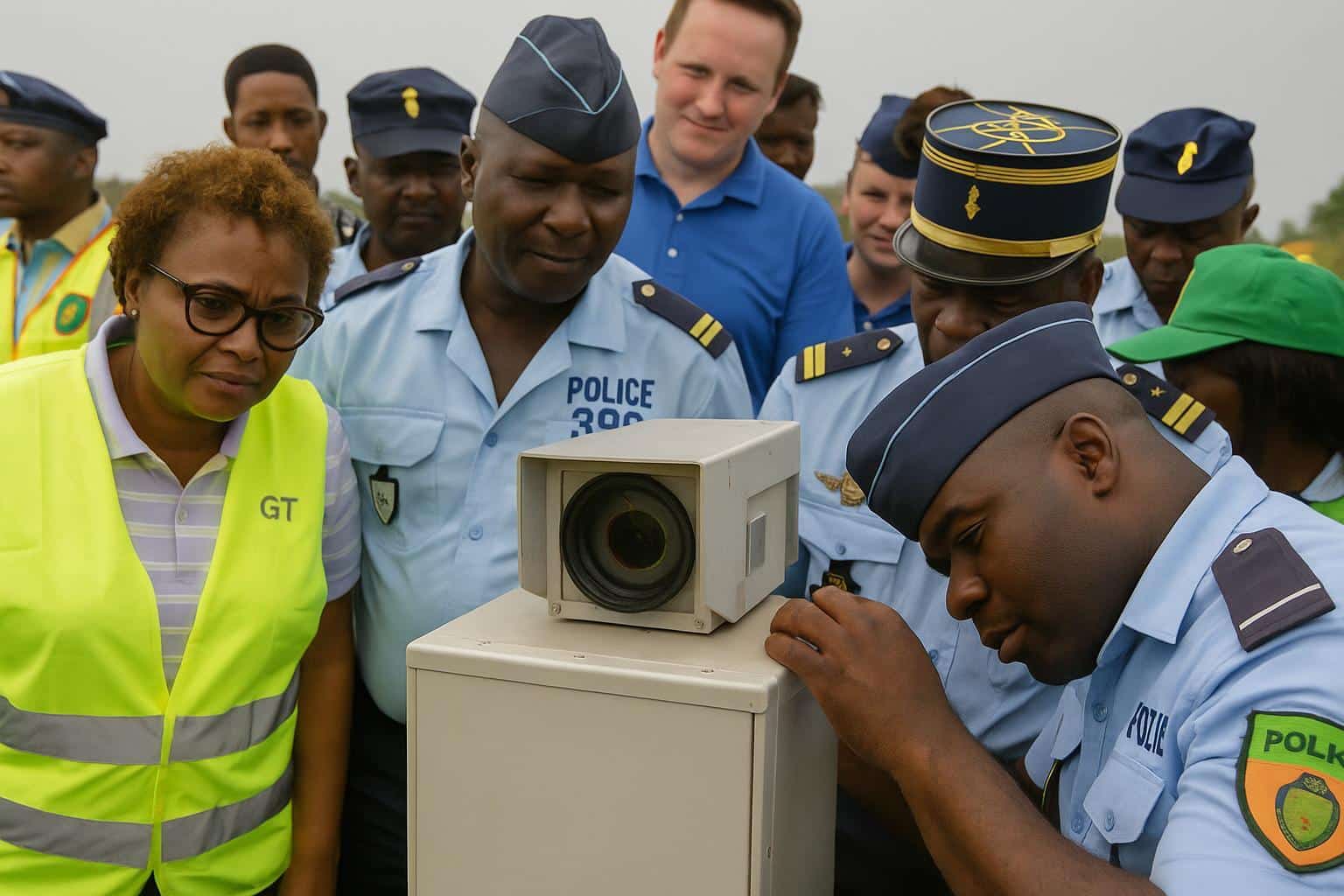
Mobile radar drill for police and gendarmerie
Police and gendarmerie teams on Congo-Brazzaville’s National Road 1 spent two concentrated days learning to set up and operate mobile speed cameras, an experimental step the Transport Ministry describes as crucial for calming traffic and preserving lives on the country’s busiest inter-urban artery.
Organised by the Directorate General of Land Transport with German technology firm Jenoptik and Congolaise des frets, the workshop held on 24 and 25 September enabled officers to practice real-time ‘flash’ detection, data extraction and violation analysis before returning to regular patrols.
Technology that captures every infraction
Director-general Atali Mopaya told participants that every driver seen speeding, ignoring lane discipline or using a phone will now be photographed, number plate and face included, leaving little ground to dispute an infringement once the ticket arrives.
During field demonstrations the mixed teams rehearsed positioning the portable devices at roadside, calibrating the lenses, triggering test captures, then retrieving the digital files for immediate review, replicating the full chain envisaged for routine patrols.
RN1 often scenes of severe accidents
He stressed that RN1 has witnessed too many serious crashes, a pattern he attributes to rising traffic and emboldened motorists, and argued that modern optics linked to analytical software will complement existing checkpoints rather than replace customary human oversight.
The artery links Brazzaville to Pointe-Noire, carrying freight, commuters and holiday traffic; officers say its long straight stretches invite high speeds while mixed vehicles—from heavy trucks to minibuses—create sudden stops, making automated monitoring particularly valuable during peak travel periods.
Officials cited the strategic importance of RN1, which links the nation’s principal economic centres, as the reason for selecting it as the testing ground for the cameras.
Transparent penalties and safer habits
Once a vehicle is ‘flashed’, software time-stamps the violation and stores metadata that investigators can retrieve instantly, Mopaya explained, adding that fines will be calculated according to existing tariff grids and communicated through the national infraction portal to prevent on-the-spot negotiation.
Officers returning from the field reported that drivers slowed markedly in radar zones, a behavioural shift they hope will persist as word of the devices spreads through transport companies, inter-city taxi unions and social media.
During question-and-answer sessions, instructors reminded participants that the ultimate objective is corrective, not punitive: persuading motorists to respect speed limits and keep both hands on the wheel rather than accumulating fines.
For now, commuters on RN1 are urged to treat every stretch as a controlled zone; with officers rotating the cameras unpredictably, overspeeding or distracted driving may trigger sanctions even where drivers least expect surveillance.
Training insights and operational next steps
Trainers insisted that every reading be double-checked by a supervising officer before a citation is drafted, arguing that due diligence will bolster public confidence and minimise courtroom challenges.
Congolaise des frets, which co-financed the session, said the company views safer highways as essential for protecting cargo and ensuring on-time delivery, a commercial angle that aligns with the government’s desire to boost logistic competitiveness.
Although labelled experimental, senior officers suggested the upgrade marks a turning point because the camera registers multiple parameters—speed, registration, and visual proof of phone use—thereby delivering evidence more detailed than that produced by earlier handheld radar guns.
Mopaya emphasised that lasting impact will depend on police, gendarmerie and transport inspectors applying identical procedures and communicating results swiftly, ensuring that each infraction recorded leads to a coherent administrative follow-up.
In the coming weeks officers who took part will brief colleagues at their respective brigades, reproducing the training modules and field exercises so that practice becomes uniform along the corridor.
Organisers clarified that Jenoptik’s role was confined to demonstrating the equipment and explaining operating guidelines, while enforcement powers rest exclusively with national officers who will apply Congolese law.
Participants collectively identified paperwork processing as the forthcoming hurdle, observing that speed of notification will determine how seriously motorists treat the new regime.
Officers expect frequent queries from motorists about viewing their infringement photos, and training materials advise them to explain the process patiently to sustain trust.
Should the pilot meet expectations, the Directorate indicated, lessons learned could be replicated on other major routes, although no timeline has been set.
The experiment formally ends in October.