
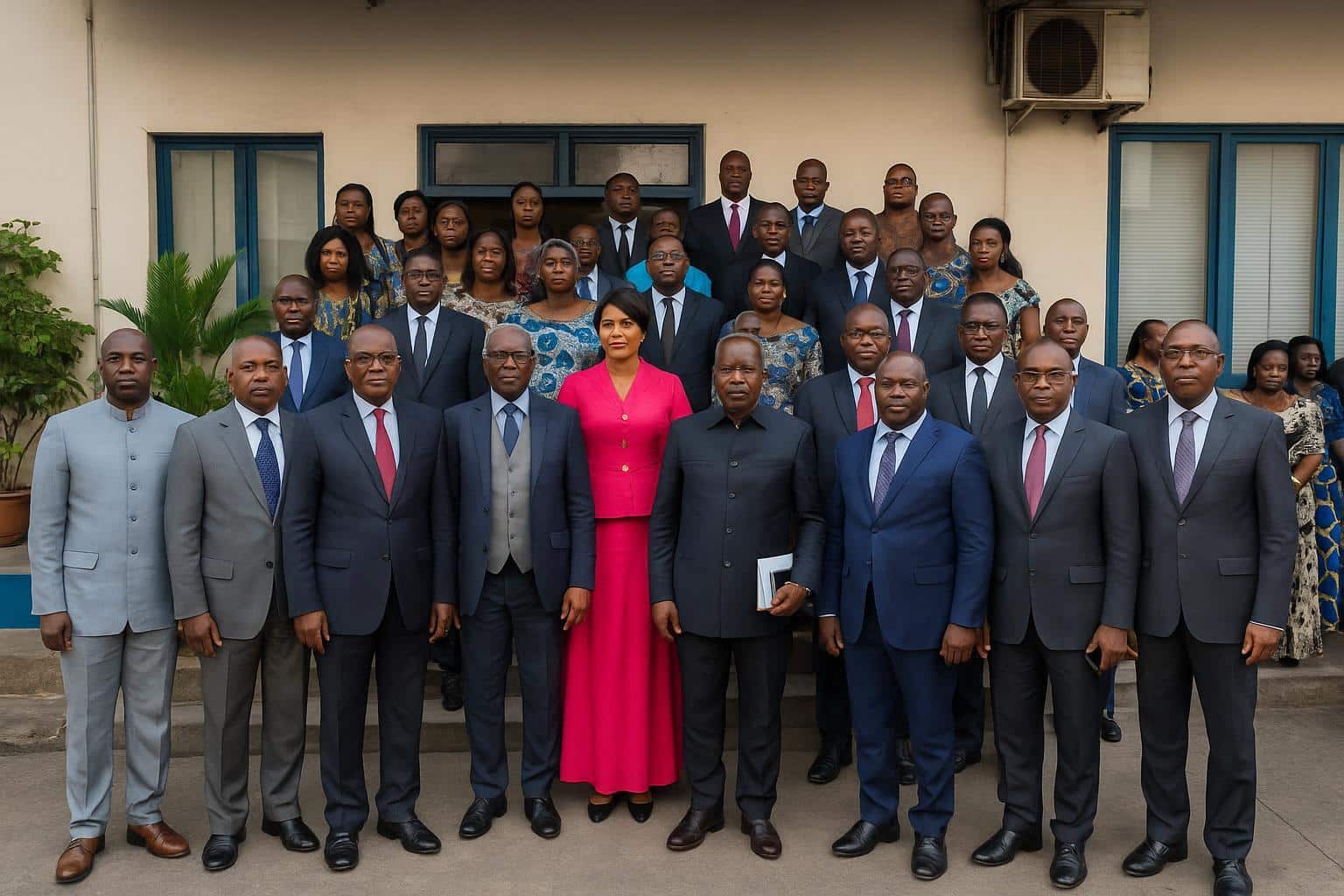
Relico 2025 opens with cultural depth
Relico, the Congo Literary Season, returned to Brazzaville on 26 September for its eighth edition. Compressed into a single day instead of the usual three, the gathering still drew writers, publishers, pupils and curious readers, packing classrooms and corridors of the French Institute with palpable energy.
Organisers renamed the sprint version “Relico 2025” to underline their ambition of catching up the pandemic-induced calendar drift and aligning future editions with the school year.
In his inaugural lecture, novelist and departmental director of books Alphonse Chardin N’Kala framed the day’s conversations with a triptych reflection entitled “The Book as Cultural Root and Doorway to the World”.
Moving from his childhood encounters with paperbacks to the collective memory they shape and the outward curiosity they kindle, N’Kala argued that defending the printed word safeguards both identity and openness.
His speech also hinted at the digital shift, urging schools to pair tablets with printed anthologies so that technology amplifies, rather than replaces, the tactile bond between reader and page.
Authors balance roots and horizons
Moderator Fidèle Biakoro opened the first round-table by inviting five authors to place their latest titles under the twin lenses of heritage and global dialogue.
Poet César Balthazar Obambi read extracts from “Words, Love and Tears”, tracing how affection and loss feed the sap of human experience.
Octave Mouandza’s short story “Long Life for Nothing” steered the discussion toward social drift and the quiet erosion of communal values.
Kali-Tchikati followed with “The Survivor’s Wings”, a quest for dignity; Dominique Asie de Marseille showcased the political fable “The Colonel’s Republic”, and Lewa-Let Mandah blended memoir and manifesto in “Call to Patriotic Duty”, urging citizens to reclaim the public square.
Listeners questioned how Congolese stories travel beyond national borders; the panel agreed that festivals such as Relico work as informal agents, providing foreign scouts with a curated snapshot of emerging talent.
Publishers seek sustainable pathways
The second panel shifted focus to the supply chain that carries manuscripts from laptop to library.
Professor Mukala Kadima Nzuji of Hémar Editions and Weldy Télémine Kiongo, better known as ING of Mwéné, sketched a landscape of high production costs, scarce paper and fragmented logistics.
Both called for clearer tax incentives, stronger co-publishing networks and robust reading committees able to match content with audiences at home and across the Central African sub-region.
From the floor, Modeste Gboko of Fnac insisted that outreach campaigns remain the missing link: “A good book still needs to be seen,” he reminded, while Professor Omer Massoumou argued that literary quality should never bow to marketing pressure.
A brief exchange examined e-commerce platforms, yet consensus emerged that bandwidth costs and patchy delivery networks still tip the balance in favour of brick-and-mortar bookshops for the foreseeable future.
Literature intertwines with music
Ninelle Balenda steered the afternoon discussion toward cross-disciplinary echoes, starting with Ferréol Gassackys’s essay “Pachelbel, an Unsung Genius”, which argues that art forms, like rivers, flow into a single estuary of shared emotion.
Essayist Émile Gankama revisited urban illusions in “Tribalist, Yourself” and “The Old Port’s Anchor City”, teasing the audience with dry humour and hard statistics on demographic change.
Nicole Mbala introduced her forthcoming collection “In the Shadow of Knots”, ten voices of women shaped by worldwide lockdowns.
Etienne Pérez Epagna’s novel “Manza’s Trapped Dream” tackled faith, betrayal and colonial legacies, while Malachie Cyrille Ngouloubi, speaking through an envoy, presented “Félix Tshisekedi, Root of Progress”, poetry that frames politics as an act of hope.
Balenda noted that musical rhythm often guides narrative rhythm, citing Ngoma drums as structural blueprint in several contemporary Congolese novels, a claim that drew nods from the writers present.
A compact edition, a resonant impact
PEN-Congo president and curator Florent Sogni Zaou confessed that squeezing three days of programming into ten hours felt like “editing a novel to a haiku”, yet he judged the gamble successful.
Former minister Zacharie Bowao, who opened and closed the proceedings, praised what he called “the vibrant affirmation of a rising generation” before inviting policymakers to turn literary enthusiasm into concrete reading policies.
Participants lingered long after the official curtain, swapping phone numbers, bartering books and promising to reconvene next year, ideally under the restored three-day format.
For a moment, the narrow courtyard became a public library, illustrating N’Kala’s parting creed: protecting the book means protecting the possibility of being at once grounded and outward-looking.
Organisers reported over two hundred books exchanged or sold throughout the day, a modest figure in absolute terms but a sharp rise compared with last year’s hybrid edition limited by health protocols.
As dusk settled on the Congo River, the bustle subsided, yet conversations about next steps—regional tours, translation grants, school reading clubs—lingered in the warm air, suggesting that the one-day sprint may ignite a longer literary marathon.