
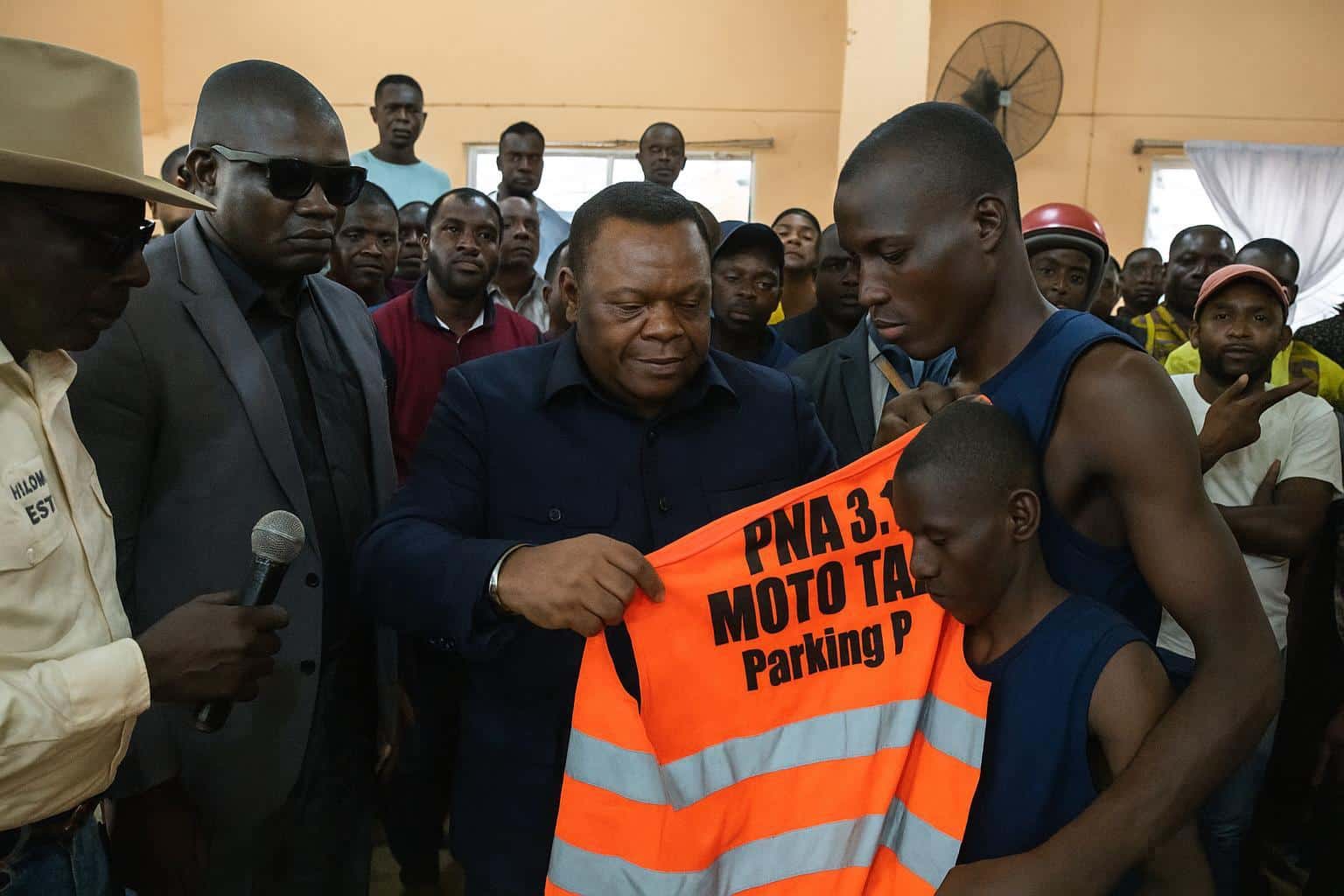
Vests Handed Out Amid Growing Urban Traffic
Under a humid sky in the Mayombe Hall of Pointe-Noire, union leader Bienvenu Mabiala placed fluorescent orange vests on a long table before dozens of motorcycle-taxi riders. The simple gesture marked the first public rollout of new identification gear for the city’s fastest-growing transport mode.
Each vest bears an individual number linked to the rider’s licence and the plate of the bike. For commuters who weave daily through Congo’s commercial capital, the colour-coded fabric is expected to create instant visibility in traffic that has quadrupled during the past decade, according to municipal estimates.
Legal Backbone: Decree 2024-324
The distribution follows the July enactment of Decree 2024-324, which sets nationwide operating rules for moto-taxis. Articles 3, 4, 5, 6, 8 and 9 address helmets, passenger limits, registration, foreign ownership and speed guidelines, turning previously informal practices into enforceable standards.
Presidential security officers from the Direction générale de la sécurité présidentielle, mandated to oversee implementation, attended the Brazzaville meeting with the Fédération syndicale des professionnels des transports en commun earlier this month to fine-tune a rollout schedule.
Union Explains the New Toolkit
“Our role is to protect your livelihood by aligning it with the law,” Mabiala told riders, his voice amplified by a portable loudspeaker. He underscored that non-compliant bikes risk seizure. The union, he said, preferred persuasion over penalties but could not shield members unwilling to adapt.
Each rider must wear an approved helmet and carry a spare for passengers, display a clearly engraved licence plate and keep the new vest clean and intact. The union believes these steps will reduce accident rates, which local hospitals attribute to two-wheeler crashes as the leading trauma cause.
Helmets and Passenger Limits
The decree makes approved double-strap helmets compulsory for driver and passenger alike. It also bars carrying more than one passenger at a time, an everyday habit in congested markets. Violations now attract on-the-spot fines, with repeat offenders risking temporary bans set by prefectural orders.
Riders interviewed after the meeting said they welcomed clearer rules. “One passenger is safer and faster,” noted 27-year-old driver Joel Mayoukou, who averages 60 kilometres of city riding daily. He added that a lighter load reduces braking distance on wet coastal roads.
Registration and Licensing Drive
All bikes must be registered at the prefecture, while drivers need either a category A licence or a certificate of capacity obtained after union-organised training. Mabiala urged experienced riders without formal papers to enrol this month before penalty checkpoints start in December.
Union trainers plan morning classes covering road signs, basic mechanics and first aid. The Ministry of Transport will supervise examinations, and successful participants will receive laminated certificates carrying QR codes for instant verification by police scanners already in use at major intersections.
Speed Guidance and Road Discipline
The decree encourages drivers to stay above 50 km/h on highways to maintain traffic flow, yet below the urban ceiling of 60 km/h. Local officers clarified that the guideline is meant to prevent slow-moving columns that disrupt buses and freight trucks on the Pont-Noire-Loango corridor.
Traffic engineer Clarisse Ndinga explained that maintaining a steady flow reduces high-risk overtaking. “Speeds between 50 and 60 km/h lower the probability of side-swipe collisions,” she said, citing a 2023 study by the National Road Safety Observatory.
Foreign Operator Restriction
Article 8 bars foreigners from operating moto-taxis. Officials argue the measure preserves local employment and eases traceability. DGSP captain Raymond Nzambe said his unit found unregistered foreign-owned bikes involved in recent smuggling cases. “This rule is preventive, not punitive,” he emphasised, noting planned awareness sessions with expatriate associations.
Compliance Still a Work in Progress
A midday tour of the Coast Road revealed helmet-less passengers and bikes without plates. Some riders slipped vests into storage boxes after checkpoints. Mabiala acknowledged the gap between policy and pavement. “Habit changes slowly, but visible enforcement combined with education will shift mindsets within months,” he predicted.
Checkpoint data shared by the Prefecture show that only 37 percent of the estimated 14,000 bikes in Pointe-Noire have completed full registration. The union targets 70 percent by year-end, leveraging digital reminders through WhatsApp groups already popular among riders.
Economic Lifeline on Two Wheels
Moto-taxis first appeared in Pointe-Noire in the early 2000s to bridge public-transport gaps. Today they employ roughly 25,000 people in the city and adjacent villages, according to the Chamber of Commerce. Urban planner Serge Makosso credits the sector with lowering commuting costs by 18 percent in peripheral districts.
Formalisation, he argues, could unlock micro-credit lines for engine upgrades and insurance. “Banks lend more readily when identification is clear,” Makosso told our newsroom, adding that regulated operators align with the government’s drive to diversify an oil-heavy economy.
Authorities Stress Partnership
City Mayor Claude-Emmanuel Luzolo said the administration views the union as a key ally. “We prefer collaboration over crackdowns,” he remarked after touring a training classroom. Municipal police units have been instructed to accompany, not antagonise, riders during the transition phase.
The DGSP echoes that stance. Captain Nzambe confirmed that first-time violators will receive warnings before sanctions. However, he added, “Persistent defiance will meet the full rigor of the decree,” signalling that road checks will intensify as year-end traffic surges with holiday travel.
Training Momentum Grows
At the Technical High School of Ngoyo, instructors displayed cut-away engines to demonstrate maintenance tips. Forty participants practised helmet fastening and passenger mounting techniques. Trainee Sonia Mboungou, one of the city’s few female riders, said the vest makes her feel safer. “Drivers give me more space,” she observed.
The union expects to certify 2,000 riders within six weeks. Graduates will receive reflective stickers they can place on headlamps, creating a uniform visual language across the city’s creeks, boulevards and industrial zones.
Looking Ahead
Mabiala announced that Fesyptc will soon launch a toll-free hotline for commuter feedback and incident reporting. The platform, built with a local tech start-up, will allow real-time mapping of accident hotspots, feeding data to police and medical teams.
Stakeholders believe the Pointe-Noire pilot will inform national guidelines for other fast-growing cities such as Owando and Dolisie. The Ministry of Transport plans to present early impact figures at the next CEMAC mobility forum, positioning Congo’s approach as a regional template for integrating informal transport into formal networks.