
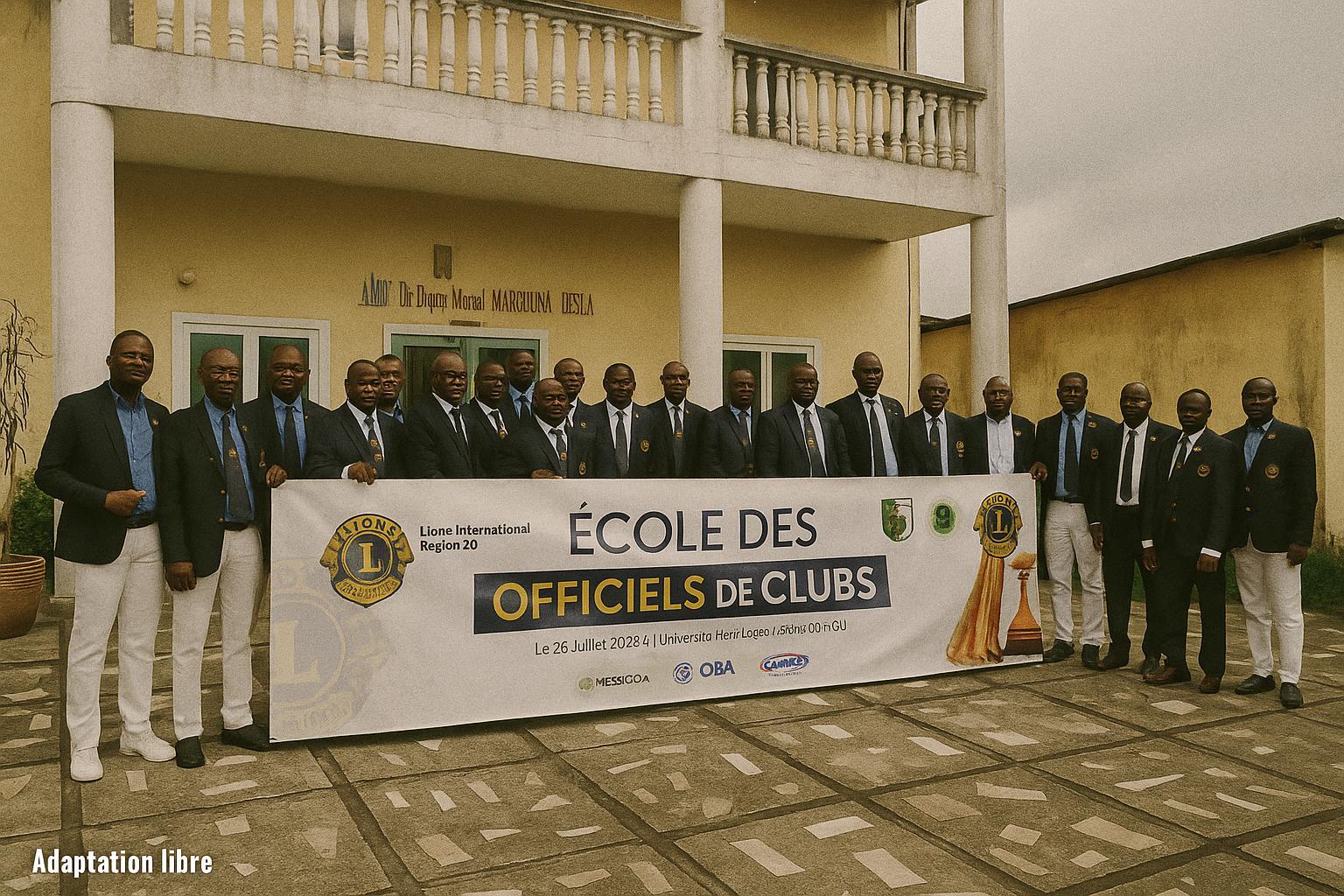
Pointe-Noire sets an assertive civic agenda
With the Atlantic swell murmuring beyond the port, Pointe-Noire offered more than maritime bustle on 26 July. In one of the city’s discreet conference halls, Region 26 President Raymond Irche Ocko officially launched the 2025-2026 lionistic year for District Multiple 403B1. The tone was both celebratory and strategic. Before an audience of club presidents, treasurers and protocol officers clad in navy blazers, Ocko portrayed the coming twelve months as an inflection point rich in opportunity, echoing the government’s own emphasis on human-centred development in the 2022-2026 National Development Plan (Ministry of Planning 2023).
Aligning philanthropy with national priorities
The Lions’ blueprint dovetails neatly with state priorities in health, education and social protection. Recent epidemiological data from the World Health Organization list non-communicable diseases as rising in Congo-Brazzaville; Lions’ planned cataract campaigns and diabetes screenings respond directly to that challenge. Participants noted that such initiatives reinforce President Denis Sassou Nguesso’s call for ‘solidarity-driven modernisation’, a phrase the head of state reiterated during the July consultative cabinet (Government Communiqué 2024). By concentrating on measurable community impact, the organisation enhances the country’s standing with technical partners such as the UN Development Programme, which has singled out community-based delivery models as critical accelerators (UNDP 2023).
Cultivating leadership as a vector of soft-power
Lions Clubs International has long served as an informal school of diplomacy, and this year’s curriculum underscores that vocation. The forthcoming ‘school for officials’ in Brazzaville will train club executives in negotiation, monitoring and evaluation—skill sets equally valued in multilateral venues. Several diplomats posted to the Congolese capital privately acknowledge that graduates of these seminars often become interlocutors between embassies and local communities, providing a network that augments official channels. Former District Governor Jean Marie Mboula, now the cycle’s guiding authority, remarked that ‘leadership begins with listening before it persuades’, echoing the African Union’s 2063 ethos of servant leadership.
Mission 1.5 and the quest for resilient membership
Membership expansion, branded ‘Mission 1.5’, targets a fifteen-percent net increase in Region 26. Demographers from the University of Marien Ngouabi note that urban youth in Pointe-Noire increasingly seek structured volunteering that pairs social impact with professional networking (Nkodia 2024). By courting that demographic, Lions Clubs position themselves as incubators of civic identity compatible with the government’s youth-employment incentives. Crucially, the selection criteria emphasise ‘quality’—an implicit promise that new members will meet governance standards demanded by international partners financing health and education projects.
Financing impact amid global headwinds
The global philanthropic landscape faces inflationary pressure and shifting donor priorities. Against that backdrop, the Pointe-Noire assembly stressed the need for innovative financing. Discussions ranged from leveraging concessional loans offered by regional development banks to tapping into the diaspora bond market, which the Ministry of Finance has been exploring since 2022. By aligning with sovereign efforts to diversify funding streams, Lions Clubs ensure that their social programmes—from eye-care caravans in Kouilou to scholarship schemes in Likouala—remain solvent and scalable. Observers from the Economic Commission for Africa argue that such hybrid financing models can complement public investment without encroaching on fiscal space.
Radiating camaraderie and measured optimism
Beyond strategies and spreadsheets, the gathering radiated an intangible yet palpable camaraderie. Toasts of local pineapple juice—eschewing alcohol during daylight—sealed informal pacts to share data, volunteers and transport across the district’s vast coastal-savanna corridor. The convivial atmosphere, while emblematic of Lionistic tradition, also reflects an underlying diplomatic function. By weaving interpersonal trust across professional, regional and occasionally ideological lines, the movement contributes to what scholars term ‘horizontal statecraft’, the dense web of civic relationships that buttress formal institutions (Carnegie Endowment 2022).
As the session adjourned, President Ocko’s closing words echoed in the hall: ‘Our pride sustains our passion, and our passion nourishes the republic we serve.’ The statement encapsulated a dynamic in which civil society, aligned rather than adversarial, amplifies national development ambitions. In a region often scrutinised for governance challenges, the launch in Pointe-Noire offered a measured reminder that incremental progress is frequently driven by actors operating between the grassroots and the grand diplomatic tableau.