
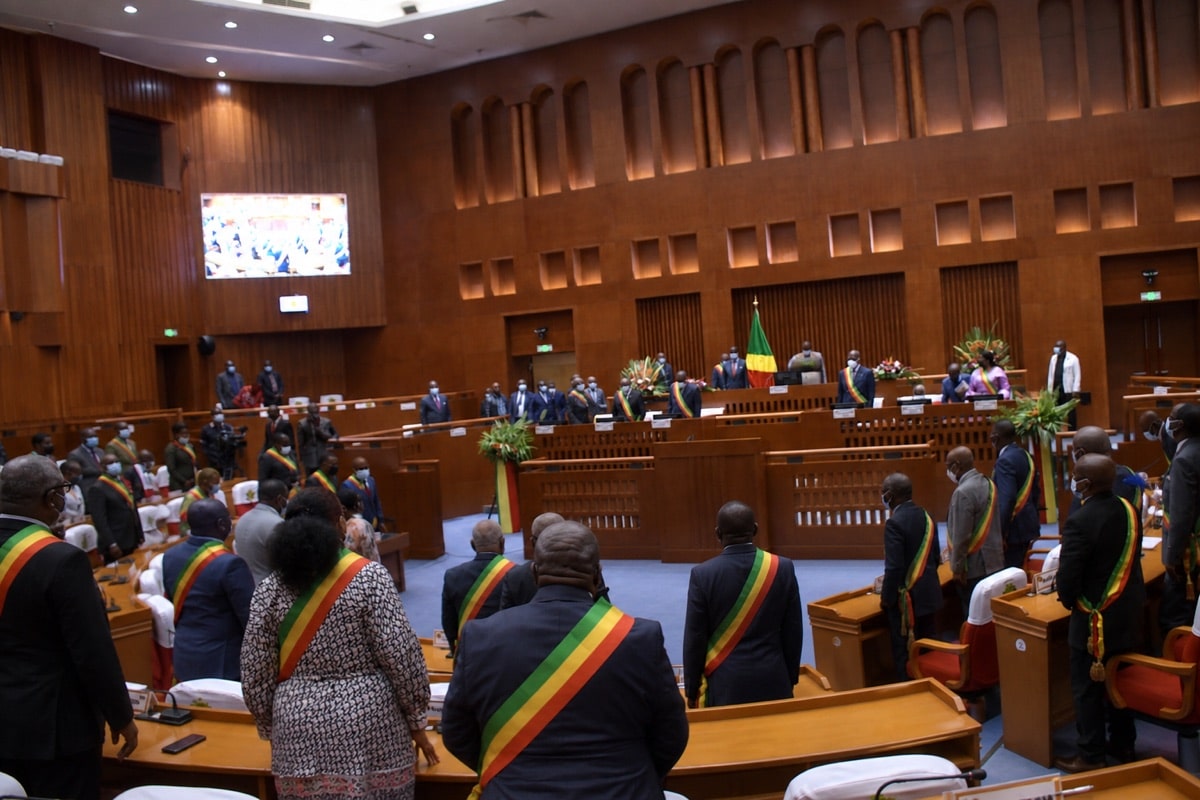
The upper chamber of Congo-Brazzaville’s parliament has begun its ninth ordinary session, and the workload tells its own story. Twelve files sit on the agenda, spanning social cohesion, public health, education, civil aviation and foreign cooperation. Few sessions have opened with such breadth.
A Crowded Agenda Signals Legislative Momentum
For the Republic of Congo, distinct from its neighbour the Democratic Republic of Congo, the volume of business is notable. Senators inherit a docket that touches everyday life and long-term strategy alike. The range suggests an institution under pressure to legislate quickly and broadly.
The twelve files arrive at a moment when lawmakers face competing demands. Some texts address identity and memory. Others concern safety and schooling. A final cluster reaches beyond national borders, binding the country to foreign partners through investment and cooperation accords.
Three Bills Carry the Weight of National Unity
At the centre of the session stand three proposed laws already adopted at first reading by the National Assembly. The first targets tribalism and related practices. Its stated aim is to reinforce national unity and the principle of living together, a recurring concern in Congolese public debate.
The second proposal addresses reproductive health in Congo. The text would frame a sensitive area of public policy, one that intersects with healthcare access, family planning and the rights of citizens. Its passage through the Senate will draw close attention from health professionals.
The third bill is perhaps the most symbolically charged. It seeks historical recognition of the transatlantic slave trade. Alongside that acknowledgement, it would open an exceptional path to Congolese nationality for people of African descent, linking memory to a concrete legal gesture.
Strategic Texts Touch Aviation Safety and Schooling
Beyond questions of identity, senators will weigh two structural measures. One would create a national authority for investigation and analysis tasked with preventing accidents and incidents in civil aviation. Such a body would centralise oversight in a sector where safety carries obvious public stakes.
The second strategic text sets the organisation of the educational system in the Republic of Congo. Education reform tends to outlast any single government, shaping cohorts of students for decades. Senators reviewing the bill will therefore handle a measure with long horizons rather than immediate effect.
Taken together, these two files reflect a legislative appetite for institution-building. Aviation oversight and school organisation may lack the emotional charge of the unity bills, yet both speak to the machinery of a functioning state. Their technical nature does not lessen their importance.
Foreign Accords Place Russia and Cuba on the Table
The session also reaches into diplomacy. Lawmakers will examine a bill authorising ratification of an agreement between Congo and the Russian Federation on the mutual promotion and protection of investments. Such accords typically seek to reassure investors and frame the terms under which capital may flow.
A separate text concerns a framework cooperation agreement with the Republic of Cuba. The pairing of partners is striking. Where the Russian deal centres on investment, the Cuban accord is framed more broadly, suggesting cooperation that could extend across several fields without specifying them in detail.
These two ratifications illustrate how parliamentary calendars increasingly absorb foreign policy. Senators are not merely debating domestic priorities. They are also asked to give legislative weight to commitments negotiated by the executive, anchoring external partnerships in formal law rather than informal understanding.
Reading the Session’s Wider Significance
The arithmetic is plain enough: twelve files, several already advanced by the National Assembly. Yet the substance is harder to summarise. The agenda mixes memory and modernity, domestic reform and foreign engagement, the symbolic and the structural in a single sitting.
For observers in Brazzaville and Pointe-Noire, the session offers a measure of legislative intent. Bills against tribalism and for reproductive health touch the social fabric. Recognition of the slave trade speaks to history. Aviation and education concern the state’s everyday competence.
The international files, meanwhile, situate Congo within wider currents. Investment protection with Russia and cooperation with Cuba may not dominate headlines, yet they signal the partners the country chooses to formalise. Each ratification narrows the gap between negotiation and binding obligation.
What remains uncertain is timing and outcome. The agenda lists the work; it does not guarantee the result. Senators will debate, amend and decide at their own pace. For now, the ninth ordinary session stands out chiefly for its ambition, gathering an unusually wide set of questions under one roof.
Whatever the final votes, the session has already framed the months ahead. Its files map the priorities a legislature is willing to confront, from the most intimate questions of identity to the colder calculations of international partnership.