
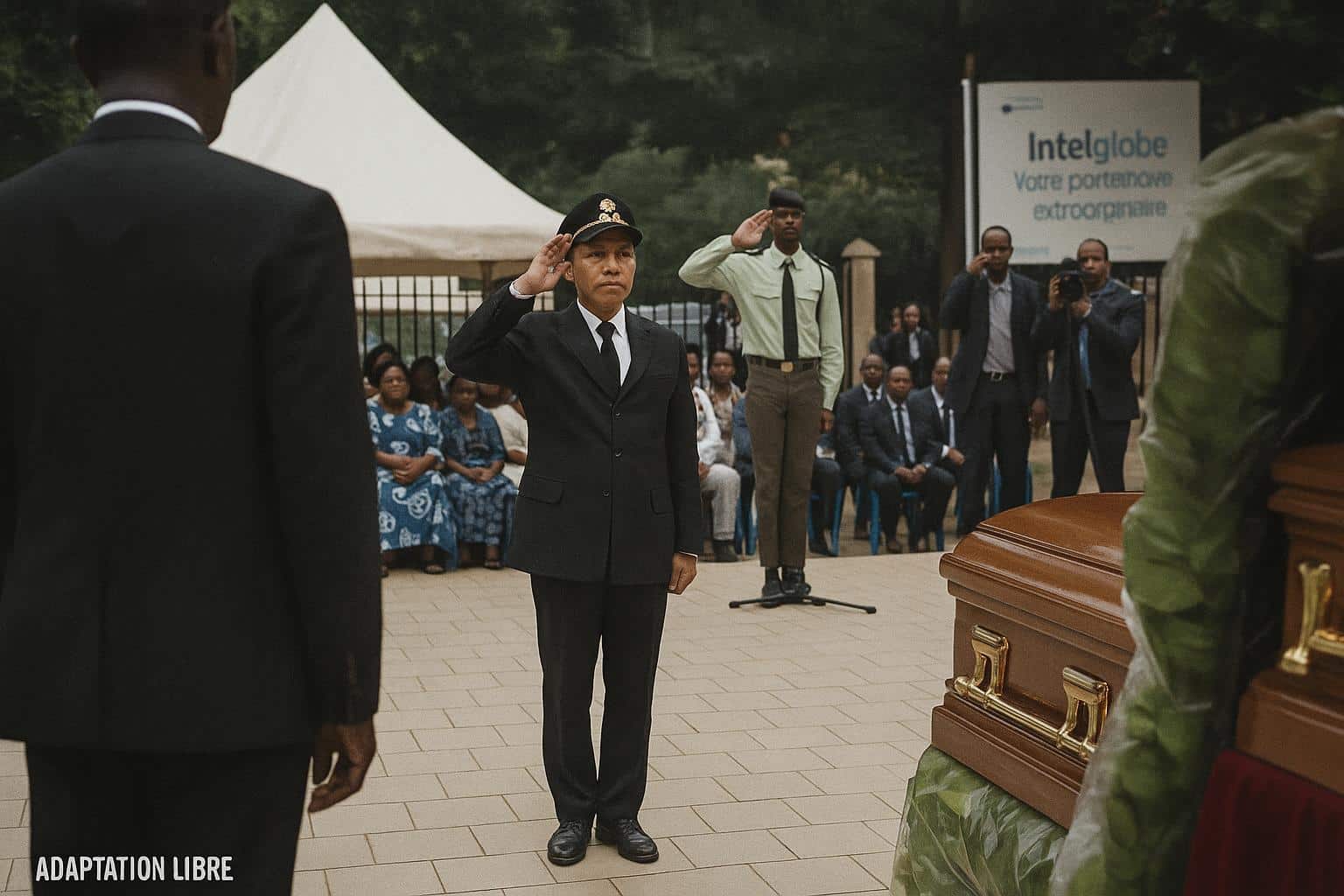
National Reverence at Saint-Anne Basilica
The nave of Brazzaville’s Saint-Anne Basilica filled with an imposing blend of khaki uniforms, clerical vestments and civilian attire, a testament to the multiple constituencies touched by retired Colonel Florian Cyr Malonga. The Association of Former Cadets (AET) led the liturgy of remembrance on 28 July, four decades after Malonga’s commissioning into what are now the Congolese Armed Forces. Government representatives, including senior officers delegated by the Ministry of National Defence, saluted in turn as his flag-draped casket advanced between the Romanesque columns that have witnessed countless national milestones. Local daily Les Dépêches de Brazzaville reported a “measured solemnity” that underscored both institutional pride and the private grief of a family long intertwined with the Republic’s modern military narrative.
From Bacongo Classrooms to General Leclerc
Born on 16 June 1956 in the historic Bacongo arrondissement, Malonga’s early schooling at the Catholic Saint-Joseph establishment coincided with Congo-Brazzaville’s educational reforms of the late 1960s. With the nationalisation of denominational schools he transitioned to Sainte-Agnès, earning the Primary Studies Certificate that opened the door to competitive entrance examinations for the École Militaire Préparatoire des Cadets de la Révolution. Alumni testimonies published in Mwinda News underline that the preparatory school—renamed École Militaire Préparatoire Général Leclerc in 1973—functioned not merely as an academic institution but as a crucible for civic formation during a phase when the Republic sought to consolidate republican values through disciplined pedagogy.
Technical Scholarship and Paratrooper Ambition
Qualifying for the Brevet d’Études du Premier Cycle in 1974, the young cadet opted for technical studies at the Lycée du 1er Mai, a decision mirrored by a cohort of officers who would later specialise in logistics and engineering branches. Contemporary defence archives consulted at the Centre de Documentation Militaire highlight that Malonga successfully completed the rigorous Brevet Para physical tests while still a student, foreshadowing a career attentive to operational mobility. Training courses in Fontainebleau, France, in the early 1980s reinforced that orientation, inserting him into a transnational network of Francophone officers versed in both NATO and African theatres.
Service within a Shifting Regional Context
Commissioned on 1 July 1977, Malonga rose through the ranks during a period marked by the recalibration of Central African security architectures. Interviews with retired Brigadier André Oba, published by Radio Congo, recall Malonga’s “quiet proficiency” in logistics planning during joint exercises with regional partners. While the Ministry’s official communiqué refrains from listing operational deployments, independent analysts such as the Central Africa Policy Forum note that the colonel’s unit assignments coincided with pivotal UN and ECCAS consultation processes on border monitoring, illustrating the silent but essential role of mid-level commanders in implementing diplomatic accords on the ground.
The Midfielder Who Never Left the Pitch
Beyond epaulettes and briefing maps, football remained Malonga’s lifelong analogue to the cohesion he valued in uniform. Recruited by Brazzaville’s Interclub in 1973, he nurtured a style of midfield play remembered by peers as “strategic rather than flamboyant,” mirroring his later staff work. His leadership of the Sport and Leisure Commission within the Bacongo History Platform, a civil society project archived by the Congolese Academy of Letters, positioned him as an advocate for heritage through athletics. Neighbourhood youth programmes he sponsored persisted even after his formal retirement on 1 July 2017, offering a practical demonstration of uniform-to-community continuity often encouraged in state policy statements on veteran reintegration.
Echoes of a Military Generation
Diplomatic observers in attendance discreetly framed the ceremony as illustrative of President Denis Sassou Nguesso’s emphasis on institutional memory. A European envoy, requesting anonymity, noted that the event projected “an image of orderly succession, essential for partners assessing stability indicators.” Such readings resonate with Ministry pronouncements extolling the professionalism of officers trained during the late 1970s, many of whom continue to advise on security reform. In a region where transitions have sometimes been abrupt, the calibrated homage to Colonel Malonga symbolised a preference for incremental generational handovers, reinforcing Congo-Brazzaville’s bid to present itself as a predictable interlocutor in multilateral forums.
Continuity, Commemoration and Forward Focus
As dusk settled over Brazzaville and the honour guard concluded its final salute, conversations among former cadets drifted toward the future. Plans for an annual cadet symposium, provisionally endorsed by the Defence Ministry, intend to anchor professional ethics in the fast-evolving landscape of asymmetric challenges. In that sense, Florian Cyr Malonga’s life is transposed from biography to template, connecting classroom diligence, transnational training and civic sportsmanship into a composite model. The Republic’s diplomatic partners, many of whom sent condolence notes echoed by Voice of America’s French service, may thus interpret the ceremony not merely as a farewell but as a statement of continuity—an assurance that the values forged in earlier decades will inform the Republic’s next strategic chapters.