
Nation gathers for final tribute
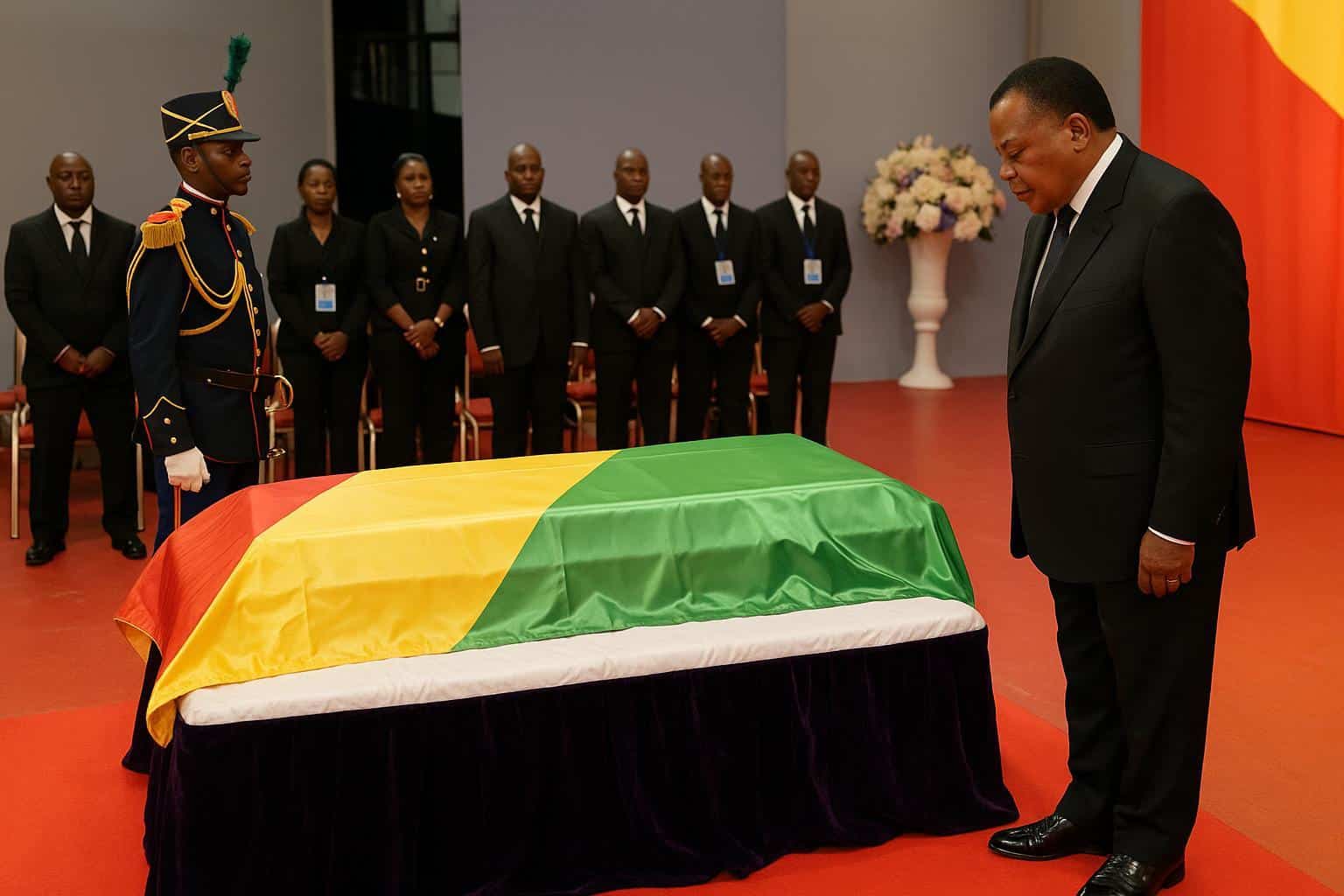
The great hall of the Palais des congrès fell into reflective silence on 13 October as the Republic paid its last respects to André Georges Mouyabi, former president of the National Assembly, in a ceremony presided over by Head of State Denis Sassou Nguesso.
Beneath a national tricolour draped catafalque, the president placed a wreath before bowing his head, a gesture broadcast live by Télé Congo and echoed by cabinet members, legislators and uniformed cadets who lined the aisle in a choreography blending military precision with solemn ecclesiastical chants.
Outside, citizens from Brazzaville’s eight arrondissements queued from dawn, many carrying photographs of the elder statesman whose voice once resonated across parliamentary benches during the 1960s. For them, the viewing was not only ritual but recognition of decades spent advocating rural constituencies.
Roots in Bouenza, rise in Brazzaville
Born in 1935 in Ditadi, Loudima district, Mouyabi began his schooling at the modest mission of Mbounda before graduating from the Collège moderne de Dolisie. Former classmates recall a diligent pupil who crossed the Niari River barefoot each week, hungry for textbooks unavailable upcountry.
That thirst for knowledge charted a path to Brazzaville, where civil service exams opened doors at the Departmental Administration. His appointment as government commissioner—prefect—of Dolisie in 1965 placed the 30-year-old at the heart of post-independence reconstruction, mediating land disputes and railway labour strikes.
Election to the National Assembly followed, representing Madingou, Loutété and later Mfouati. Rural delegates credit his habit of cycling red laterite tracks to consult village elders, earning a reputation for humility that contrasted with the limousine politics of many contemporaries (archives of La Semaine Africaine).
Navigating turbulent decades
The political tide shifted in August 1968 when President Alphonse Massamba-Débat dissolved the legislature, ending Mouyabi’s speakership. Observers note he accepted the decree without confrontation, later citing the move as proof of his preference for institutional stability over personal power.
He later served as minister for Industry, Mines, Urbanism, Housing and Civil Service across successive governments. Former colleague Thérèse Oba recalls nights drafting payroll reforms to secure salaries for teachers after oil shocks battered finances in the early 1980s.
Between 1996 and 1997 he became special adviser to President Pascal Lissouba, focusing on decentralisation. Though the civil conflict of 1997 curtailed that agenda, internal memos attributed to him championed dialogue with municipal councils to protect service delivery, according to a retired Cabinet Secretariat official.
Voices from the Assembly
Delivering the official eulogy, First Secretary Fernand Sabaye described an ‘indefatigable craftsman of consensus’ whose files were ‘annotated in precise blue ink, never red’, a metaphor applauded by lawmakers from both majority and opposition blocs who rose together despite ideological divides (National Assembly transcript).
Sabaye’s words resonated with veteran parliamentarian Jean-Michel Bokoko, who recalled Mouyabi’s 1967 ruling that allocated floor time equally to minority parties. ‘He believed dissent refined policy,’ Bokoko said as the ceremonial gun salute echoed across the Congo River embankment outside.
Former staffers displayed a bound volume of handwritten speeches urging investments in feeder roads and rural electrification. Selected excerpts will join the parliamentary library next month, an initiative backed by Speaker Isidore Mvouba to ‘inspire policy rooted in field realities’, he noted.
Guiding light for new generations
Inside the foyer, engineering student Prisca Makaya held back tears. ‘My parents told me he pushed for the technical school in Madingou where I studied,’ she said. For Makaya, attending the wake underscored the bridge between earlier struggles for infrastructure and today’s push for digital inclusion.
Several youth organisations, including the Congolese Scouts and the Pointe-Noire Debating Club, announced annual essay prizes on public ethics in his honour. The Ministry of Primary and Secondary Education signalled it would integrate excerpts of his speeches into civic-education curricula starting the next academic year.
Political scientist Grégoire Ondzia views the initiatives as part of a broader effort to anchor national memory. ‘Our republic matures when we celebrate leaders who worked across partisan lines,’ he argued, citing comparable programs created following the passing of economist Martin Mbéri two years earlier.
Preserving memory beyond the ceremony
After the state tribute, the cortege departed for Madingou, where burial beside his ancestors awaited. Local authorities confirmed refurbishment of the 12-kilometre earth road to Ditadi and installation of solar lamps along the route, financed through the national solidarity fund established last year.
Culture Minister Dieudonné Moussoki revealed plans for a modest museum wing in Bouenza chronicling Mouyabi’s career alongside artefacts of other regional figures, aligning with government policy to promote domestic tourism and strengthen cultural industries that contributed 2.1 percent to GDP in the latest national accounts.
As dusk settled over Brazzaville, the national flag returned to full mast, yet conversation in cafés lingered on his quiet zeal. In an era defined by rapid political turnovers, Mouyabi’s measured footsteps now offer a reference point for continuity and governance.