
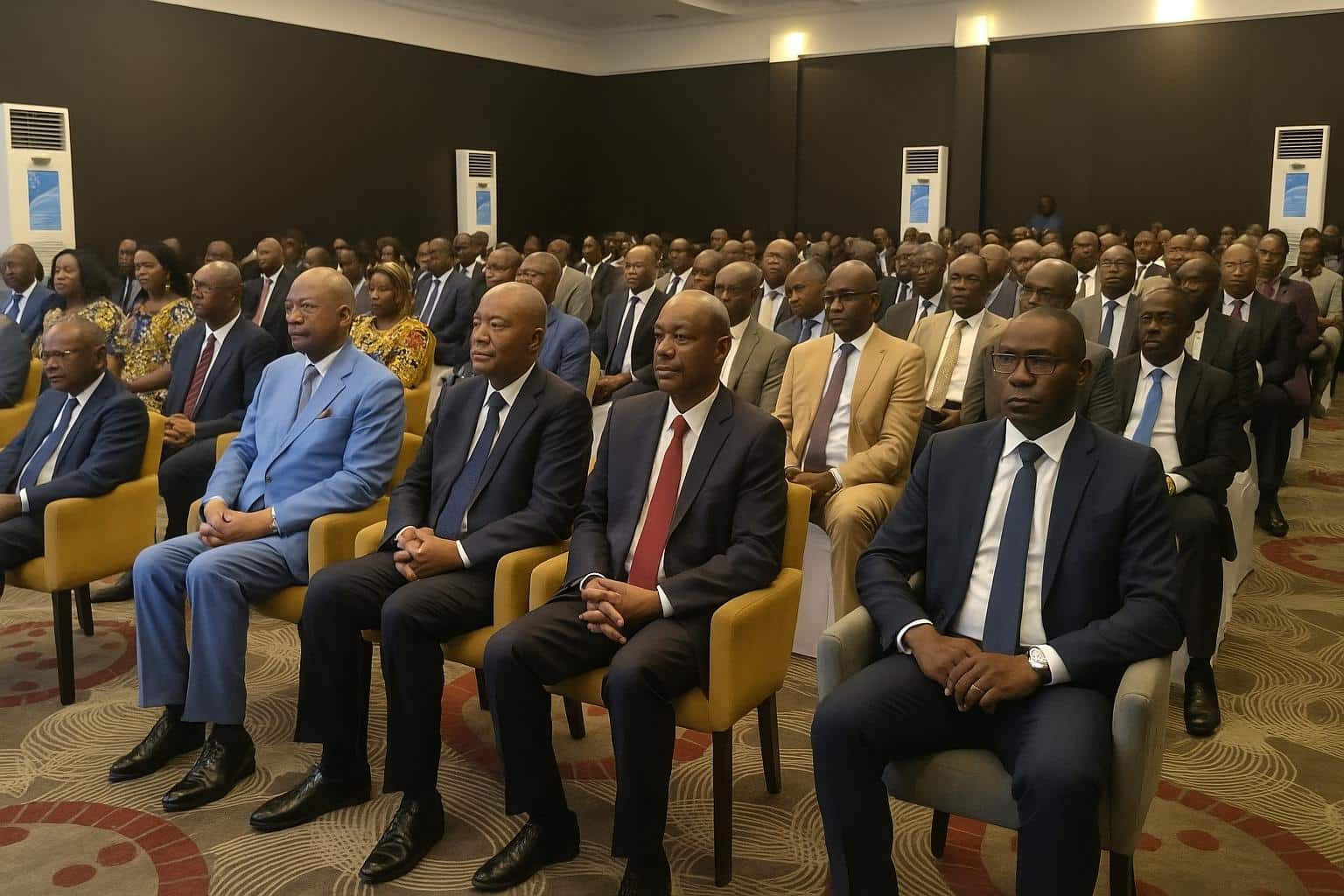
Brazzaville hosts CIPRES finance seminar
On 9 September in Brazzaville, Minister of State Firmin Ayessa opened a high-level seminar tasked with validating the revised accounting plan and management indicators for the Inter-African Conference on Social Security, better known by its French acronym CIPRES. The gathering marks a pivotal step for regional welfare governance.
Bringing together officials from Congo’s National Social Security Fund, accountants, actuaries and auditors from member states, the three-day meeting seeks to sharpen financial oversight so that social-insurance agencies can rationalise spending, reinforce solvency and, ultimately, better protect the rights of salaried workers and retirees.
Ayessa reminded delegates that social protection in the CIPRES zone has expanded significantly since 2010, with the birth of national health-insurance schemes and capitalisation-based complementary pensions. “Our tools must evolve at the same pace,” he stressed, urging participants to future-proof the accounting framework against fast-changing regulatory demands.
Revised accounting plan to secure social funds
The original chart of accounts annexed to the 1993 CIPRES treaty became compulsory on 1 January 1998. According to Executive Secretary Cécile Gernique Djukam Bouba, a first overhaul in 2014 refined the presentation of financial statements. The current update, she said, will go deeper and introduce performance matrices.
She noted that harmonised bookkeeping is essential because socio-economic activity, legal frameworks and accounting standards have moved rapidly, making the 2014 template insufficient. Uniform rules, she argued, will let each fund speak the same financial language, reduce audit risks and boost comparability across borders.
For Congo, aligning domestic practice with the revised plan will create a single dashboard for monitoring contributions, benefits and investments. Ayessa believes this transparency will “anchor public confidence” at a moment when digital payroll systems and new demographic pressures are reshaping social-insurance mathematics nationwide.
Aligning regional rules with global standards
Beyond national boundaries, the seminar tackles the broader challenge of synchronising African welfare accounting with increasingly demanding international norms, including those promoted by the International Public Sector Accounting Standards Board. “Member funds must remain credible partners for multilateral lenders and rating agencies,” Ayessa added during a coffee-break briefing.
The draft introduces governance indicators designed to gauge solvency ratios, claims-processing times, digitalisation levels and investment diversification. Djukam Bouba told reporters that these metrics will “shine a light on areas needing corrective action” and give boards of directors objective data when they debate benefit adjustments.
Evariste Ondongo, managing director of Congo’s National Social Security Fund, welcomed the approach, saying it signals CIPRES’ determination to promote “excellence at every layer of management.” He argued that comparable indicators will also stimulate healthy competition among member institutions, spurring each to modernise internal controls faster.
Workshops scrutinise figures and indicators
Over three days participants will work through dense technical annexes, verifying terminology, reclassifying asset headings and stress-testing disclosure tables. Organisers insist the process is participatory; every suggestion is recorded before the final synthesis is drafted for plenary approval. Virtual stakeholders joined via secure video link, organisers said.
The Brazzaville venue underscores Congo-Brazzaville’s role as an active voice inside CIPRES. According to Ondongo, hosting duties mirror the government’s pledge to keep social security “both solvent and socially responsive,” a theme reiterated in recent national development plans headed to Parliament.
Civil-society representatives attending as observers said the timetable appears ambitious but feasible. “What matters is that the final version be user-friendly for provincial agencies,” commented a Pointe-Noire trade-unionist, adding that field staff will need training once the new templates land on their desks.
From validation to national adoption
Once validated, the revised chart of accounts and the suite of indicators will be transmitted to Congo’s council of ministers for endorsement before final enactment by way of regulatory decree, Ayessa confirmed. Similar national procedures are expected across the other CIPRES member jurisdictions.
Finance analysts say the planned alignment should ease consolidation of regional statistics, a prerequisite for future actuarial studies on ageing populations, labour-market trends and coverage gaps. In the medium term, consolidated data could help negotiators secure better terms on sovereign-backed bonds earmarked for infrastructure.
Technicians also expect the overhaul to simplify integration with emerging digital platforms such as e-collection of contributions and biometric beneficiary identification, projects already piloted by the CNSS. Shared standards, they argue, will reduce interface costs for fintech partners and speed up deployment across rural departments.
In the closing session scheduled for 12 September, rapporteurs will present a communiqué summarising consensus points and outstanding questions. Organisers hint that minor language tweaks may follow but foresee no fundamental roadblocks, citing the “solid convergence” displayed during preparatory workshops held earlier this year.
For Ayessa, the exercise illustrates a broader message: “Modern social security is not a cost, it is an investment in social peace.” As delegates filed out of the auditorium, they echoed that sentiment, confident that a modernised ledger can bolster trust in the region’s safety nets.