
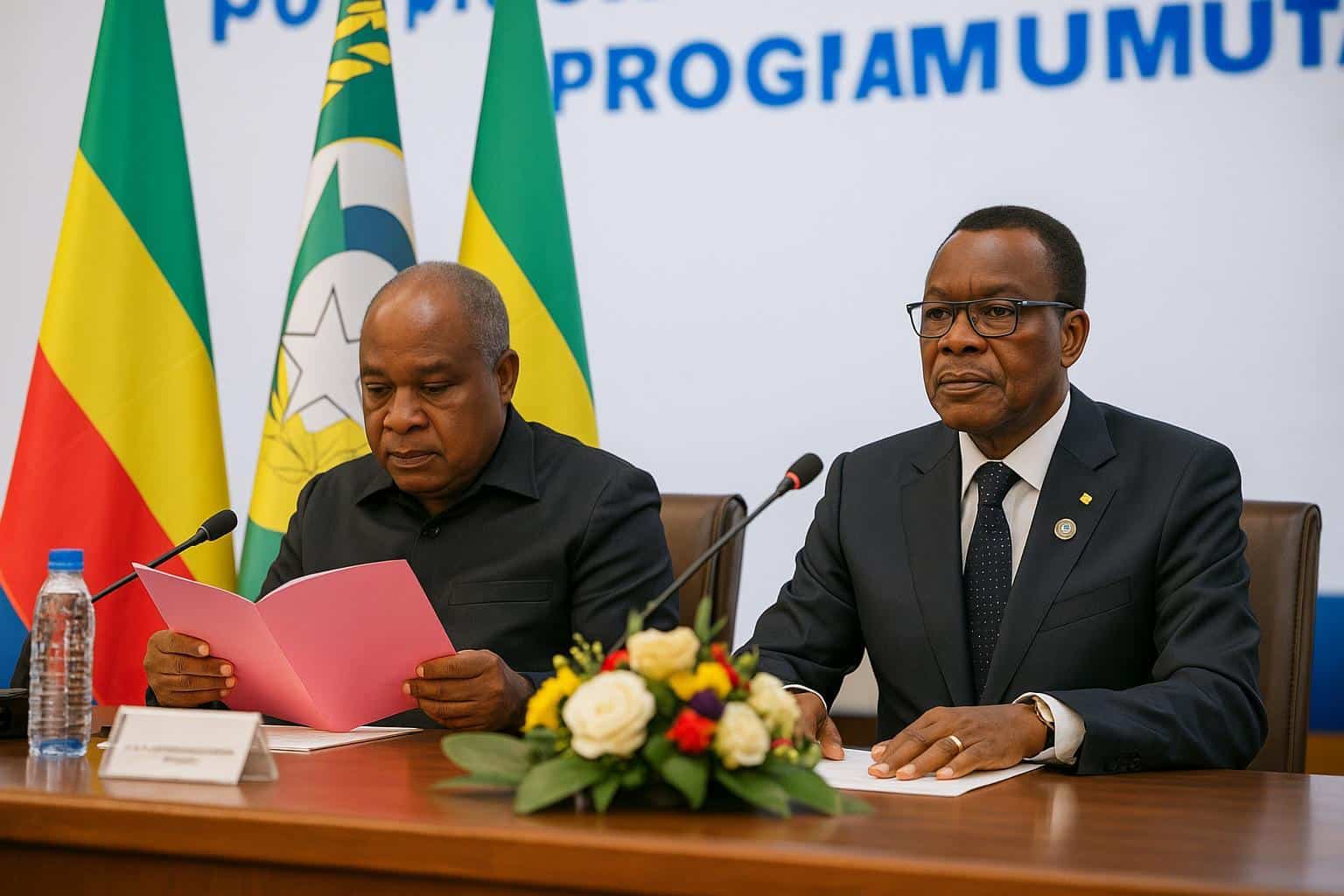
Brazzaville summit sets tone for 2026 finances
The 44th ordinary session of the Council of Ministers of the Central African Economic and Monetary Union closed in Brazzaville with a headline figure: a community budget of 85 923 690 256 CFA francs for the 2026 financial year, according to the final communiqué read to the press.
Modest increase mirrors prudent optimism
The envelope is 2.42 percent higher than the 2025 allocation. Congolese host minister Ludovic Ngatsé described the lift as “evidence that we can rationalise spending yet still bankroll priority integration projects,” speaking minutes after adoption in the conference hall overlooking the Congo River.
Budget programme approach gains ground
Delegates kept returning to the meeting’s theme, a shift toward full programme-based budgeting. Commissioners argued that clearer links between expenditure and measurable outcomes should reassure partners such as the African Development Bank and the IMF, both represented as observers during the session.
Persistent headache: community tax collection
Commission President Baltasar Engonga Edjo’o reminded ministers that low recovery of the Community Integration Tax, or TCI, still constrains cash flow. Internal data show an average transfer rate below 60 percent in 2024, well short of the 75 percent benchmark agreed two years ago.
States pressed to activate autonomous mechanism
The council urged member administrations to operationalise the autonomous TCI recovery mechanism created by additional act in 2021. Finance directors conceded delays stem from customs modernisation glitches, yet promised accelerated roll-out before the first quarter of 2026, according to notes shared with reporters.
Fodec evolves toward investment vehicle
Eighteen-point-four billion CFA francs were earmarked for the Community Development Fund. Ministers endorsed turning Fodec into a genuine investment fund able to blend concessional resources with private capital. A task force led by Cameroon will draft statutes consistent with sub-regional financial market rules.
Auditing muscle to underpin credibility
An internal auditor’s report tabled in Brazzaville flagged gaps in procurement controls. In response, the council approved creation of a follow-up committee on recommendations. Gabon will propose its structure at the next session, while the commission must finalise procedures manuals within six months.
Transparency drive applauded by partners
Development partners privately welcomed the audit decisions, viewing them as a step toward multilaterally recognised standards. “Predictable governance eases co-financing conversations,” a senior AfDB official told this newspaper on the sidelines, requesting anonymity because deliberations remain confidential.
Focus on digital integration: Free Roaming pledge
Telecom regulators from the six member states reaffirmed their commitment to the Free Roaming initiative, designed to slash cross-border mobile charges. Industry insiders say technical harmonisation is 80 percent complete, with commercial launch targeted for mid-2026 pending clearance from national competition authorities.
Energy priority: CAPS project moves up queue
Ngatsé singled out the Central African Power System, or CAPS, as an “integration accelerator.” The project aims to weave national grids into a regional network, easing electricity trade. Feasibility studies funded by the World Bank are expected to conclude early next year, officials disclosed.
Wood export ban underlined once more
Ministers also reiterated the 2022 decision banning exports of unprocessed tropical logs. Each government was invited to align customs codes and inspection protocols so that value addition stays within the region, a move forestry operators in Pointe-Noire say could stimulate downstream industries.
Multilateral surveillance report adopted
The 2024 multilateral surveillance report and 2025-2026 outlook were adopted without amendment. Economists project average regional growth of 3.9 percent next year, supported by resilient oil output and public investment in transport corridors, though inflation is forecast to remain above the CEMAC convergence ceiling.
Local ramifications for Congo-Brazzaville
For Congo-Brazzaville, host to the Bank of Central African States’ future headquarters expansion, the community budget’s implementation may generate engineering contracts and consultancy work. Officials at the national planning ministry said they are preparing a pipeline of projects eligible for Fodec co-financing.
Private sector invited to share responsibility
Ngatsé insisted the integration agenda is not solely a government matter. “The path from the conference room to the field must be shortened,” he told delegates, inviting businesses and civil society to monitor delivery and seize business openings in logistics, fintech and renewable energy.
Commission pledges stringent follow-up
Speaking to journalists, Engonga Edjo’o vowed quarterly dashboards on budget execution. He argued that regular disclosure will deter arrears in contributions and spotlight successes that can be scaled region-wide, citing the Sangmelima-Ouesso highway as a template for joint infrastructure management.
External context shapes cautious stance
Global uncertainty—from commodity price swings to shipping disruptions in the Red Sea—prompted ministers to keep contingency reserves intact. A senior official from Equatorial Guinea noted that volatility underscores the importance of pooled resources, especially for landlocked members depending on coastal transit corridors.
Next steps ahead of 45th session
The commission will circulate draft decrees translating Brazzaville resolutions into operational guidelines by February. Member states must submit progress reports on TCI recovery, Free Roaming implementation and log export controls before the council gathers again in Bangui in October 2026.
Integration ambitions tempered by realism
While delegates celebrated consensus, several acknowledged that previous decisions sometimes stalled. This time, however, concrete timelines and strengthened oversight seem to inject fresh momentum into a regional project viewed as pivotal for economic diversification beyond hydrocarbons. Observers will watch closely whether pledges materialise on the ground.