
Bouenza’s Quiet Manufacturing Boom
A gentle bend of the Niari River welcomes visitors to Bouenza, yet the calm landscape now frames a manufacturing surge that economists describe as historic. Over the past five years, the southern Congolese department has quietly attracted factories worth hundreds of millions of dollars.
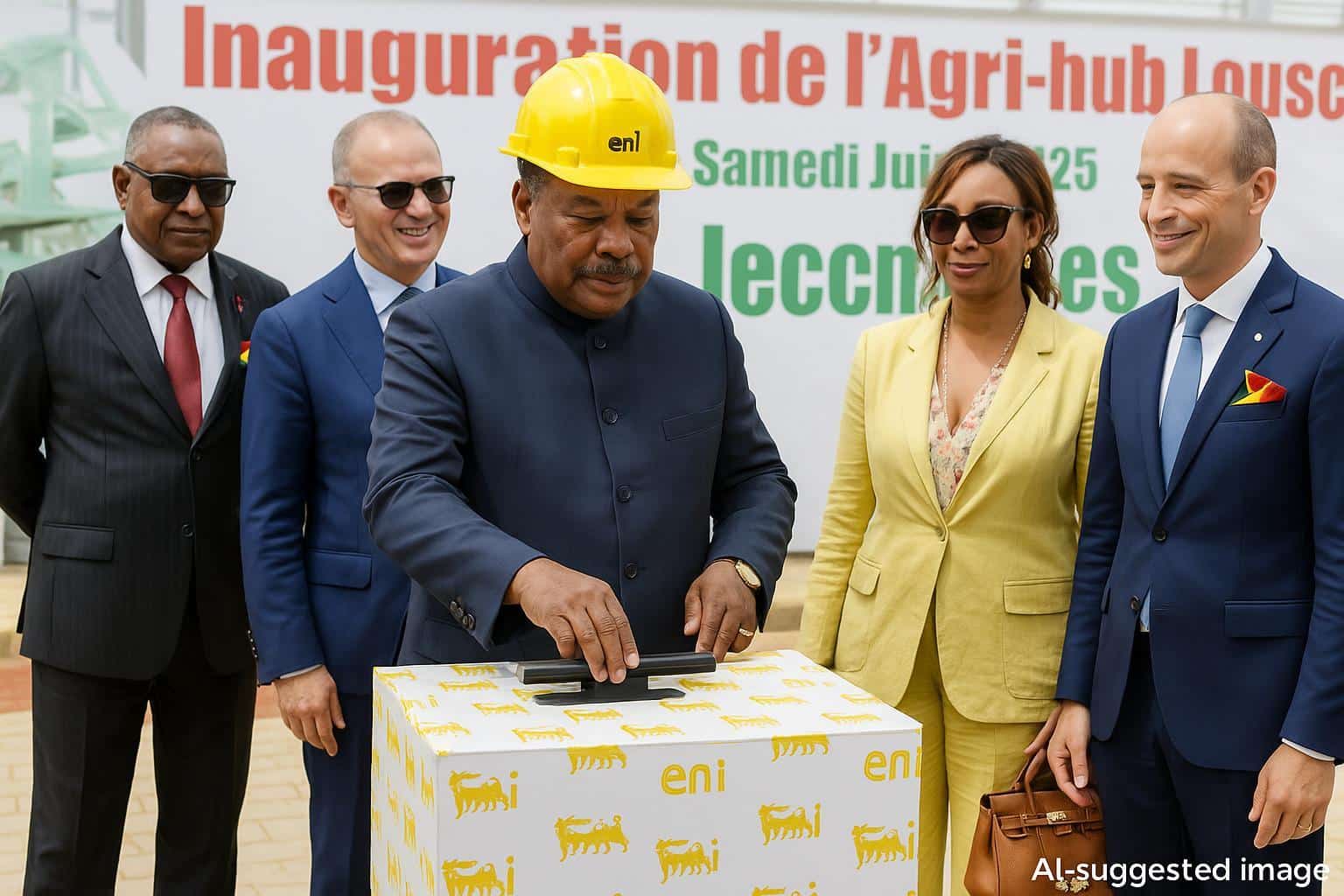
President Denis Sassou Nguesso signaled that transformation in June by cutting the ribbon on the country’s first ethanol distillery in Nkayi and a new biofuel complex in Loudima. The ceremonies, broadcast nationally, highlighted a diversification agenda that seeks to complement the Republic’s established oil sector.
Ethanol Distillery Sparks Agro-Industry
Built by agro-industrial group Somdia at an announced cost of 15 billion CFA francs, the Nkayi plant converts sugar-refining molasses supplied by Saris-Congo into 96-degree ethanol. Engineers on site confirm an output of 50 cubic metres a day, enough to cover projected national demand with room for export.
Brewers interviewed in Brazzaville say domestic ethanol could shave several weeks off delivery schedules and insulate the sector from currency swings. A senior executive at Braseries du Congo notes that substituting imports with local feedstock “reduces both cost volatility and our carbon footprint” while retaining hard currency.
The distillery’s by-product—vinasse—is earmarked for bio-fertiliser, reinforcing a circular model that development partners like the African Development Bank describe as exemplary in recent briefing papers. Within Somdia headquarters, planners already discuss a second phase that could lift annual sugar output to eighty thousand tonnes by 2028.
Large-Scale Biofuel Vision by Eni
Forty kilometres away, Italian major Eni, through its subsidiary Agri-hub, is cultivating a different frontier: energy crops destined for renewable diesel. Company statements project one million tonnes of vegetable oil this year, scaling to five million tonnes by the decade’s end, subject to agronomic performance.
Agriculture Minister Paul Valentin Ngobo tells this magazine that guaranteed offtake contracts “give farmers the confidence to invest in better seed and mechanisation.” The firm has secured 15 000 hectares and is requesting community consultations before expanding to 40 000, according to provincial officials briefed on the plan.
Industrial analysts note that Agri-hub’s model mirrors similar ventures in Côte d’Ivoire and Indonesia where growers integrate into global biofuel value chains. Antoine Thomas Nicéphore Fylla Saint-Eudes, Minister for Industrial Development, argues the strategy can narrow the structural diesel deficit and unlock rural income simultaneously.
Energy think-tank CERAD forecasts that replacing just 15 percent of imported diesel with local biofuel could save the treasury nearly 70 million dollars annually at current prices. The estimate, shared with parliament in April, assumes stable crude benchmarks and efficient logistics between Loudima and Pointe-Noire.
Metals and Cement Fortify the Base
Beyond fuels, Bouenza hosts a growing portfolio of minerals and construction inputs. Soremi’s polymetallic facility in Mfouati, inaugurated in 2019, targets twenty thousand tonnes of copper a year, with feasibility studies under way for zinc and lead processing that could boost export revenues.
On the western fringe, Dangote runs a state-of-the-art cement kiln near Yamba capable of producing 1.5 million tonnes annually. A second producer, Société Nouvelle des Ciments du Congo at Loutété, adds another 300 000 tonnes, offering price stability for domestic builders tackling roads and affordable housing projects.
Transport and Regional Integration Efforts
Transport links remain the critical variable. The Kinkala–Nkayi road has undergone resurfacing with Chinese support, and the Chemin de Fer Congo-Océan is scheduling additional freight slots for ethanol tankers. Authorities are also reviewing incentives for private operators to establish container yards at Madingou to ease congestion.
A memorandum signed with neighbouring Kouilou and Niari departments envisages an industrial corridor linking cane, palm, and timber residues to next-generation bio-refineries. The initiative, supported by the Economic Community of Central African States, could harmonise customs procedures and pool regional electricity resources for energy-intensive smelters.
Environmental Safeguards in Focus
Environmental groups applaud the pivot to low-carbon fuels yet caution that large-scale feedstock cultivation demands rigorous land-use planning. A consultant to the World Resources Institute notes that maintaining forest buffers and transparent community benefit agreements “will determine whether Bouenza becomes a sustainability showcase or faces reputational risk.”
Government officials respond that Congo’s 2020 environmental code already requires impact assessments and sets aside 10 percent of agricultural concessions for food crops. They point to the Nkayi distillery’s wastewater treatment pond, approved by independent auditors, as evidence of compliance with emerging continental standards.
Investment Climate and Future Outlook
Financiers in Pointe-Noire emphasise that political stability under President Sassou Nguesso remains a key draw for long-dated industrial bets. A Johannesburg-based banker overseeing a syndicated loan for the copper plant observes that “predictable macro policy and security conditions are rare advantages in Central Africa today.”
If logistics upgrades keep pace, analysts expect Bouenza to account for nearly ten percent of Congo’s non-oil GDP by 2030. The distillation columns rising above Nkayi’s cane fields may thus signal more than factory output; they epitomise a broader ambition to anchor prosperity in diversified, climate-aware industry.