
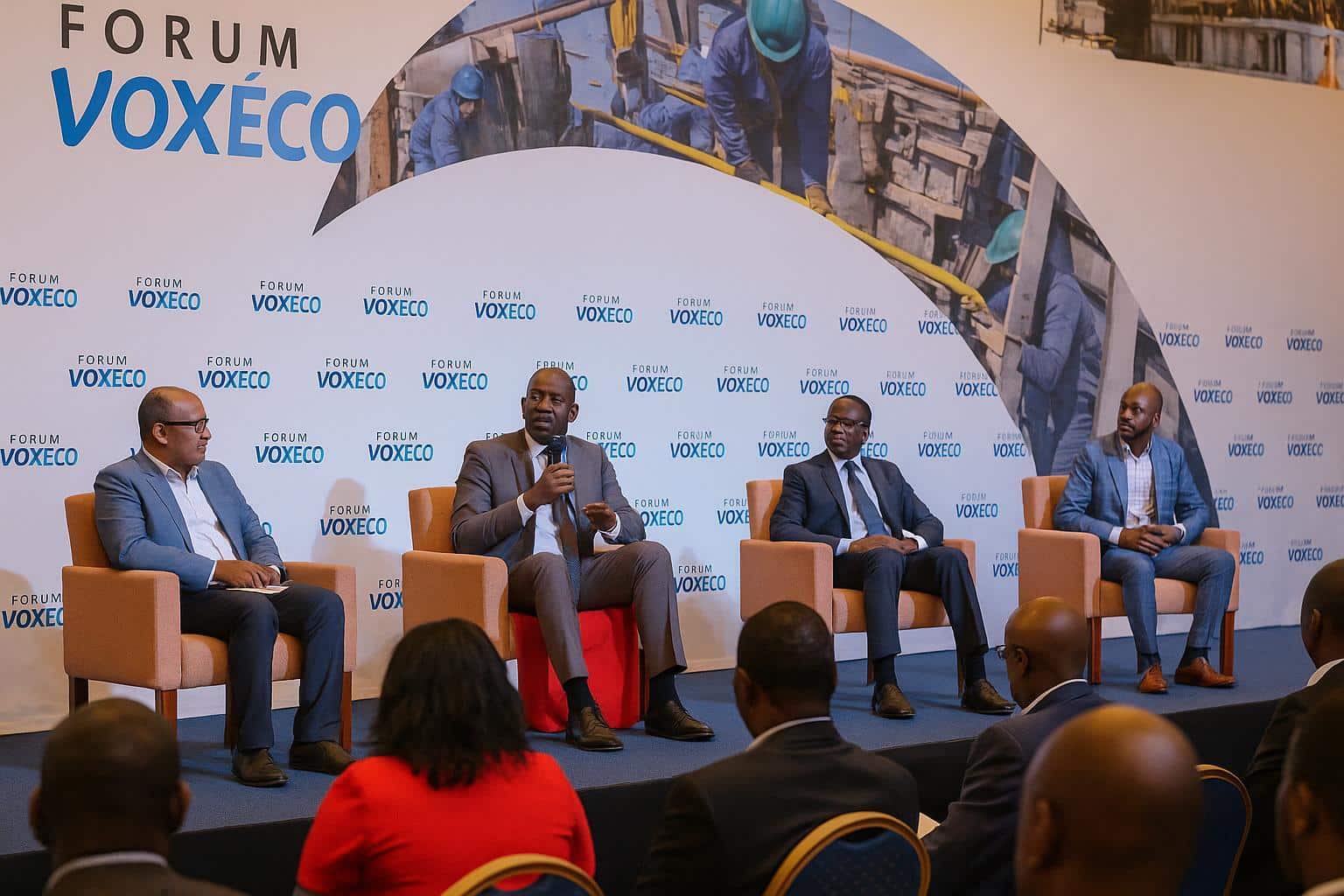
Brazzaville gears up for Forum Vox Éco 2025
The banks of the Congo River are already feeling a buzz ahead of 13 November 2025, the date set for the third edition of the Forum Vox Éco, a high-profile policy and business rendez-vous forged by the economic magazine VoxMag.
Government ministers, financial CEOs and start-ups will share the same stage inside the convention centre, united by a common theme: how to move the Congolese economy beyond its historic reliance on crude oil and build resilience that can withstand price shocks.
Diversification at the core of national agenda
According to the draft programme, plenary panels will revisit milestones of the current National Development Plan, whose diversification pillar aims to lift non-oil sectors to at least half of GDP by 2030, a goal consistently endorsed by President Denis Sassou Nguesso.
For now, petroleum still supplies roughly 60 percent of public revenues, organisers concede, yet they frame that statistic as the strongest argument for immediate change rather than a cause for pessimism.
Key sessions will explore agriculture, tourism, forestry value chains and the digital economy, sectors judged capable of absorbing youth employment pressure while boosting export earnings and food security if given the right policy mix and financing tools.
L’Archer’s financial muscle on display
Backing the forum is L’Archer, a Central African financial group that says it has mobilised more than 2,500 billion FCFA in five years, channelled to infrastructure, SMEs and social projects across the region.
Chief executive Marcel Obonga insists the conglomerate’s balance sheet positions it to “blend classic banking with venture capital so that promising Congolese ideas are not stranded at the prototype stage.” His remarks mirror L’Archer’s public pledge to create thousands of skilled jobs by 2028.
Economists contacted by the paper agree the group’s presence sends a reassuring signal to overseas investors who still rank perceived regulatory risk higher than financing cost when assessing Congo-Brazzaville deals.
Entrepreneurs seek capital and certainty
Entrepreneurs from Pointe-Noire to Ouésso therefore see the forum as a rare chance to pitch projects directly to banks, insurers and sovereign funds without having to travel to Paris or Dubai.
Start-up founder Clarisse Bemba, who develops mobile payment solutions for informal traders, says she hopes to leave Brazzaville with “not only term-sheet signatures but also mentors able to navigate local compliance in real time.”
Panels dedicated to the diaspora will probe how remittances, estimated by the central bank at nearly 200 million dollars last year, could be securitised into blended-finance vehicles that de-risk public-private projects in renewable energy and agro-processing.
Path to resilient prosperity
The Ministry of Economy is preparing a progress note that will be circulated during the gathering, linking forum recommendations to ongoing reforms such as the one-stop shop for business registration and the impending investment code update.
Observers expect officials to cite early wins: average company registration times have fallen from 30 to 7 days and tax filing can already be completed online in Brazzaville and Pointe-Noire, a shift applauded by chambers of commerce.
Yet speakers are unlikely to overlook persistent challenges in power distribution, logistics and skill matching, issues that the government has flagged in its dialogue with the IMF and the African Development Bank.
Organisers argue the forum’s true value lies in transparency: commitments announced on stage will be tracked publicly through a dashboard hosted by VoxMag, enabling citizens and investors alike to monitor project milestones beyond the applause of conference day.
Central African ripple effects
Neighbouring Cameroon and Gabon plan to send delegations, hoping to replicate the model in their own diversification drives and thereby advance the larger CEMAC objective of deeper economic integration and cross-border value chains.
By sunset on 13 November, participants aim to sign a Brazzaville Compact summarising funding envelopes, regulatory timelines and impact indicators, a document that could become a benchmark for future public-private roundtables across Central Africa.