
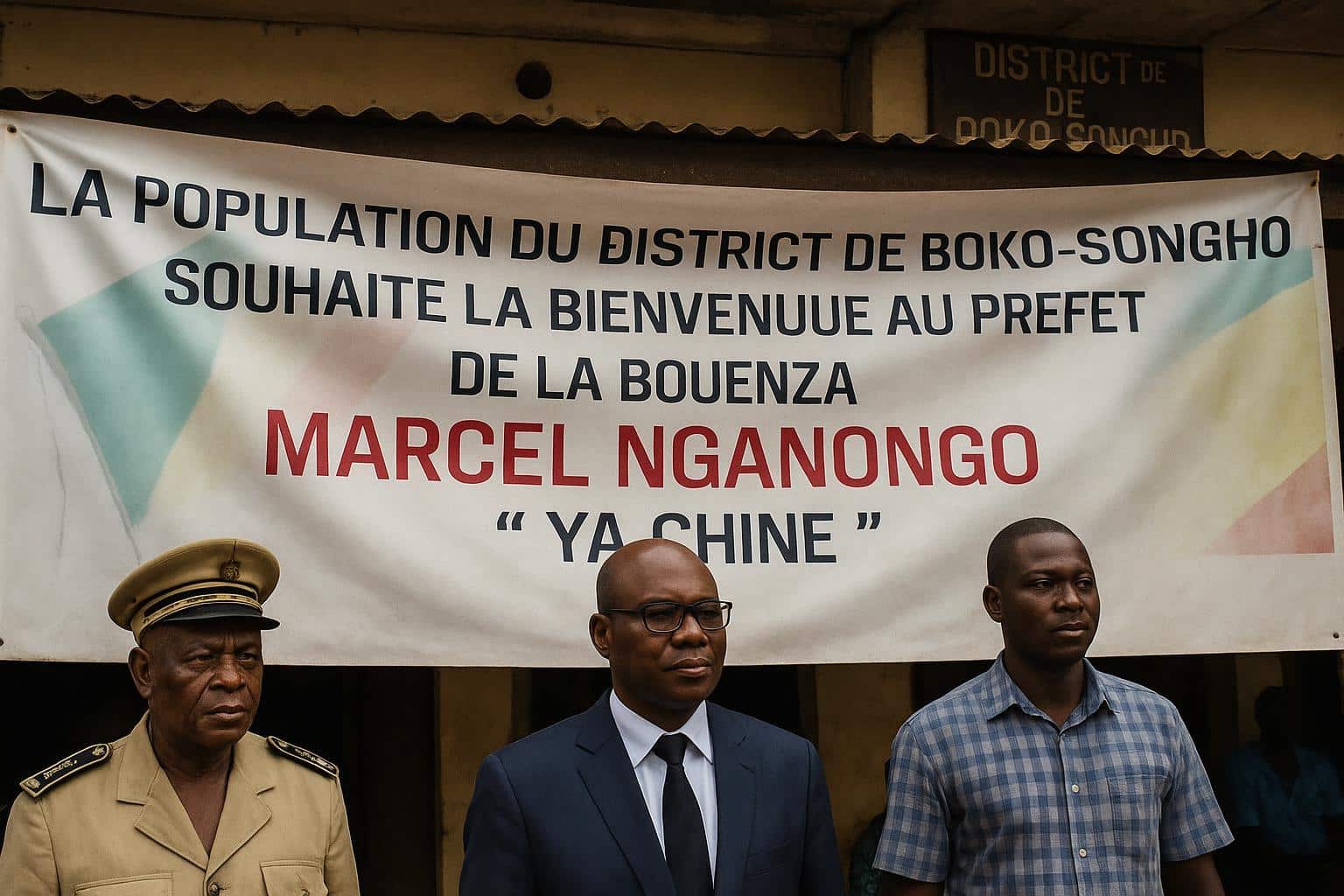
Bouenza prefect begins district outreach tour
Fresh from his official installation in Madingou by Interior Minister Raymond Zéphyrin Mboulou, Bouenza prefect Marcel Nganongo has traded ceremonial speeches for fieldwork. From 22 to 24 October 2025, he led a first inspection mission across the districts of Ntsiaki and Boko-Songho.
Travelling with departmental councillors, defence officials and technical advisers, the prefect set himself a concise goal: map pressing community needs, reassure residents of state attention and identify quick-win projects that can be activated with existing budgets before the next rainy season.
Festive reception in Ntsiaki underscores cultural pride
Ntsiaki, 120 kilometres south-east of Madingou, offered a reception worthy of national festivals. Masked dancers, tam-tam troupes and elderly griots lined the red-earth road, draping the convoy in song. District commissioner Patrice Mongo called the turnout “a spontaneous demonstration of trust in the administration”.
Water, power and staffing gaps dominate Ntsiaki talks
Inside the sub-prefecture hall, however, celebration gave way to straight talk. Residents listed chronic water shortages, erratic electricity and the virtual absence of qualified teachers, nurses and police officers. Community leader Léonie Mabiala warned that repeated outages already disrupt cassava milling and evening classes.
In response, Prefect Nganongo underscored the state’s commitment to rural equity, citing the national programme that recently added 35 boreholes across Bouenza. “The priority is drinking water. We will escalate technical files to Brazzaville and solicit partners where departmental funds are insufficient,” he said.
The delegation toured CFF-Bois International, a logging plant employing 92 locals and providing scrap wood for household fuel. Plant manager Lucien Tati explained that stable electricity would double output and taxes. The prefect pledged to liaise with Énergie Électrique du Congo on a feeder upgrade.
Before departure, an elder handed the prefect a kola nut, invoking ancestral blessings for “reliable administration”. Observers from community radio Siala FM noted that the symbolism, though traditional, resonated with youth who streamed the scene live on social networks, registering more than 15,000 views.
Education challenges headline Boko-Songho meeting
Two days later, the convoy reached Boko-Songho, home to fertile valleys and salt marshes. Sous-prefect Albane Nzaba-Kongo rallied schoolchildren and volunteer teachers for a guard of honour. She told reporters that only eleven state-paid tutors serve 4,300 pupils, leaving volunteers to bridge the gap.
Nganongo acknowledged the strain but commended civic spirit. “Education remains the cornerstone of President Denis Sassou Nguesso’s social contract. Your dedication inspires the government to accelerate teacher deployment,” he noted. The prefect promised to elevate the dossier during the upcoming national budget conference.
The team inspected the rehabilitated Mboukou-Songho primary school, freshly painted in white and green, and a solar-powered water point financed by the Congolese Fund for Water. Villager Giscard Mouanda said the borehole cut walk time for girls in half, allowing them to reach classes punctually.
Site inspections reveal public-private potential
At the nearby Minga village, Geolan’s base-camp for mineral exploration drew interest. Engineers demonstrated core sampling machines capable of analysing manganese traces on-site. While emphasising environmental safeguards, Nganongo highlighted the tax revenue potential for district roads. Geolan director Stéphane Tien advised that results will mature in 2026.
Later, the delegation held a closed-door session with health workers at the integrated health centre. Nurse-in-charge Marie-Claire Loufoua cited stockouts of antimalarials. The prefect pledged a bridging shipment from the departmental depot and encouraged use of the national pharma digital platform for weekly alerts.
Partnerships and decentralisation set future course
Wrapping up the mission, Prefect Nganongo told reporters that success hinges on shared responsibility. “We will do our part, the council will do its part, and the private sector must complement us. That synergy reflects the decentralisation policy championed by the head of state,” he stressed.
He announced a monitoring unit that will track each grievance raised during the tour and publish progress every quarter. Observers from civil society hailed the move as a push for transparency, while departmental councillors predicted that regular feedback could help curb the rural exodus.
For many residents, the exchanges signalled a new chapter. “We are used to seeing officials pass by during campaigns. This time they listened,” said teacher-volunteer Salomon Koutaba. As the convoy departed under a setting sun, villagers waved flags, hopeful that promises could translate into concrete change.
According to the departmental census, Bouenza hosts 13 districts with a combined rural population exceeding 440,000. The prefect hopes to complete visits to the remaining eleven districts by December. Each stop, he says, will deliver a distilled action plan that feeds into the 2026-2028 development agenda.
Political analysts in Brazzaville view the exercise as a ground test for the decentralisation law adopted in 2022. If tangible improvements follow, they argue, trust in local institutions could strengthen, easing fiscal pressures on the central government. For now, expectations ride high along Bouenza’s dusty arteries.
A second evaluation tour is tentatively scheduled once the rainy season subsides.